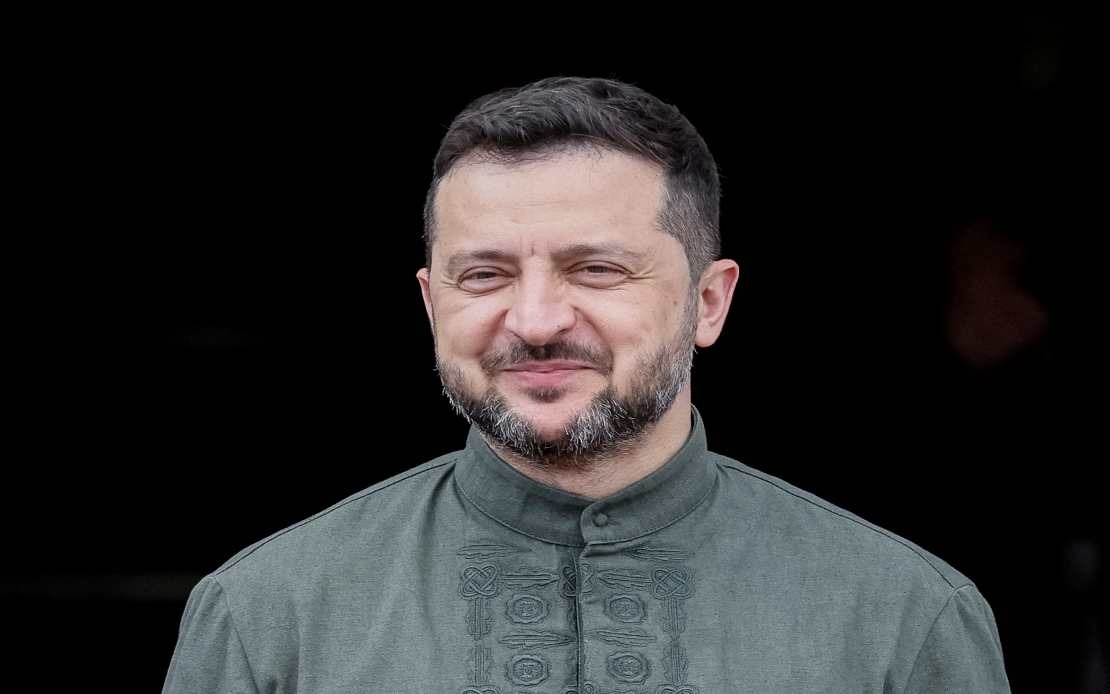
Ukrainian President Volodymyr Zelensky has signed a law creating a state pantheon dedicated to national heroes, the country's parliament announced on Saturday, marking the formal adoption of a deeply contentious measure that threatens to further strain relations between Kyiv and Warsaw at a critical moment in their alliance. The decision to proceed with the memorial, which will be located in the capital, represents a deliberate assertion of Ukrainian sovereignty over historical memory, even as it risks deepening a diplomatic wound with one of Ukraine's most steadfast Western supporters in its struggle against Russian aggression.
The pantheon is designed to enshrine figures from Ukraine's historical past, tracing back through medieval Kyivan Rus and extending into the modern era. Beyond serving as a repository for commemorating independence fighters and national icons, the memorial will also function as a burial site for Ukrainian presidents, cementing its role as a secular shrine to the nation's political and military legacy. This dual purpose underscores Ukraine's ambition to create a unifying symbol of national identity during its ongoing war against Russia.
The legislation's most volatile component concerns the planned inclusion of members of the Ukrainian Insurgent Army, or UPA, an underground nationalist force that operated during World War II. Ukraine views many UPA fighters as heroes who resisted foreign occupation, whether by Nazi Germany or the Soviet Union. However, this historical narrative collides sharply with Polish collective memory and documented historical evidence. Historical records establish that UPA units were responsible for orchestrating mass killings of ethnic Poles and Jews, particularly in the Volyn region of what is now western Ukraine, claiming tens of thousands of lives during the German occupation. For Poland, honouring such figures constitutes a glorification of genocide, a wound that remains painfully raw in the national consciousness.
President Zelensky's stance on the matter is unambiguous. Speaking before an assembly of war veterans on Saturday, he declared that Ukraine alone would determine who merited recognition as a national hero, and that the pantheon would undoubtedly be constructed. This rhetorical position, while appealing to Ukrainian nationalism and historical autonomy, effectively dismisses Polish grievances and signals that Kyiv views this as a matter beyond international negotiation. The statement reflects a broader tension within Ukrainian nation-building: the desire to establish an inclusive national narrative that encompasses diverse resistance movements must somehow accommodate the historical realities that some of those movements committed atrocities against neighbouring peoples.
Poland's response has been measured in public but unmistakably severe in substance. Following the parliament's passage of the law in July, the office of Polish President Karol Nawrocki issued a carefully worded statement asserting that from Warsaw's perspective, elevating perpetrators of genocide in Volyn to hero status contradicted Poland's westward orientation and democratic values. The calculated restraint in tone masks profound concern about where the commemoration trend is heading and what it portends for Poland-Ukraine relations.
The deterioration has already manifested in concrete diplomatic gestures. Earlier tensions emerged in June when Zelensky's administration granted the honorary title "Heroes of the UPA" to a military unit. In response, the Polish government executed a symbolic but meaningful reversal: it withdrew the Order of the White Eagle, one of Poland's highest honours, that had previously been bestowed upon Zelensky. Multiple Ukrainian and Polish politicians subsequently returned decorations they had received from the neighbouring country, creating a cascade of reciprocal denunciations that signalled a rupture in the bilateral relationship.
The timing of this pantheon law is particularly fraught given Ukraine's strategic dependence on Western support. Poland has been instrumental in channelling military aid, hosting refugees, and providing diplomatic backing for Kyiv's position within Western institutions. Unlike some NATO members who have wavered in their commitment to Ukraine, Warsaw has remained consistently hawkish in advocating robust assistance to Ukrainian forces. A serious estrangement with Poland therefore carries concrete consequences for Ukraine's war effort, potentially affecting the coordination of logistics, intelligence sharing, and unified Western advocacy for Ukrainian interests.
For observers in Southeast Asia and the broader international community, this dispute illuminates the complex intersection of historical memory, national sovereignty, and geopolitical alliance-building. Ukraine's insistence on controlling its own historical narrative reflects a legitimate aspiration of a nation reasserting independence after prolonged subjugation. Simultaneously, Poland's objections reflect the legitimate concerns of a state that experienced its own historical trauma at the hands of forces now proposed for heroic commemoration. There exists no simple resolution to this tension, as neither side appears willing to compromise on what each views as a fundamental principle.
The pantheon legislation also raises broader questions about how post-Soviet states navigate contested histories involving nationalist movements that both resisted foreign domination and committed crimes against minorities. Ukraine's decision to proceed despite Polish objections suggests that Kyiv has calculated that domestic nationalist sentiment and the assertion of historical agency outweigh the diplomatic costs. Whether this calculation proves correct will depend partly on whether the disagreement can be isolated from other bilateral cooperation mechanisms or whether it metastasizes into a broader estrangement.
Looking forward, the implementation of the pantheon law may offer opportunities for dialogue and negotiation around specific commemorative practices and interpretive frameworks. Some observers suggest that Ukraine might find ways to honour UPA resistance to Soviet and Nazi occupation without explicitly glorifying individuals directly implicated in atrocities against Polish and Jewish civilians. Such nuance, however, requires political will from both sides to move beyond zero-sum positioning on historical questions that remain emotionally charged for both nations. The challenge facing Kyiv and Warsaw is whether they can compartmentalise this historical grievance and preserve their strategic alliance, or whether unresolved historical trauma will gradually erode the partnership that both nations need to secure their futures in an increasingly unpredictable European security environment.

