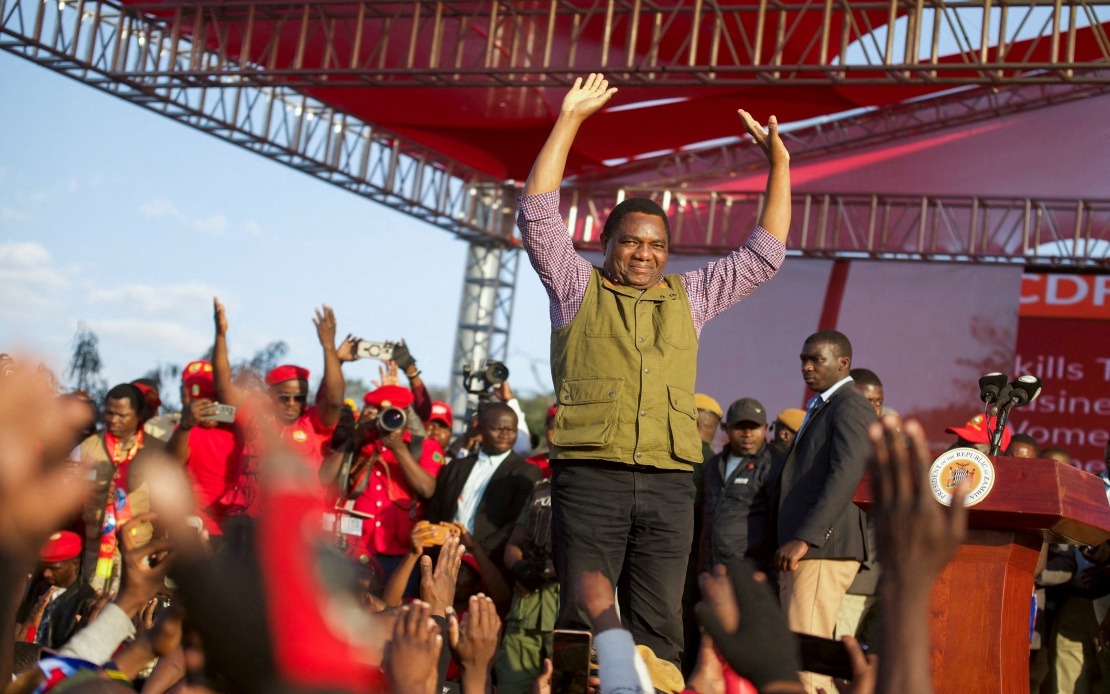
Zambian President Hakainde Hichilema has secured a decisive re-election victory, positioning himself for a second five-year term after electoral officials announced results early Tuesday morning. The 64-year-old political leader garnered more than 2.9 million votes in last Thursday's presidential election, comfortably surpassing the constitutionally mandated threshold of 50 per cent plus one vote that determines outright victory in Zambian presidential contests.
Hichilema's commanding margin of victory reflects substantial public endorsement for his administration's direction over the past five years. His primary challenger, Brian Mundubile of the National Restoration Party for Unity and Progress (NRPUP), received 1.8 million votes, leaving the incumbent with a comfortable lead of more than one million ballots. Electoral Commission of Zambia chairperson Mwanagala Zaloumis formally declared Hichilema president-elect at a ceremony held at the national election centre in Lusaka, the capital city.
Zaloumis noted that Hichilema's margin proved sufficiently substantial to render the outcome mathematically irreversible, even accounting for incomplete tallies from polling stations across five of Zambia's 226 constituencies. This assessment underscores the scale of the electoral endorsement received by the incumbent United Party for National Development (UPND), which now enters its second consecutive presidential term with renewed popular mandate. The Electoral Commission's confidence in declaring a winner despite outstanding results demonstrates the magnitude of Hichilema's victory across the nation's diverse regions.
In his immediate response to the electoral victory, Hichilema expressed gratitude to Zambian voters through a social media statement posted shortly after his official declaration. The president-elect emphasised the responsibility accompanying another electoral mandate, framing his return to office as a renewed commitment to serve the nation's citizens. His measured tone suggested recognition that five years of governing had generated sufficient public confidence to warrant continuation, though challenges certainly remain within Zambia's complex political and economic landscape.
The announcement triggered spontaneous celebrations throughout Lusaka's streets, with residents emerging before dawn to mark the electoral outcome. Citizens from varied social backgrounds gathered in public spaces, creating an atmosphere of jubilation that persisted throughout the morning hours despite the early and uncomfortable temperatures typical of Zambian winter conditions. These scenes reflected genuine popular engagement with the electoral process and satisfaction with its outcome among significant segments of the urban population.
Collins Maoma, serving as national chairperson of the ruling UPND, reinforced the message of continuity and leadership affirmation when addressing media representatives. Maoma's characterisation of voters as having demonstrated renewed confidence in Hichilema's stewardship provides the governing party's official interpretation of electoral results. The UPND chairperson's framing emphasises leadership quality and public trust rather than the specific policies or programmes that may have influenced voter behaviour, reflecting typical post-election party messaging strategies across African democracies.
For regional observers monitoring Southern African political developments, Zambia's election outcome carries significance beyond its national boundaries. The decisive re-election of an incumbent president through competitive electoral competition contributes to broader narratives about democratic consolidation and institutional resilience within the region. Zambia's 2024 electoral process demonstrates that despite economic challenges and governance complexities common throughout Southern Africa, democratic procedures can deliver clear results and enable peaceful power transitions or continuations.
The magnitude of Hichilema's victory margin suggests that his administration's performance across domestic policy areas proved sufficiently satisfactory to warrant public endorsement. Whether such support reflects economic management, infrastructure development, anti-corruption initiatives, or other priority areas remains subject to analytical interpretation. Nonetheless, the numerical outcome indicates that opposition platforms and alternative visions for Zambia's direction failed to gain traction with the broader electorate, at least in sufficient quantities to threaten incumbent continuity.
Looking forward, Hichilema's second-term mandate will face immediate tests as Zambia navigates persistent economic pressures and infrastructural demands. The president's return to office carries implications for regional diplomacy and continental positioning, particularly regarding Zambia's relationships with other Southern African Development Community nations and engagement with global economic partners. His renewed tenure provides opportunity for strategic initiatives while simultaneously imposing accountability for addressing unresolved developmental challenges that likely influenced some voter considerations.
The peaceful and transparent electoral process itself merits recognition within regional context, where electoral competition occasionally generates tensions. Zambia's commitment to announcing results promptly and allowing opposition challengers opportunity for public acknowledgment reflects procedural maturity that strengthens democratic institutions. As Malaysian observers assess African political developments, Zambia's demonstration of competitive yet orderly democratic practice offers important examples of institutional functionality in developing democratic systems operating amid genuine economic constraints.

