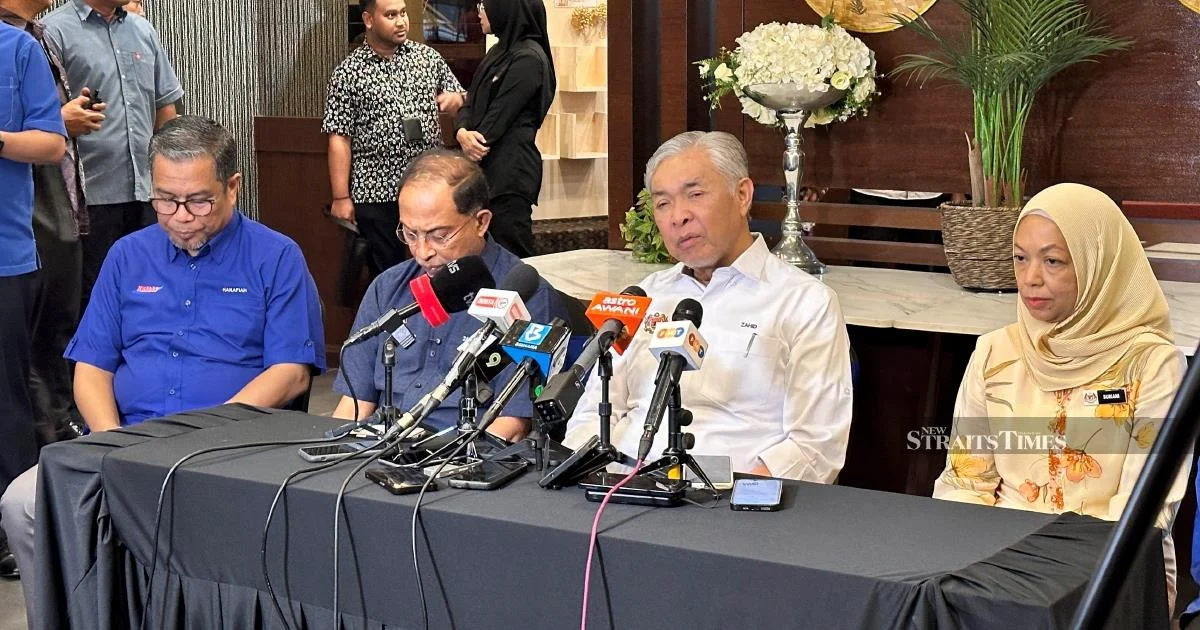
Barisan Nasional chairman Datuk Seri Dr Ahmad Zahid Hamidi has called on unity government partners to move forward from disputes centred on Najib Razak and Datin Seri Rosmah Mansor, particularly regarding their deployment in Johor's election campaign. The remarks, delivered in Kluang, appeared directed at a fellow coalition member whose decision to feature Rosmah's image in campaign materials has reignited sensitivities within the broader alliance.
The intervention underscores deepening friction within Malaysia's unity coalition, where multiple power centres jostle for influence and messaging control. Zahid's statement reflects wider frustration at how historical grievances—rooted in the 1MDB scandal and subsequent convictions—continue to complicate contemporary political calculations. The unity government, an unprecedented arrangement uniting Barisan Nasional, Pakatan Harapan, and smaller partners, has repeatedly struggled to reconcile competing narratives and leadership legacies.
Najib's legacy remains divisive across Malaysian politics. The former Prime Minister's legal troubles, including his 2023 conviction and sentencing in connection with SRC International funds, cast a long shadow over Barisan Nasional's positioning. While he retains a substantial support base within UMNO and among certain voter demographics, his association with the 1MDB controversy continues to alienate urban and younger voters—demographics critical to BN's electoral recovery.
Rosmah's high public profile, meanwhile, carries its own baggage. Her extravagant spending habits and prominent role in the previous administration symbolise the excess and alleged mismanagement that defined the Najib era. Using her image in campaign materials, therefore, signals a troubling tone to swing voters and younger Malaysians increasingly animated by accountability and transparency concerns.
Zahid's rebuke reveals the precarious balance the unity government must maintain. Barisan Nasional requires broad-based support across different voter cohorts to remain electorally viable, yet portions of its electoral coalition—particularly in traditional heartlands—view Najib and Rosmah more favourably. This tension has consistently hampered BN's ability to project a unified, forward-looking political message.
For the Johor campaign specifically, the state represents crucial battleground territory. As Malaysia's second-most populous state and a traditional BN stronghold, Johor's electoral performance carries outsized significance for the coalition's national standing. Any campaign missteps or internal disharmony risk handing initiative to opposition parties positioning themselves as custodians of institutional reform and anti-corruption sentiment.
The broader unity government framework, established post-2022, was conceived partly to stabilise Malaysian politics and prevent the opposition from capitalising on public disillusionment. However, the arrangement perpetually struggles with message coherence and strategic alignment. Partners often operate according to competing interests rather than shared vision, creating openings for critics to exploit apparent hypocrisy or inconsistency.
Zahid's intervention also reflects his own positioning within UMNO and BN leadership. As chairman, he shoulders responsibility for electoral outcomes while navigating competing factions within the party and coalition. His willingness to publicly address the Rosmah campaign deployment suggests that the matter had generated sufficient internal concern to warrant intervention, rather than remaining unaddressed.
Malaysia's electorate, meanwhile, demonstrates increasing sophistication in detecting and punishing perceived insincerity. Voters who perceive the ruling coalition as attempting to rehabilitate discredited figures while simultaneously claiming reform credentials are likely to express their dissatisfaction through ballot-box action. This dynamic has benefited opposition parties in recent contests, particularly among urban constituencies and those with tertiary education.
The Johor campaign thus becomes a test of whether the unity government can maintain disciplined, coherent messaging whilst managing internal dissent. Success would require coalition members accepting limits on individual self-promotion and maintaining consistency with broader strategic narratives. Failure risks perpetuating the perception that governing partners prioritise factional interest over collective electoral viability.
Looking forward, similar tensions will likely resurface as Malaysia approaches subsequent election cycles. The fundamental challenge remains reconciling historical accountability with present political expediency—a task made more complex by competing perspectives within the unity arrangement. Zahid's message appears directed as much toward his own coalition members as toward the broader electorate: move on from the past, or risk compromising collective future prospects.
The incident also highlights how personalities and historical controversies continue dominating Malaysian political discourse, even as policymakers attempt redirecting attention toward governance and economic performance. Until the nation comprehensively addresses questions of institutional accountability and democratic renewal, such disputes will likely persist, periodically threatening to destabilise governing arrangements.

