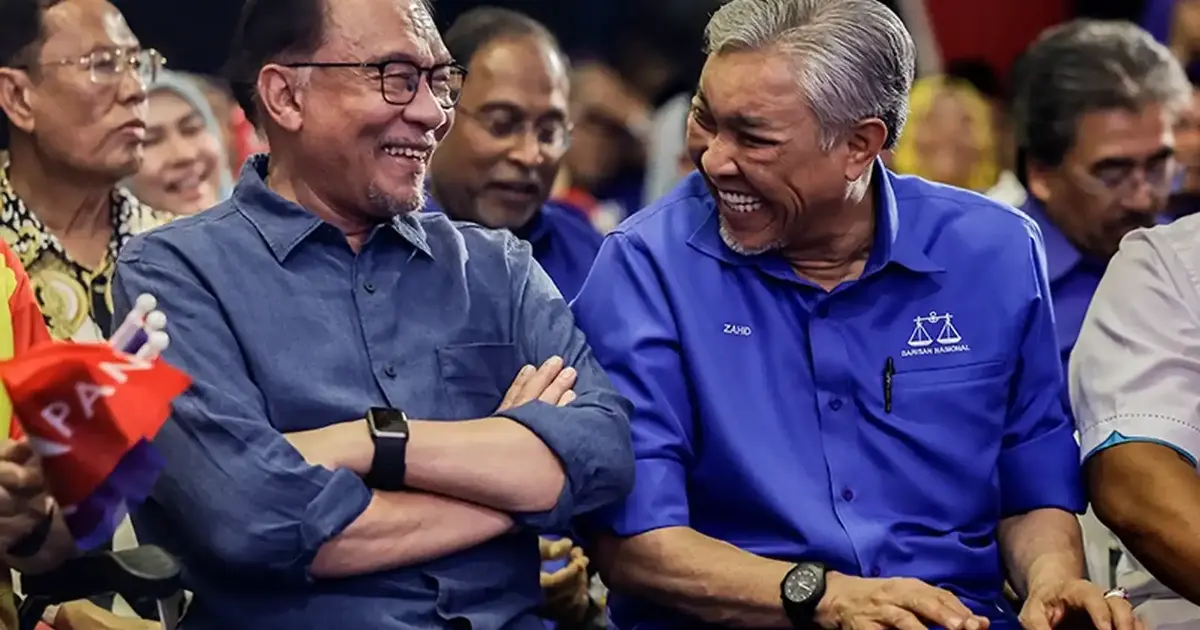
Deputy Prime Minister Zahid Hamidi has chosen an unconventional medium to address recent remarks from Prime Minister Anwar Ibrahim, responding with a poem of his own in what appears to be a carefully calibrated exchange between the two leaders at the helm of Malaysia's ongoing unity government.
The poetic exchange, while unusual in contemporary Malaysian politics, reflects the complex relationship between UMNO, the dominant force within Barisan Nasional, and Pakatan Harapan, which leads the coalition government. Such symbolic gestures carry significant weight in Malaysian political culture, where public communications between top officials often contain layers of meaning beyond their literal words. The use of verse suggests an attempt to convey messages with both dignity and subtlety rather than through direct confrontation.
Zahid's intervention as both Deputy Prime Minister and Barisan Nasional chairman carries particular weight given his dual roles overseeing both the government and the main opposition-turned-coalition partner. His decision to respond in kind to Anwar's poem demonstrates a recognition of the cultural and political significance of the original message. The exchange occurs against the backdrop of ongoing negotiations over the direction of the unity government and the balance of power between its constituent parties.
Beyond the poetic exchange itself, Zahid took pains to underscore Barisan Nasional's unwavering commitment to sustaining the unity government until the conclusion of its full term. This reassurance carries substantial implications for political stability in Malaysia, as the unity framework has provided unexpected continuity following the 2022 general election. The strength of this commitment matters considerably for investors, civil society, and citizens seeking predictability in governance during economically challenging times.
The unity government represents a historic departure from Malaysia's two-bloc electoral tradition, bringing together parties that have opposed each other for decades. Maintaining this delicate coalition requires constant attention to the concerns and prerogatives of each participating faction. Zahid's affirmation suggests that despite underlying tensions and jockeying for advantage, the fundamental commitment to the government's survival remains solid at the leadership level.
Barisan Nasional's position within the unity framework remains distinctive, as the coalition itself comprises multiple parties with sometimes competing interests. UMNO's dominance within BN means that Zahid's statements carry weight throughout the larger grouping. His reaffirmation of commitment suggests that core BN figures do not view the unity government as a temporary expedient but rather as a strategic arrangement with longer-term value for the coalition.
The timing of this exchange deserves scrutiny, as poetic exchanges between national leaders often emerge during periods of heightened political sensitivity. Whether prompted by specific policy disagreements, succession planning concerns, or broader questions about the future shape of Malaysian politics, such symbolic communications typically surface when direct dialogue would be more fraught. The choice of this literary approach may indicate an attempt to lower temperature while addressing substantive concerns.
For regional observers and Southeast Asian governments, the stability of Malaysia's unity government holds implications extending well beyond domestic politics. As Southeast Asia's third-largest economy and a linchpin of regional supply chains, trade relationships, and security arrangements, political disruption in Malaysia resonates across the region. The reassurance from BN's leadership that the government will persist through its intended term provides welcome certainty for regional partners and international investors assessing political risk.
The dynamics between Anwar and Zahid will continue shaping Malaysian governance, particularly as both figures harbour ambitions extending beyond their current posts. The Prime Minister represents Pakatan Harapan's leadership while Zahid stands as heir apparent within UMNO's traditional hierarchy. Managing the tension between cooperation and competition within the unity framework remains a central challenge for both leaders and their respective parties.
Questions about the unity government's trajectory became increasingly relevant as Malaysia approaches the latter stages of the current parliamentary term. Whether the coalition will continue in its present form, reorganise, or fragment ahead of the next general election remains uncertain. Zahid's reiteration of BN's commitment signals that at least one major pillar of the government intends to maintain the arrangement, though circumstances and political calculations can shift rapidly.
The poetic exchange ultimately reflects the sophisticated nature of high-level Malaysian political communication, where public gestures often convey negotiated messages rather than spontaneous expressions. For analysts and citizens seeking to understand the health of the unity government and the relationships governing Malaysia's political trajectory, such symbolic interactions provide valuable indicators of the underlying state of play among the leadership.

