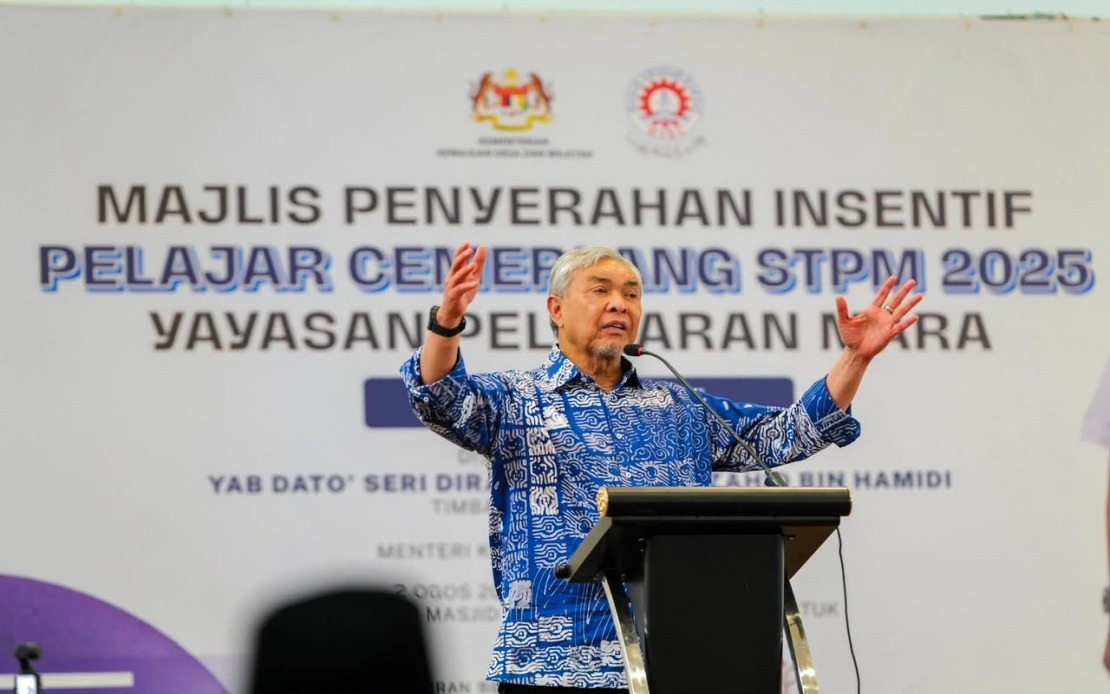
Deputy Prime Minister Datuk Seri Dr Ahmad Zahid Hamidi has commended 38 students from two Bagan Datuk secondary schools for their outstanding performance in the 2025 Sijil Tinggi Pelajaran Malaysia (STPM) examination, presenting them with the Yayasan Pelajaran MARA (YPM) Excellence Incentive. The recipients, drawn from Sekolah Menengah Kebangsaan Khir Johari and Sekolah Menengah Kebangsaan Tun Abdul Razak, represent a cohort of high achievers whose success reflects the potential within the Perak district when students receive adequate educational support and direction.
Beyond the STPM recognition, the achievements of Bagan Datuk's young people extend into the international sphere. Three students from the district have secured admission to Al-Azhar University in Egypt, where they intend to pursue studies in Islamic Syariah and Usuluddin, a development that Zahid Hamidi highlighted as particularly encouraging. This dual pathway—with some students progressing through local merit-based scholarships while others gain entry to prestigious overseas institutions—illustrates the diverse trajectories available to well-performing Malaysian secondary school graduates and the appeal of Islamic scholarship programmes in the region.
The recognition scheme operates alongside broader educational support mechanisms. In addition to the excellence awards, 23 students from the district received assistance through the YPM Education Compassionate Fund, which targets learners facing financial or social barriers to continuing their studies. This layered approach to educational support acknowledges that achievement in formal examinations tells only part of the story; equally significant are interventions that ensure no capable student is left behind due to economic circumstances.
As Bagan Datuk's Member of Parliament, Zahid Hamidi framed these outcomes within a narrative of community development and social mobility. His public acknowledgement of the cohort's success serves multiple functions: it validates the efforts of the students and their families, it highlights the effectiveness of institutional scholarship programmes, and it reinforces the notion that education remains the primary vehicle for uplifting families and entire districts from lower socioeconomic positions. This positioning reflects a broader Malaysian policy consensus that educational attainment correlates directly with poverty reduction and community resilience.
The Bagan Datuk case study is instructive for understanding regional educational dynamics in Malaysia. The district, located within Perak Darul Ridzuan, encompasses both urban and rural populations, presenting the typical challenge of ensuring equitable access to quality secondary education across mixed settlement patterns. The fact that two schools—both government institutions—produced a cohort of 38 STPM-level achievers suggests that resource allocation and teaching quality in the region have reached a functional threshold, though the complementary need for compassionate funding highlights ongoing disparities in student circumstances.
Educational achievement at the STPM level carries particular significance in Malaysia's post-secondary ecosystem. Students who excel at this qualification gain direct entry into local universities, government-funded diploma programmes, and increasingly, pathways to international institutions. The STPM qualification remains more rigorous and selective than some alternatives, making these 38 recipients part of a relatively elite cohort nationally. Their subsequent progression to universities—whether through YPM's scheme, Al-Azhar, or other channels—represents a substantial filtering up from Malaysia's much larger population of Form Five completers.
The emphasis on students returning to contribute to Bagan Datuk's development reflects a conscious strategy of human capital retention at the district level. Malaysian policymakers have long grappled with the challenge of brain drain, whereby successful graduates migrate to Kuala Lumpur or abroad for career opportunities, leaving their home communities depleted of educated professionals. By publicly celebrating these scholars and expressing hope for their eventual return, Zahid Hamidi signals that the district values its graduates and expects them to reinvest their education in local initiatives.
Yayasan Pelajaran MARA's role in this ecosystem warrants examination. As Malaysia's principal scholarship and educational funding body, YPM operates both as a merit recognizer and as a safety net, distributing both excellence awards and compassionate funds. The dual mechanism visible in the Bagan Datuk cohort—38 excellence recipients and 23 compassionate fund recipients—demonstrates how the foundation balances reward for high achievement with support for students whose circumstances might otherwise prevent progression. This bifurcated approach aligns with Malaysia's constitutional commitment to educational access across social strata.
The geographic and institutional context also influences the significance of this announcement. Perak, as a state with significant rural hinterland and a more dispersed population than Selangor or Kuala Lumpur, faces particular challenges in maintaining educational standards and access. Secondary schools in such regions compete for qualified teachers and resources against better-funded urban institutions. When district-level schools produce STPM cohorts of this size and quality, it suggests that despite structural disadvantages, effective teaching and student motivation can overcome geographic constraints—a message relevant to other Malaysian districts facing similar limitations.
The pathway to Al-Azhar University for the three Syariah and Usuluddin students reflects broader regional educational connections within the Islamic world. Malaysia maintains long-standing scholastic ties with Al-Azhar, and entry to this institution represents both an academic achievement and a form of cultural capital, particularly for students pursuing Islamic studies. These placements situate Bagan Datuk within transnational networks of Islamic education, elevating the district's profile beyond national rankings.
Parental and family support emerges as an implicit theme in Zahid Hamidi's commentary. His specific call for parents to remain sources of strength and encouragement underscores research consensus that parental engagement, irrespective of formal education level, correlates strongly with student success. This recognition validates working-class and rural families whose members, though perhaps not highly educated themselves, prioritize their children's schooling and create conditions for study and achievement.
Looking forward, the sustainability of such cohorts depends on maintaining the pipeline of quality primary and secondary education that feeds into STPM examination readiness. The 38 award winners represent a cross-section of the approximately 2,000 or so Malaysian students who achieve top STPM grades annually. For Bagan Datuk, reproducing this achievement in subsequent years will require continued investment in school infrastructure, teacher training, and pedagogical innovation—areas where district-level and state-level policies intersect with federal educational strategy.
Ultimately, the Bagan Datuk awards embody a quiet success story within Malaysia's educational system. While national headlines often focus on crises or systemic failures, stories of genuine achievement by students in less prominent districts demonstrate that the mechanisms for identifying and nurturing talent remain functional. Whether these 38 students—and the 23 receiving compassionate support—fulfill the hopeful vision of returning to develop their district remains an open question, but their current achievements demonstrate that potential, when matched with opportunity, yields results that merit celebration and sustained institutional commitment.

