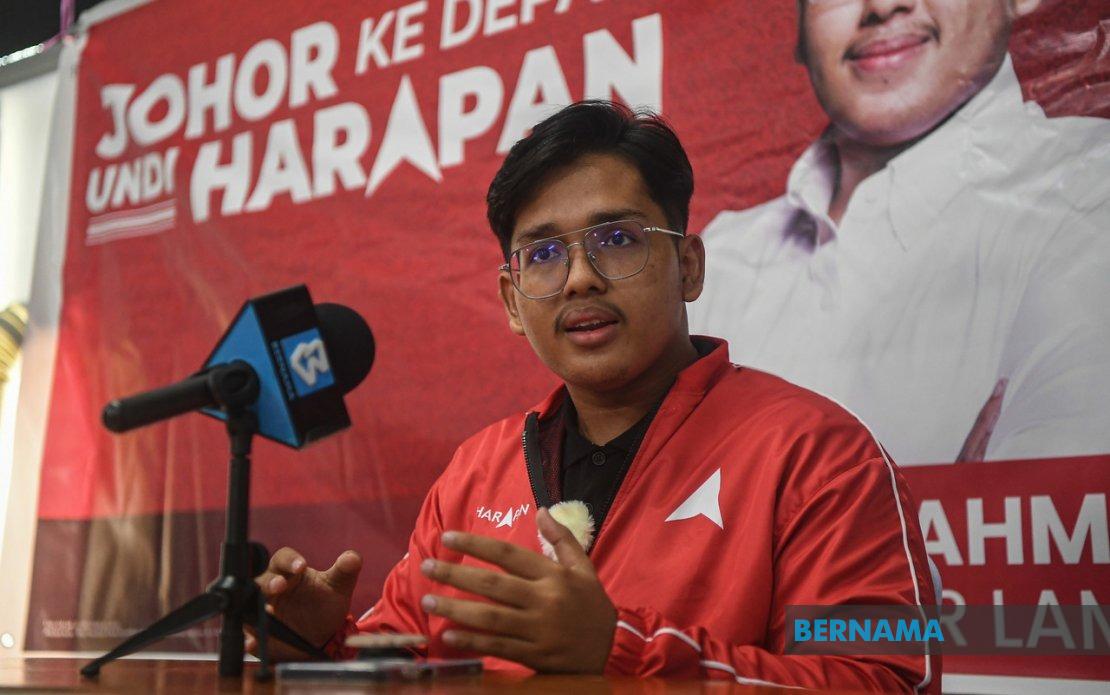
The Johor Lama state constituency race has found an unlikely catalyst for change in the form of Danish Hossman Abd Rahman, who at 23 has become the youngest candidate contesting in the 16th Johor state election. Running under the Pakatan Harapan banner, Hossman's campaign has generated considerable momentum, with supporters describing his approach as an injection of renewed energy into a constituency where demographic challenges and economic stagnation have long been concerns. His reception during field engagement suggests that voters across different age groups are responding positively to his presence and message, creating an opening that traditional political calculations may have underestimated.
What sets Hossman apart in this three-cornered contest against incumbent Norlizah Noh of Barisan Nasional and Aisah Esa of Perikatan Nasional is his unconventional framing of youth candidacy. Rather than positioning his age as an inherent advantage or claiming a mandate to discard the old guard entirely, Hossman articulates a more nuanced vision of himself as a connective tissue between generations. This rhetorical strategy appears deliberate and calculated, designed to neutralize traditional criticisms about inexperience while simultaneously appealing to younger voters seeking representation from someone closer to their age and circumstances.
The veteran vote represents a particularly revealing indicator of Hossman's campaign viability. His fieldwork has evidently struck a chord with older residents who, according to his own observations, have grown weary of established leaders who maintain distance from grassroots concerns. This intergenerational frustration reflects a broader dynamic across Malaysian politics, where long-serving representatives sometimes become disconnected from the daily realities facing their constituents. Veterans, many of whom have witnessed decades of Malaysian political evolution, appear to appreciate both Hossman's sincerity and his visible commitment to face-to-face engagement, suggesting that age alone may be less determinative than actual dedication to community concerns.
As a Master of Information Technology student at Universiti Tun Hussein Onn Malaysia, Hossman brings credentials that align with Johor's economic aspirations, though the technical qualification alone would be insufficient without demonstrated understanding of local challenges. His intensive fieldwork has allowed him to develop familiarity with multiple constituencies within the broader Johor Lama electorate, from urban areas to Federal Land Development Authority settlements. This granular approach to campaigning, repeated across different neighborhoods rather than token single visits, suggests a campaign infrastructure willing to invest time in establishing genuine voter connections rather than relying on media visibility alone.
The substantive policy agenda that Hossman has articulated directly addresses demonstrable challenges facing Johor Lama residents. The constituency's young people have been migrating outward in search of employment and affordable housing, a pattern that reflects both limited economic opportunity and unaffordable residential property. These are not abstract political talking points but immediate pain points affecting families and communities throughout the state. Hossman's commitment to attracting investment and developing downstream industries aligned with local potential represents an economic development philosophy rooted in maximizing existing assets rather than pursuing entirely new directions. Agriculture and livestock activities, already present in the constituency, could form the foundation for value-added processing and related economic activities that would create stable employment.
The affordability crisis in housing deserves particular attention given its centrality to Hossman's campaign messaging. Malaysian housing markets have become increasingly unaffordable for young professionals and families, particularly outside the Klang Valley, and Johor constituencies are no exception. The inability of young people to establish independent households in their home communities creates centripetal pressure toward urban centers, depleting rural and semi-rural constituencies of their most productive demographic cohorts. A candidate prioritizing housing accessibility demonstrates understanding of how macro-economic forces translate into micro-level desperation for ordinary voters.
Hostman's approach to campaign messaging emphasizes capability assessment rather than partisan hostility, a positioning that may resonate differently in the fractious contemporary Malaysian political environment. His call for voters to evaluate candidates based on their competence and policy commitments rather than through the lens of political tribalism or personal animosity reflects either genuine conviction or shrewd recognition that negative campaigning, while sometimes effective, can alienate undecided voters. In a three-cornered contest where the outcome remains uncertain, the ability to appeal to voters who have grown cynical about political mudslinging could prove decisive.
The generational bridge concept that Hossman repeatedly articulates deserves closer examination as a political theory. Rather than claiming that youth should supplant age or that experience should indefinitely entrench power, this framing suggests that optimal governance emerges from dialogue between different life-stage perspectives. Younger people bring energy, current technological fluency, and intuitive understanding of emerging challenges, while older generations offer institutional memory, networks, and proven judgment tested across multiple crises. The most effective leaders might indeed be those who deliberately synthesize these different forms of knowledge rather than privileging one at the expense of the other.
The broader Johor state election context gives additional weight to what happens in Johor Lama. With 172 candidates contesting for 56 seats across the 16th state election cycle, individual constituency battles accumulate into statewide results that carry implications for federal coalition politics. Johor's political trajectory has shifted multiple times in recent decades, with BN facing challenges from both PH and PN, creating genuinely competitive conditions across many constituencies. Hossman's performance in Johor Lama will contribute to the overall narrative about whether demographic shifts are translating into voting pattern changes and whether PH can recover ground lost during recent electoral cycles.
Women and small business owners represent another demographic slice that Hossman has explicitly targeted in his closing campaign push. These constituencies often have distinctive priorities relating to market access, credit availability, childcare support, and workplace flexibility that differ from mainstream party messaging. A young candidate attentive to these specialized concerns demonstrates that generational change does not necessarily mean indifference to particular community segments but rather an ability to recognize and articulate multiple distinctive needs within the broader electorate.
The polling taking place this Saturday will provide definitive evidence about whether Hossman's campaign strategy and personal appeal translate into actual electoral support. His confident assertions about voter reception require verification through the ballot box, where sentiment becomes behavior. A strong showing by the youngest candidate in the 16th Johor election could signal that Malaysian voters are indeed receptive to a different style of political engagement that combines youthful enthusiasm with demonstrable policy focus. Conversely, a poor result would suggest that traditional factors—incumbent advantage, organizational machinery, and established partisan loyalty—remain more determinative than generational novelty. The Johor Lama race thus serves as a microcosm for assessing how Malaysian politics is evolving at the intersection of generational change and persistent structural constraints.

