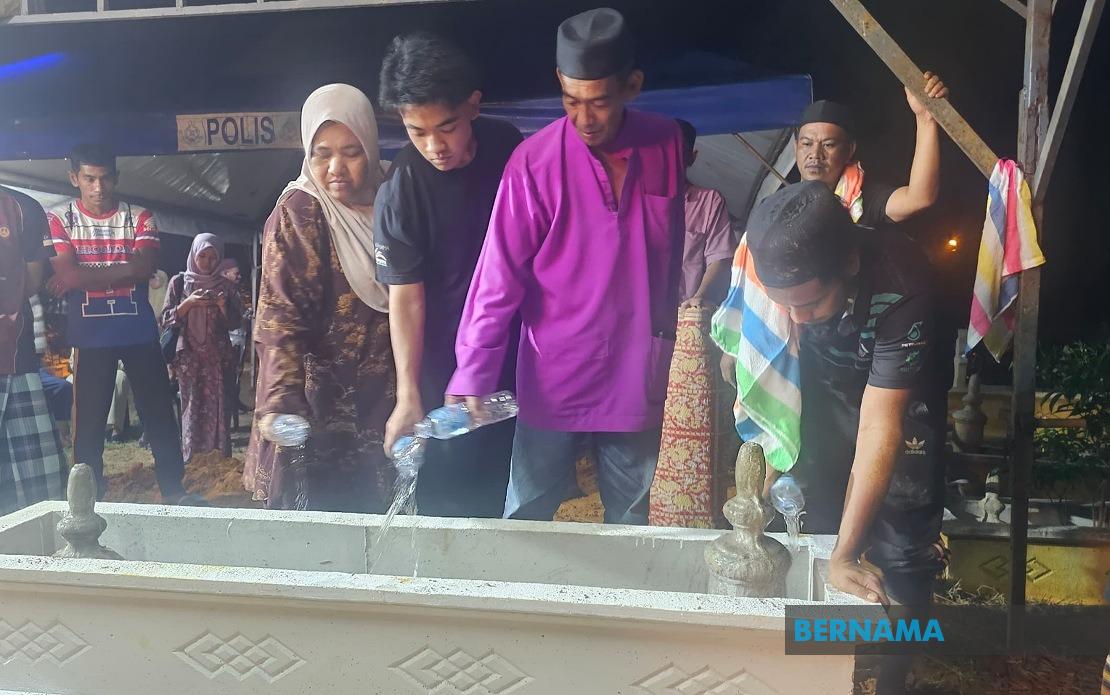
A 24-year-old police constable who died in a tragic electric shock incident in Sabah has been buried in his hometown of Dungun, Terengganu, in an early morning ceremony that drew hundreds of mourners. Constable Muhammad Raimi Ismarubee was among three officers who lost their lives in the incident at Jalan Weston, Kampung Weston, Beaufort on Wednesday evening, marking one of the deadliest workplace accidents involving the police force in recent years.
The young officer's body arrived at his family home in Felda Kerteh 2 late Tuesday night at 11:40 pm, where relatives and fellow officers paid their final respects before the funeral prayers commenced. The burial took place at the Felda Kerteh 2 Muslim Cemetery at 1:15 am Wednesday, with the ceremony conducted with full police honours befitting his rank and years of service to the nation. The early morning timing, whilst unconventional in Malaysian funeral practice, reflects the urgency with which the family wished to lay their son to rest according to Islamic rites.
The logistics of returning Muhammad Raimi's remains to Terengganu involved significant coordination across multiple agencies and states. His body was transported by a Royal Malaysian Air Force aircraft from Kota Kinabalu International Airport to Kuantan Air Base in Pahang, before being transferred by hearse for the final journey to his family's burial ground. This elaborate arrangement underscores the respect accorded to fallen law enforcement personnel and the institutional support provided to grieving families during such tragic circumstances.
The funeral service was presided over by Datuk Satiful Bahari Mamat, chairman of the Terengganu State Education, Higher Education, Science, Technology and Human Development Committee, indicating the significance placed upon the occasion by state authorities. The attendance of approximately 200 police officers and personnel, alongside the Dungun District Police Chief Supt Nik Ab Halim Nik Mat and numerous family members and friends, demonstrated the widespread impact of the tragedy within law enforcement circles and the broader community.
Muhammad Raimi's career with the police force was notably brief. He had commenced duties at Weston Police Station merely a month earlier in September 2024, suggesting he was still in the early stages of his professional development and integration into the force. As the second of three siblings, he remained unmarried, leaving his parents to navigate their grief without the presence of grandchildren or an established household to manage his affairs. The loss of such a young officer at the beginning of what promised to be a lengthy career resonates deeply within police communities across the nation.
Two colleagues perished alongside him in the Wednesday evening incident. Corporal Chiu Teck Siong, aged 40, and Corporal Mohamad Nur Hafiz Ibrahim, aged 29, also succumbed to electric shocks at the same location. The fact that three officers were simultaneously affected suggests the incident may have involved a significant electrical hazard or infrastructure failure at the site. The circumstances of how all three came to be exposed to the electrical current remain subjects of investigation, with initial reports indicating they encountered live electrical wires or faulty equipment whilst conducting police duties.
The incident occurred at 5:50 pm on the evening of August 7, during what would typically be routine operational hours for the Weston Police Station. The fact that multiple officers were incapacitated simultaneously points to either a large-scale electrical fault or a structural hazard that had not been previously identified or remediated. Such accidents prompt critical questions about workplace safety standards, risk assessments, and emergency preparedness within police facilities and operational areas across Malaysia and the broader Southeast Asian region.
For Malaysian readers, the tragedy highlights ongoing concerns about occupational safety within the police and other public service sectors. Whilst Malaysia has established workplace safety regulations under the Occupational Safety and Health Act 1994, enforcement and implementation across all operational areas remain inconsistent. Police personnel working in rural or semi-developed areas, such as those stationed in Beaufort, Sabah, may face particular vulnerabilities due to ageing infrastructure, inadequate maintenance cycles, and limited immediate access to medical facilities in emergencies.
The incident also raises important considerations about emergency response capabilities and medical intervention protocols. In electrical accidents, immediate defibrillation and advanced life support can mean the difference between survival and fatality. The remoteness of the Weston location relative to major medical centres may have constrained the speed with which emergency medical services could respond and provide life-saving treatment. This geographical reality affects not only police personnel but countless civilians across Sabah and Sarawak who depend on distant healthcare resources.
Families of fallen officers often face substantial financial and emotional hardship following workplace deaths. Whilst the police force typically provides death benefits and support to bereaved families, the loss of a breadwinner, particularly in cases involving young officers with limited accumulated pension entitlements, can create lasting economic vulnerability. The Malaysian government and police leadership should ensure that comprehensive support systems, including counselling services, financial assistance, and vocational rehabilitation for family members seeking alternative employment, remain readily accessible.
The funeral of Constable Muhammad Raimi serves as a sobering reminder of the occupational hazards faced by frontline law enforcement personnel across Malaysia. Beyond the immediate tragedy affecting three families and their respective communities, the incident warrants a comprehensive review of workplace safety protocols at police stations and operational areas throughout the country. Such reviews should encompass electrical safety inspections, hazard mitigation procedures, emergency response training, and infrastructure maintenance schedules to prevent similar tragedies.
As Malaysia continues to modernize its police force and upgrade operational facilities, workplace safety must remain a paramount consideration. The legacy of officers like Muhammad Raimi, who gave their lives in service to the nation, should catalyse meaningful reforms that protect the wellbeing of the thousands of dedicated personnel who work tirelessly to maintain public order and security across the country.

