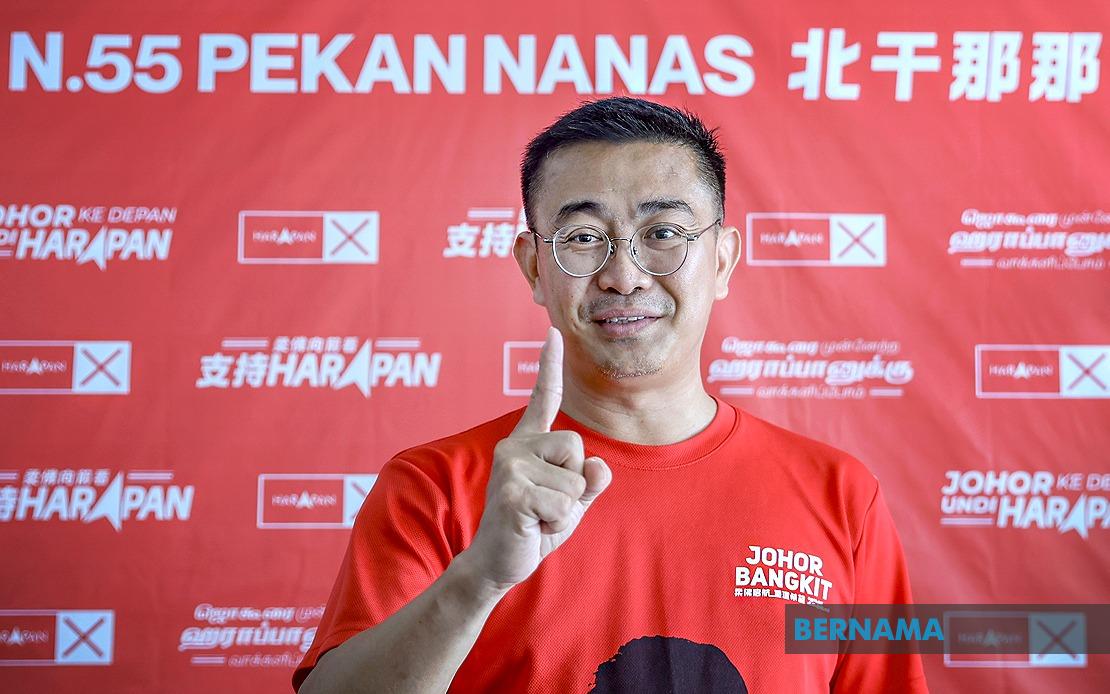
Pakatan Harapan's bid to reclaim the Pekan Nanas state seat rests significantly on the shoulders of Yeo Tung Siong, the constituency's former representative who governed for two consecutive terms between 2013 and 2022 before losing the seat. Speaking in Pontian ahead of Johor's state election, Yeo expressed confidence that his demonstrated service record during his decade in office provides a compelling narrative for voters considering whether to return him to the legislative assembly. His optimism appears rooted not merely in nostalgia for past administration but in extensive ground contact accumulated during the current campaign cycle.
The intensity of Yeo's grassroots outreach reveals a deliberate strategy to rebuild the voter coalition that once supported him. According to his own assessment, he has successfully engaged approximately 60 per cent of the electorate through an diversified approach encompassing traditional walkabout campaigns, informal talks, organised group meetings, house-to-house canvassing, and informal visits to markets and food establishments. This methodical coverage suggests a candidate attempting to compensate for time spent out of office by demonstrating renewed commitment to direct constituent engagement. The positive reception he reports from these interactions, while naturally subject to candidate bias, indicates that PH believes this seat remains competitive against the incumbent Barisan Nasional administration.
Yeo's appeal to voters fundamentally hinges on a performance-based argument rather than partisan rhetoric. As a former vice-principal and discipline teacher, he frames his approach to constituent service around accessibility and personal responsiveness—emphasising that he operates without pretension, maintains availability for those seeking assistance, and conducts personal visits to address community concerns. This positioning contrasts implicitly with bureaucratic distance and suggests a candidate who views the assemblyman's role as that of a responsive problem-solver rather than a distant administrator. For a Pekan Nanas constituency seemingly preoccupied with infrastructure and economic challenges, such an accessibility-centred pitch may resonate with voters fatigued by perceived government remoteness.
During his previous tenure, Yeo points to concrete interventions that addressed longstanding infrastructure deficiencies within his constituency. Most notably, he secured RM500,000 in allocation specifically directed toward rectifying the Pulai River's flow patterns—a project designed to mitigate chronic flooding that had plagued the area for years. Additionally, he collaborated with private sector partners to implement drainage infrastructure in Kampung Melayu Raya, demonstrating capacity to broker partnerships beyond traditional government channels. These examples, whether fully realised or not, establish that Yeo is prepared to itemise specific accomplishments rather than speak in generalities about development and progress.
The campaign messages emerging from Yeo's canvassing activities reveal which voter anxieties carry most weight in Pekan Nanas. Traffic congestion and employment opportunities dominate the concerns raised during his constituency tours, suggesting that residents prioritise mobility and economic security above other issues. These are decidedly practical preoccupations rather than ideological ones, indicating a electorate focused on immediate quality-of-life improvements. For a candidate seeking to reclaim a seat, these voter priorities offer a roadmap for credible commitments that can be articulated without departing from established constituency demands.
Yeo's platform for a potential return to office revolves substantially around transportation infrastructure improvements aimed at reducing travel friction between Pekan Nanas, Pontian, and Johor Bahru. Two specific shortcut projects feature prominently: a route connecting Ulu Pulai to Pekan Nanas and another linking Pulai to the Sri Bunian junction. By his calculation, these interventions would materially diminish commute times for residents regularly traversing these corridors. The specificity of these proposals—naming actual routes and projected outcomes—suggests campaign strategy built on identifiable, measurable deliverables rather than aspirational rhetoric. For constituencies experiencing growing congestion as urban sprawl extends southward from Johor Bahru, such infrastructure commitments hold tangible appeal.
Beyond transportation, Yeo has identified employment promotion as a second pillar of his agenda. He references a career carnival previously organised during his term as assemblyman, conducted in partnership with major regional employers operating within or near Pekan Nanas. If returned to the assembly, he proposes reviving and expanding this initiative to create more systematic linkages between local job-seekers and business recruiters. This approach recognises that constituency service increasingly encompasses facilitating economic opportunity rather than merely providing social assistance. For younger voters and families concerned about graduate employment and income security, such initiatives speak to a conception of representation that extends into economic enablement.
Social support provision comprises a third dimension of Yeo's platform. He emphasises his intention to ensure that vulnerable populations receive appropriate assistance by working closely with government welfare agencies including the Social Welfare Department and the Social Security Organisation (SOCSO). This commitment, though couched in bureaucratic language, addresses a constituency demographic reality: Pekan Nanas contains populations dependent on or vulnerable to fluctuations in formal employment, necessitating reliable access to safety-net programmes. A candidate's demonstrated familiarity with welfare apparatus and apparent willingness to facilitate benefit access can prove consequential in such constituencies.
The Pekan Nanas contest ultimately represents a straight fight between two candidates embodying distinct political trajectories. Yeo returns as an erstwhile incumbent seeking restoration after electoral defeat, while his opponent Tan Eng Meng represents the Barisan Nasional incumbency that displaced him. This bipolar configuration removes complicating three-way splits and forces voters toward clear choice between continuity and change. For Yeo, the campaign narrative centres on retrospective vindication—that his prior stewardship merits restoration—combined with forward-looking pledges addressing identified voter grievances. Whether this combination of demonstrated track record, intensive grassroots engagement, and specific policy commitments proves sufficient to overcome the electoral consequences of his previous defeat remains contingent on mobilisation rates and any broader swings in Johor's political climate during the state election cycle.

