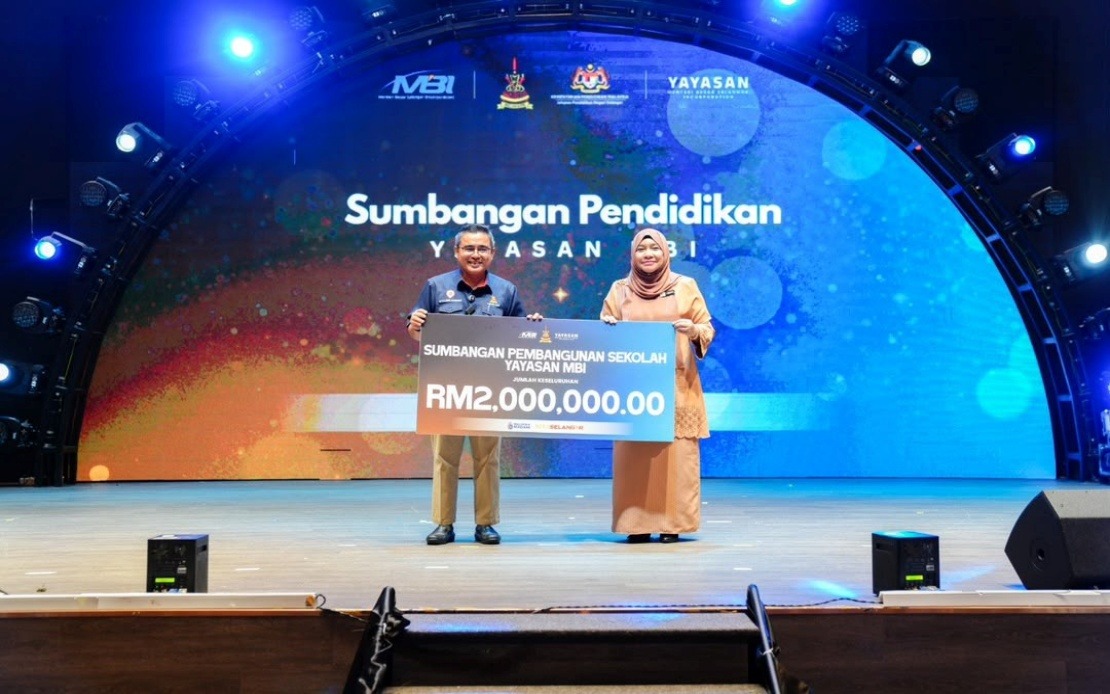
Yayasan Menteri Besar Selangor (Incorporated) has announced a RM2 million allocation directed towards improving school infrastructure and learning environments across the state, marking another significant step in the foundation's ongoing effort to elevate educational standards in Selangor. The disbursement, made through the School Development Contribution scheme, underscores the organisation's determination to create better facilities and working conditions for both educators and learners throughout the region.
Ahmad Azri Zainal Nor, heading the foundation, emphasised that education occupies a central position within the organisation's strategic agenda. Roughly two-thirds of the foundation's overall initiatives concentrate on educational advancement, reflecting a deliberate prioritisation that goes beyond temporary relief measures. Rather than viewing education support purely through a social assistance lens, Yayasan MBI conceptualises its role as one of long-term investment in human capital development, recognising that today's educational quality directly shapes Selangor's competitive advantage and demographic dividend in coming decades.
The latest funding announcement coincided with the Yayasan MBI Education Aspiration 2026 event, a gathering designed to forge stronger collaborative ties among stakeholders and honour the contributions made by teachers throughout Selangor's public education system. This platform enabled the foundation to communicate its vision while simultaneously acknowledging the frontline professionals upon whose shoulders educational transformation ultimately rests. By bringing together educators, administrators, and community representatives, such convening efforts help align expectations and foster shared ownership of educational improvement goals.
Yayasan MBI operates a diverse portfolio of education programmes tailored to address different gaps within the learning ecosystem. The Back to School Tour Programme represents one mechanism for reaching students, whilst partnerships with Parent-Teacher Associations facilitate grassroots engagement and community involvement in school governance. The Selangor People's Tuition Programme provides supplementary learning support at no cost to participants, addressing the persistent challenge of unequal access to remedial education that often correlates with family income levels. Meanwhile, the Didik Kasih Programme extends direct assistance to learning institutions themselves, allowing schools to address infrastructure and resource deficits that might otherwise hinder teaching quality.
What distinguishes Yayasan MBI's approach is its systematic coordination with the Selangor State Education Department, ensuring that funding flows to genuine priority areas rather than following guesswork or disconnected assumptions about school needs. This alignment mechanism proves crucial in resource-constrained environments where directing capital towards the most impactful interventions yields substantially better outcomes than scattershot assistance. By anchoring its grants programme within official departmental frameworks, the foundation enhances the likelihood that RM2 million translates into tangible improvements rather than duplicative or underutilised investments.
For Malaysian education observers, Yayasan MBI's trajectory illustrates how state-level foundations can function as catalysts for sectoral progress when properly resourced and strategically deployed. Unlike federal programmes that must accommodate national diversity and competing priorities, state-centric organisations can tailor interventions to local contexts and emerging challenges. Selangor's experience demonstrates that sustained, multi-year commitments to education funding—combined with deliberate effort to strengthen partnerships between government departments, schools, and civil society—create conditions for measurable improvement in learning environments and educational access.
The emphasis on infrastructure and facility improvements deserves particular attention given Southeast Asia's broader development trajectory. As Malaysia transitions toward higher-value economic activities requiring advanced technical and cognitive skills, the physical and pedagogical quality of schooling becomes increasingly consequential. Schools lacking adequate learning resources, functional laboratories, or dignified teaching spaces struggle to deliver curriculum content effectively, particularly in STEM subjects where hands-on engagement proves essential. Infrastructure investment therefore represents not merely spending on buildings but foundational investment in skills development.
Yayasan MBI's focus on reducing barriers to learning access addresses equity dimensions that remain pressing across Selangor despite the state's relative prosperity. Free tuition programmes and financial support schemes acknowledge that family circumstances frequently determine whether capable students continue their education or exit prematurely to contribute household income. By providing these support mechanisms, the foundation helps unlock human potential that might otherwise remain dormant, benefiting both individual recipients and Selangor's economic competitiveness over the medium term.
The foundation's multi-stakeholder coordination model also reflects evolving best practices in education policy. Rather than operating in isolation, Yayasan MBI actively cultivates relationships with educators, parent groups, and government departments, creating feedback loops that enable continuous programme refinement. This collaborative architecture helps prevent the siloing that sometimes afflicts government education bureaucracies, where policy initiatives may proceed without sufficient input from practitioners who understand ground-level realities. When foundations and official departments work in tandem, complementing rather than competing, the entire system benefits from expanded resources and improved information flow.
Looking toward Selangor's Education Aspiration 2026 framework, the RM2 million commitment signals that the foundation intends to remain an active partner in achieving stated targets. Education systems rarely achieve transformation through one-time injections; rather, sustained commitment over multiple years, coupled with strategic focus and effective execution, generates meaningful progress. Yayasan MBI's demonstrated willingness to allocate substantial resources year after year, combined with its efforts to ensure alignment with state education priorities, positions it as a reliable anchor institution within Selangor's education ecosystem.
For other Malaysian states considering comparable foundation structures or examining how to deepen private and quasi-public sector engagement in education, Selangor's model offers useful lessons. The state's approach demonstrates that education funding mechanisms need not rely exclusively on government budgets; strategic partnerships with foundations committed to long-term impact can meaningfully expand resources available for school improvement. As demographic trends shift and fiscal pressures increase, this diversified funding approach may become increasingly important across Malaysia's education landscape.

