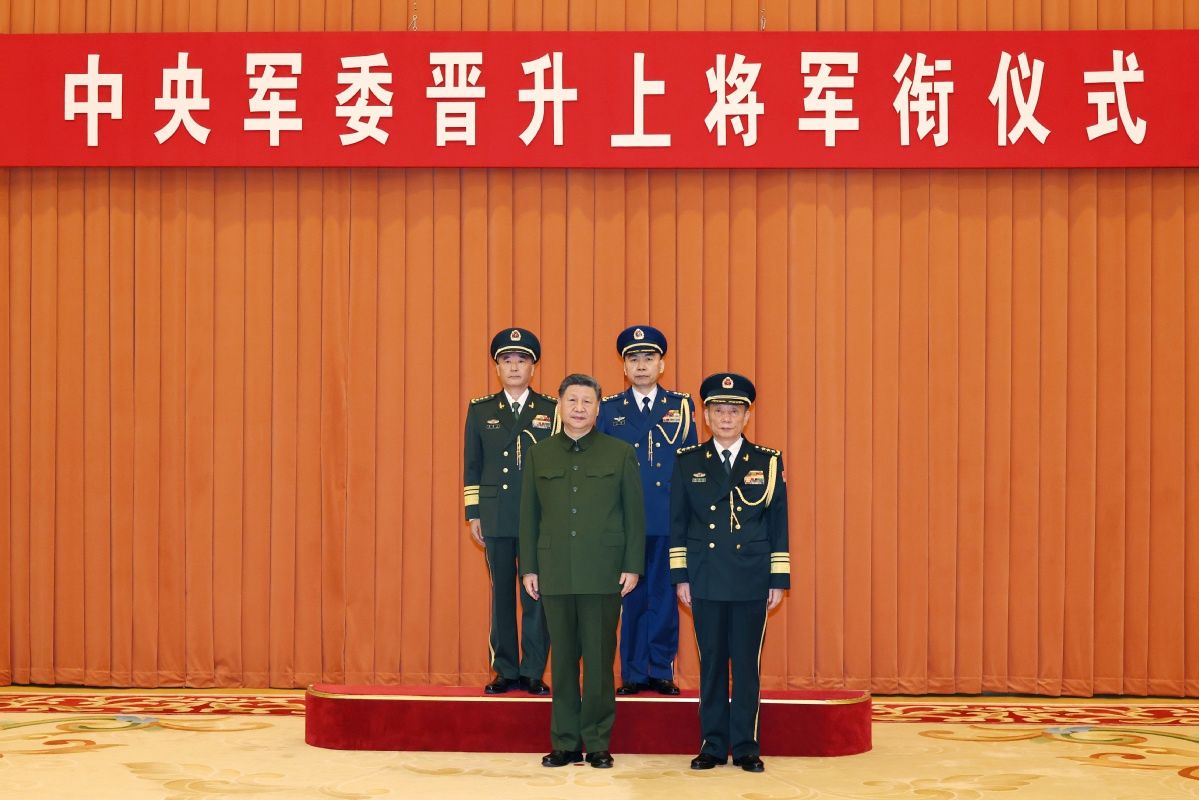
Chinese President Xi Jinping has elevated Zhang Shuguang to lead the military's anti-corruption efforts, marking another significant personnel shift in what observers characterize as the most extensive restructuring of China's armed forces in more than fifty years. The appointment was formally announced through state media during a ceremony in Beijing on Friday, July 3, with Xi present at the proceedings. Simultaneously, Wang Gang has assumed command of the People's Liberation Army Air Force. Both officers were promoted to the rank of general, the highest active-duty military grade in the Chinese system.
The timing and scope of these changes underscore the magnitude of Xi's consolidation efforts within the military establishment. Zhang Shuguang now heads the Central Military Commission's discipline inspection commission, a position that places him at the centre of enforcement mechanisms tasked with identifying and addressing misconduct across the armed services. His predecessor, Zhang Shengmin, has transitioned to the role of vice chairman of the Central Military Commission, a shift that represents both a promotion in prestige and a reduction in direct operational oversight of anti-graft activities. The trajectory of former Air Force Commander Chang Dingqiu remains unconfirmed, though his removal from the aviation branch signals the depth of leadership rotation occurring throughout military hierarchies.
This personnel restructuring must be understood within the context of Xi's broader consolidation strategy that commenced in mid-2023. Following his unprecedented securing of a third consecutive presidential term—a development that broke with decades of collective leadership precedent in Chinese politics—Xi initiated a far-reaching campaign to eliminate what Communist Party officials characterize as systemic corruption entrenched within military ranks. The campaign's scope has proven remarkably extensive: two vice chairs of the Central Military Commission have been removed, three additional CMC members have been purged, the defence minister has been replaced, and no fewer than a dozen commanding generals overseeing major military regions and strategic commands have been displaced from their positions.
The investigation into Zhang Youxia, Xi's former ally who previously served as a top general, exemplifies the unpredictability and reach of these proceedings. Zhang Youxia's status as a historically trusted figure within Xi's inner circle makes his downfall particularly significant, signalling that proximity to power offers no protection from scrutiny. This development has reverberated through political and military circles, establishing a clear message that internal loyalty and established relationships will not shield senior figures from accountability processes.
Beyond the officer corps, Xi's consolidation has extended into the legislative sphere. Last week, Beijing moved to strip six military lawmakers of their seats in the National People's Congress, the rubber-stamp legislature that formally represents all constituencies including the armed forces. This action demonstrates that the purge transcends operational military structures and reaches into formal state institutions, removing individuals from positions that carry symbolic political weight alongside whatever actual legislative functions they exercise.
For Malaysian and Southeast Asian observers, these developments carry strategic implications that warrant careful analysis. China's military stability directly influences regional security calculations, particularly regarding South China Sea tensions, freedom of navigation operations, and the balance of power affecting maritime routes vital to Malaysian commerce and energy security. A military establishment undergoing significant leadership turbulence introduces uncertainty into the calculation of Chinese strategic intentions and decision-making processes. When military leadership is in flux, the institutional knowledge and established channels of communication that allow adversaries and regional players to anticipate responses become unreliable.
The purge also reflects deeper questions about factional dynamics within China's leadership structure. Xi's consolidation of military authority follows a pattern observed in his civilian governance, where he has systematically eliminated potential rivals and removed officials associated with his predecessors, Hu Jintao and Jiang Zemin. The scale of military removals suggests either that resistance to Xi's authority ran deeper within the armed forces than in civilian structures, or that Xi views military loyalty as particularly crucial given the Communist Party's historical dependence on military support for political legitimacy.
The rotation of personnel creates opportunities for Xi to install commanders and officials whose personal loyalties align with his vision for military modernization and readiness. China's military has undergone significant technological transformation over the past decade, with new capabilities in cyber warfare, space operations, and advanced naval systems reshaping the force structure. Leadership changes allow Xi to ensure that officers commanding these emerging domains possess ideological alignment with his strategic preferences and are less likely to resist his directives regarding military deployment or strategy.
International observers have characterized these removals as potentially disruptive to military effectiveness and institutional continuity. However, the Chinese military has previously navigated major restructuring periods without apparent loss of operational capability. The People's Liberation Army maintains extensive systems for training and promoting officers through standardized advancement mechanisms, reducing dependence on any individual leader's particular expertise. Nevertheless, the simultaneous removal of multiple commanders creates knowledge gaps in areas requiring deep institutional memory, such as command relationships, logistics networks, and established protocols for crisis response.
The implications for civil-military relations within China also merit consideration. Xi's aggressive pursuit of purges signals that military institutions remain subordinate to political authority, reinforcing the historical principle that the party commands the gun rather than the gun commanding the party. This assertion of civilian control over the military hierarchy reflects Xi's concern about autonomous military power centres potentially constraining his decision-making authority. By removing generals and officials who might harbour independent power bases or allegiances to previous leaders, Xi has streamlined military decision-making around his personal directives.
Regional analysts should monitor how these changes affect military command structures relevant to specific theatres. The appointment of new Air Force leadership, for instance, could indicate shifts in strategic emphasis regarding air superiority, space operations, or power projection capabilities that extend beyond China's immediate territorial waters. Similarly, changes in the anti-corruption apparatus may reveal which military sectors Xi considers most vulnerable to institutional resistance or which commanders he views as most threatening to his consolidated authority.
The broader pattern of these personnel changes demonstrates Xi's determination to eliminate any remaining centres of autonomous military authority that might complicate his strategic decision-making or constrain his political flexibility. Whether this consolidation ultimately strengthens or weakens Chinese military effectiveness remains an open question that strategic analysts across Southeast Asia and beyond will continue to assess through operational readiness metrics and command responsiveness indicators that emerge in coming months.

