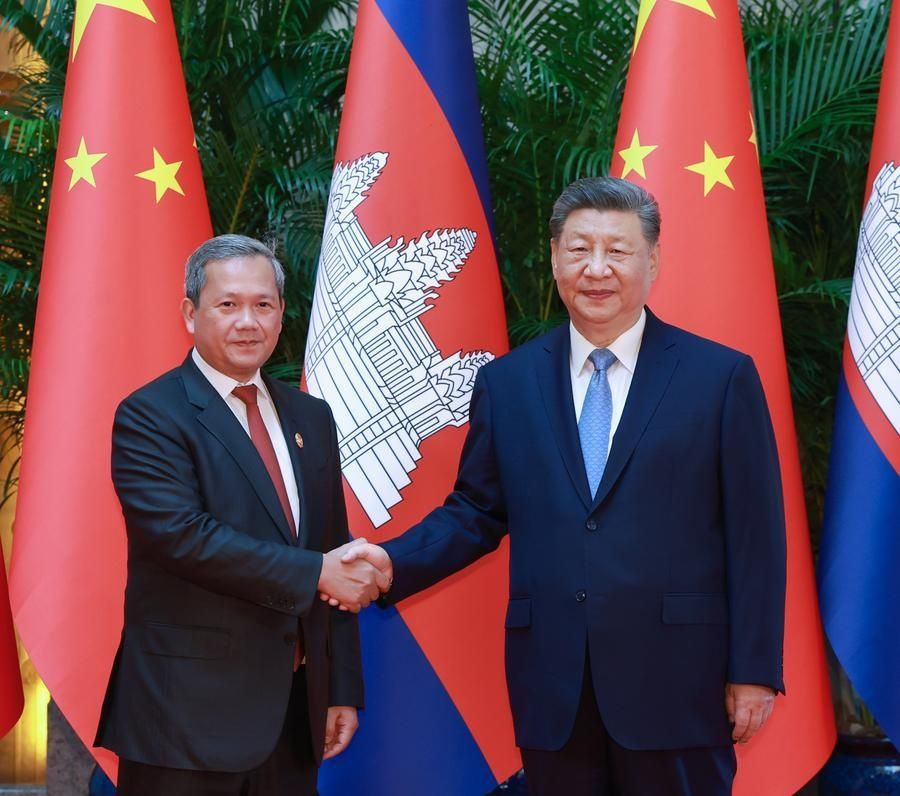
Chinese President Xi Jinping has reaffirmed Beijing's commitment to strengthening its relationship with Cambodia, describing the bond as an "ironclad friendship" rooted in decades of leadership commitment from both nations. The remarks came during a high-level meeting in Shanghai on Friday, July 17, where Xi received Cambodian Prime Minister Hun Manet, who was visiting China for the 2026 World Artificial Intelligence Conference and High-Level Meeting on Global AI Governance as well as conducting official bilateral discussions.
The meeting signals the continued importance both governments attach to their strategic partnership at a time of shifting regional dynamics and evolving international circumstances. Xi's emphasis on preserving the foundational relationship established by previous generations of leaders reflects Beijing's broader strategy of maintaining influence in Southeast Asia through deep institutional and personal ties. Cambodia's geopolitical significance stems partly from its geographic position in the Mekong region and its alignment with Chinese interests on various regional issues.
Central to the bilateral agenda is what Xi termed the "Diamond Hexagon" cooperation framework, a mechanism designed to coordinate efforts across multiple sectors. Within this structure, the two nations are prioritising the Industrial Development Corridor and the Fish and Rice Corridor—initiatives that promise to integrate Cambodian agriculture and manufacturing capabilities with Chinese investment and technology. These infrastructure projects represent more than mere commercial arrangements; they embed Cambodia's economy within Chinese supply chains and development priorities, potentially deepening economic interdependence between the two countries.
The expansion of traditional economic sectors such as electricity and agriculture forms the backbone of near-term cooperation, with China leveraging its technological expertise and capital reserves to support Cambodian development. Simultaneously, both governments are positioning themselves to capitalise on emerging opportunities in artificial intelligence and the digital economy. For Malaysian observers, this represents a notable example of how China is operationalising technological partnerships to strengthen regional influence, a dynamic that extends implications throughout Southeast Asia.
Security cooperation emerged as a significant component of the dialogue, with both leaders committing to combat cross-border criminal activities including counterfeiting, smuggling, online gambling, and telecom fraud. The prominence accorded to telecom fraud in particular reflects a genuine shared problem affecting both nations and the broader region. Cambodia's challenges with organised crime networks conducting international scams have escalated markedly in recent years, making cooperation with Beijing a practical necessity alongside ideological alignment.
Perhaps most diplomatically sensitive was Xi's intervention on Cambodia's long-running border tensions with Thailand. Rather than directly endorsing one party, Xi characterised the dispute as a matter requiring mutual trust-building and suggested China stands ready to assist in facilitating dialogue. This positioning allows Beijing to maintain its role as a neutral regional mediator while subtly reinforcing its influence over Cambodian foreign policy decision-making. Xi's statement that ceasefire consolidation serves "fundamental and long-term interests of both countries" implicitly encourages Cambodia toward conflict resolution, demonstrating how China uses diplomatic pressure within bilateral frameworks.
Hun Manet's response embodied Cambodia's consistent strategic orientation toward China. His explicit reaffirmation that Cambodia's pro-China policy remains unshakeable regardless of "shifts in the international situation" effectively addresses potential concerns from Beijing that geopolitical pressures or domestic political changes might alter Phnom Penh's alignment. The prime minister's gratitude for historical Chinese support acknowledged the material foundation of bilateral ties, encompassing decades of economic assistance, military support, and development financing that have shaped Cambodia's institutional capacity and political stability.
Cambodia's restatement of commitment to the one-China policy carries particular significance given ongoing international discussions regarding Taiwan. By explicitly reasserting this position during high-level bilateral talks, Hun Manet signalled that Phnom Penh maintains its alignment with Beijing on this fundamental matter, even as other Southeast Asian nations navigate more ambiguous positions. For Malaysia, which maintains careful balance between major powers, Cambodia's unequivocal stance offers a contrasting approach—one that prioritises deep bilateral alignment over hedging strategies.
The emphasis on expanding bilateral trade and advancing "major infrastructure and other key projects" suggests concrete expansion of Chinese investment pipelines in Cambodia. These projects likely encompass both the aforementioned economic corridors and potentially other strategic infrastructure with dual-use implications. The frequency with which China and Cambodia invoke frameworks like the Diamond Hexagon demonstrates how bilateral relationships are increasingly structured around institutional mechanisms that survive individual leadership transitions and provide consistent architecture for deepening integration.
The bilateral commitment to intensified efforts combating telecom fraud represents pragmatic cooperation addressing genuine transnational challenges, yet it simultaneously serves to strengthen security coordination mechanisms between the two governments. Enhanced intelligence-sharing and joint enforcement operations necessarily create deeper ties between security establishments, extending the relationship beyond formal diplomatic channels into operational domains where trust and coordination become institutionalised.
For Southeast Asia more broadly, the Xi-Hun Manet meeting exemplifies how China systematically deepens strategic partnerships with individual nations through multi-layered engagement spanning economics, security, and regional diplomacy. The combination of development corridors, technology cooperation, security collaboration, and diplomatic mediation creates overlapping interdependencies that incrementally bind partners closer to Beijing. While Cambodia's alignment with China is particularly pronounced, the mechanisms and rhetoric employed—emphasising shared futures, ironclad friendships, and all-weather partnerships—appear consistently across Chinese bilateral relationships throughout the region, reflecting a coherent strategy of consolidating influence through institutionalised cooperation.
The Shanghai meeting also underscored China's cultivation of Southeast Asian engagement through multilateral forums such as the AI governance conference, strategically combining official visits with participation in high-profile international events. This bundled diplomacy maximises opportunity costs and embeds bilateral discussions within broader narratives of technological cooperation and innovation leadership, positioning China as not merely a strategic partner but a civilisational model worthy of emulation.

