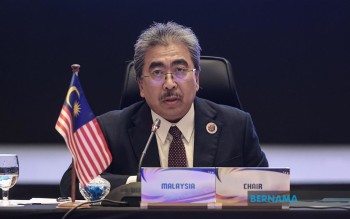
Malaysia's Investment, Trade and Industry Minister Datuk Seri Johari Abdul Ghani has delivered a stark warning that the World Trade Organization risks becoming obsolete unless it fundamentally adapts to the realities confronting the global economy today. Speaking at the 39th Asia-Pacific Roundtable in Kuala Lumpur on June 30, Johari emphasised that an institution created to dismantle trade barriers and expand market access must now grapple with an entirely transformed international landscape shaped by geopolitical rivalry, supply chain fragility and the race for technological dominance.
The WTO, established during an era when free trade was seen as the primary engine of prosperity and stability, now operates in a world where governments prioritise resilience and self-sufficiency alongside commercial openness. Johari's remarks signal Malaysia's recognition that the rules-based multilateral trading system, while still valued, requires significant evolution to remain credible and effective. Without such adaptation, he warned, the WTO faces the genuine risk of gradual irrelevance as nations increasingly turn to bilateral agreements, regional blocs and protective measures that sit uneasily within the institution's existing framework.
The fundamental shift Johari identified reflects a broader reordering of economic priorities across developed and developing nations alike. Where previous decades emphasised market liberalisation and the removal of tariff walls, contemporary policymaking now revolves around securing critical supply chains, maintaining leadership in emerging technologies and preserving what officials call strategic autonomy. This pivot away from pure market opening reflects hard lessons learned from pandemic disruptions, semiconductor shortages and the realisation that over-reliance on globalised manufacturing networks can pose national security risks. The minister's emphasis on how "the debate has shifted from opening markets to how strategic capabilities should be protected" encapsulates this fundamental recalibration.
Johari called explicitly for the WTO to strengthen its capacity to police discriminatory trade practices wherever they materialise. This is particularly salient for Malaysia and other middle-income trading nations that often find themselves vulnerable to protectionist measures disguised as public policy by larger economies. The multilateral system's credibility depends on its ability to enforce consistent rules that prevent powerful countries from using non-tariff barriers, industrial subsidies or state-owned enterprise advantages to distort competition unfairly. Without robust mechanisms to address such practices, smaller economies lack the leverage to challenge the major powers individually.
The minister underscored that credible multilateral rules have arguably become more essential than ever, not less. In an era of intensifying strategic competition between major powers, the absence of clear, binding frameworks raises the likelihood that economic disputes will escalate into broader geopolitical conflict. The WTO's core function as a mechanism for managing trade tensions through transparent dispute resolution procedures and agreed-upon standards takes on heightened importance precisely because bilateral relationships have become more fraught. Yet the institution can only fulfil this stabilising role if it demonstrates the agility to address contemporary economic challenges rather than retreating into outdated doctrines.
Malaysia's position as a Southeast Asian nation deeply embedded in global supply chains gives the country particular stake in WTO modernisation. As a major manufacturing hub and trading partner for both developed and developing nations, Malaysia benefits from an open, predictable trading environment but also faces pressure from supply chain realignment and strategic decoupling initiatives. The country's own economic security depends partly on a functioning system that can mediate disputes and reduce uncertainty in international commerce. Johari's emphasis that Malaysia reaffirms support for the multilateral system while insisting it evolve demonstrates Kuala Lumpur's pragmatic approach to navigating these tensions.
The timing of Johari's remarks at the Asia-Pacific Roundtable is significant, given that the conference convenes policymakers, diplomats, military officials, academics and business leaders to address the geopolitical and economic challenges shaping the region. The conference theme, "Accelerating Agency and Action," suggests that countries across Asia-Pacific increasingly feel they must shape global institutions rather than simply accept them as fixed. Johari's speech reflects this expectation that medium-sized Asian powers like Malaysia must articulate clearly what kind of WTO they want to see emerge, rather than passively observing as larger economies reshape the system unilaterally.
The challenge for the WTO in modernising lies in balancing competing demands. The institution must accommodate legitimate concerns about supply chain security and technological competition without abandoning the fundamental principles of non-discrimination and transparent rules that give smaller trading nations a voice in the system. This requires sophisticated institutional design that allows countries to take certain measures for genuine security reasons while preventing abuse of such exceptions. It also demands that the WTO's dispute resolution process remain swift and accessible to all members, not just wealthy nations with extensive legal resources.
For Southeast Asia more broadly, the fate of WTO modernisation carries profound implications. The region has benefited enormously from the relatively stable, rules-based trading system that allowed countries of vastly different development levels to integrate into global commerce. Further fragmentation of the global trading system into competing blocs would threaten the region's development model and could force ASEAN nations into uncomfortable geopolitical choices between major powers. This makes Johari's call for WTO reform not merely an institutional housekeeping matter but a strategic priority for regional stability and prosperity.
The pathway forward remains uncertain. Major WTO members hold divergent views on how deeply the institution should reform, with some seeing recent developments as temporary aberrations best addressed through existing mechanisms, while others argue fundamental restructuring is essential. Malaysia's intervention, voiced by a minister with direct responsibility for trade policy, adds weight to the argument that member states across the developing world increasingly view WTO modernisation as non-negotiable. The coming months and years will reveal whether major powers prove willing to undertake the difficult political negotiations necessary to adapt this 30-year-old institution to serve the vastly different world it now inhabits.

