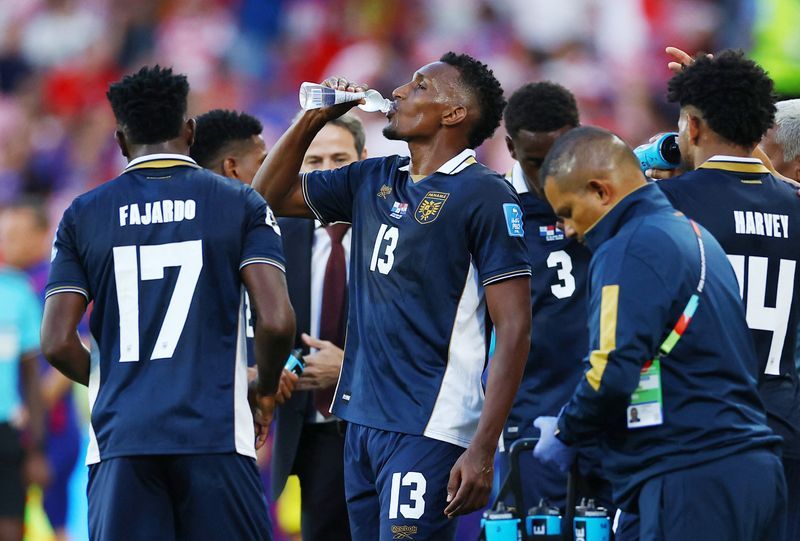
FIFA president Gianni Infantino has pushed back against accusations that mandatory hydration breaks at the World Cup serve primarily commercial interests, asserting instead that the governing body introduced the measure purely to safeguard player welfare in challenging climatic conditions across North America.
The three-minute stoppages, implemented at fixed intervals during the 22nd and 67th minutes of all tournament matches, have generated considerable controversy since the opening fixtures. Critics ranging from elite coaches to supporters have questioned whether the breaks fundamentally compromise the sport's integrity, even as broadcasters benefit from additional advertising slots created by the extended interruptions.
Infantino rejected the notion that FIFA stands to gain financially from the breaks. He stated categorically that all commercial agreements underpinning the tournament were finalised well before the hydration break protocol was established, meaning the measure generates no incremental revenue for the federation. This clarification directly addresses speculation that FIFA designed the breaks to accommodate broadcaster demands for expanded advertising windows during match action.
The defence becomes necessary because the breaks have created unexpected opportunities for television networks to insert commercials, intensifying scrutiny of FIFA's motivations. Viewers across multiple markets have complained about commercial interruptions during these mandatory pauses, raising questions about whether player protection became a convenient justification for a commercially-driven initiative. Infantino's statement attempts to sever this perceived link between sporting measures and profit motives.
Beyond the revenue debate lies a more substantial sporting controversy. The breaks permit coaching staff to deliver tactical instructions and make strategic adjustments during live play, a significant departure from football's traditional continuous flow. Several high-profile managers have publicly expressed concern that this opportunity fundamentally alters how matches unfold. England's Thomas Tuchel characterised the breaks as disrupting the sport's essential nature, while Uruguay coach Marcelo Bielsa argued that fragmenting matches into shorter, interrupted segments strips away football's defining characteristic of uninterrupted play.
Yet not all elite voices dismiss the innovation. Spain coach Luis de la Fuente and Netherlands captain Virgil van Dijk have acknowledged the safety rationale behind hydration breaks in genuinely extreme heat, though both have questioned whether the measure remains necessary in cooler conditions or when matches occur in climate-controlled venues. This nuanced position suggests the underlying idea has merit, even if implementation could be more flexible or contextual.
Infantino elaborated on the practical realities confronting tournament organisers. The World Cup spans 39 days with competing teams potentially playing as many as eight matches within that window. The cumulative physical toll intensifies dramatically under these compressed schedules, particularly in hot climates. From this perspective, mandated rest moments serve a genuine physiological function rather than representing theatrical pauses. Players accumulate fatigue across multiple games, and the breaks provide essential opportunities for physical recovery and mental reset during demanding stretches.
Equity considerations also feature prominently in FIFA's reasoning. Infantino emphasised that ensuring uniform conditions across all matches remains paramount. Without standardised breaks, coaches operating in hotter venues would enjoy tactical advantages unavailable to their counterparts in cooler settings. One coach might exploit heat-induced fatigue to implement game-altering substitutions or formation changes, whilst another competing in milder temperatures operates under different constraints. This inconsistency would introduce unfair variables into the competition's fundamental structure.
Infantino further contended that the breaks have not diminished match intensity or player performance standards. According to FIFA's assessment, teams have maintained competitive vigour throughout matches despite the stoppages, suggesting the breaks function primarily as recovery mechanisms rather than momentum-disrupting impositions. This claim warrants scrutiny from independent analysts, but the argument addresses concerns that hydration breaks undermine the sport's excitement and intensity.
For Malaysian and Southeast Asian football enthusiasts, this debate carries particular relevance. The region frequently experiences intense heat and humidity during international fixtures, making player welfare during such conditions genuinely significant. If FIFA's protocols prove effective in managing these environmental challenges safely, similar measures might eventually inform how tournaments across Asia approach fixture scheduling and player management.
The broader tension underlying this controversy reflects football's evolving relationship with commercialisation and technology. The sport increasingly accommodates administrative, safety, and broadcast requirements that interrupt traditional match flow. While hydration breaks serve legitimate health purposes, their bundling with commercial opportunities inevitably generates cynicism among supporters who question whether player welfare or profit maximisation drives policy changes. Infantino's defence, despite its logical coherence, struggles against this accumulated scepticism. Trust in such reassurances ultimately depends on whether observable outcomes validate FIFA's stated priorities, a judgment fans, coaches, and players continue forming as the tournament progresses.