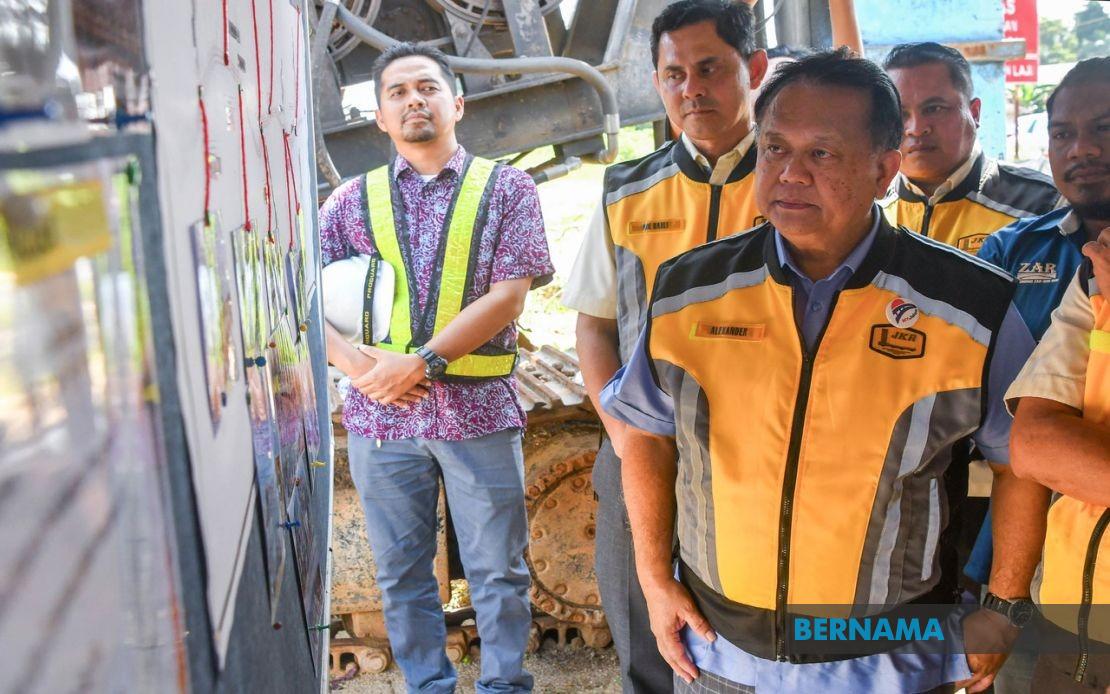
The Ministry of Works is ramping up efforts to bring stalled infrastructure projects back on track, with Works Minister Datuk Seri Alexander Nanta Linggi disclosing that 50 of approximately 865 projects under the ministry's management have been classified as "sick" and require intensive monitoring. The revelation came during a site visit to the FT209 and FT131 road upgrading project in Kota Bharu, underscoring the government's commitment to tackling project delays that have accumulated across the nation and are impacting delivery timelines.
The minister's statement provides a sobering snapshot of implementation challenges facing Malaysia's public infrastructure agenda. From the 865 projects managed by the ministry, the identification of 50 problematic cases represents roughly six percent of the overall portfolio—a significant proportion that reflects the complexity of managing large-scale development initiatives. In Kelantan alone, where the minister was visiting, only seven of the 104 Works Ministry projects have encountered serious difficulties, suggesting regional variation in project performance and suggesting that implementation challenges are unevenly distributed across different states.
The causes of project delays are multifaceted and reveal systemic vulnerabilities in Malaysia's infrastructure delivery model. Nanta identified contractor financial instability and management deficiencies as primary culprits, alongside complications from land acquisition processes that frequently exceed initial timelines. Utility relocation—the complex task of moving water, electricity, and telecommunications infrastructure—has also emerged as a persistent bottleneck. Perhaps most revealing are unforeseen site conditions, including underground obstructions not detected during planning stages, which suggests that some projects are proceeding with incomplete geological and environmental surveys, forcing costly and time-consuming rework once construction begins.
The ministry's response strategy demonstrates a nuanced approach to project rehabilitation that balances completion objectives with fiscal prudence. Rather than automatically terminating underperforming contracts, officials are adopting a graduated response that considers the proximity of projects to completion. When a project is nearing the finish line with only ten to fifteen percent of work remaining, the ministry may grant extensions of time rather than incur the substantially higher costs associated with contract termination and appointing replacement contractors. This pragmatic stance reflects lessons learned from previous costly project restarts, though it also raises questions about whether deadline extensions inadvertently enable contractor underperformance.
Governance and oversight mechanisms have been restructured to enhance monitoring effectiveness. Weekly reviews of delayed projects now occur following post-Cabinet meetings, introducing regular touchpoints into the project management cycle. The deputy minister has been tasked specifically with supervising the monitoring apparatus, creating a dedicated oversight channel distinct from routine administrative functions. This institutional reorganisation suggests that previous monitoring efforts may have lacked sufficient senior-level engagement or regular structured review processes.
The ministry has signalled a willingness to enforce consequences for persistent non-performance. Projects that continue to deliver unsatisfactory results face the prospect of contractor removal or contract termination. However, Nanta stressed that any decision to terminate must be executed carefully and in strict accordance with governance protocols to mitigate legal exposure. This caveat is significant; it acknowledges that Malaysia's contractual environment involves substantial litigation risk when projects are terminated, potentially making enforcement more difficult than policy statements suggest.
The FT209 and FT131 road upgrading initiative, a RM191 million undertaking in Kelantan, exemplifies both progress and complications facing major transport infrastructure projects. Connecting Pasir Hor interchange to Panchor, the six-kilometre project has achieved 71.61 percent physical progress, indicating substantial advancement but also suggesting completion remains months away despite scheduled delivery in September 2025. The project's objective—alleviating chronic traffic congestion along Federal Road FT131, particularly the Kubang Kerian to Sabak to Pengkalan Chepa corridor—addresses a genuine transportation bottleneck affecting daily commuters and commercial activity in the region.
Land acquisition has emerged as a particularly resource-intensive component of this project. The acquisition of 300 property lots has required more than RM200 million in compensation, representing approximately a quarter of the total project value and underscoring how property-related expenses frequently consume disproportionate shares of transport infrastructure budgets in Malaysia. These figures highlight why land acquisition delays can dramatically impact overall project timelines and budgets; the process involves multiple stakeholders with divergent interests and limited incentives to expedite resolution.
Unexpected environmental complications have surfaced during construction, demonstrating how large-scale works can generate secondary impacts requiring midstream interventions. Flooding affecting residents adjacent to the project site prompted intervention from Pengkalan Chepa Member of Parliament Datuk Dr Ahmad Marzuk Shaary, who requested mitigation measures. The contractor has been instructed to construct a temporary 40-metre drainage channel immediately, with permanent solutions scheduled for implementation upon project completion. This reactive approach to environmental management, while addressing urgent resident concerns, suggests that drainage and environmental impact assessments may not have been sufficiently comprehensive during the design phase.
For Malaysian infrastructure stakeholders, this disclosure of widespread project delays carries important implications. The identification of 50 troubled projects signals that implementation challenges are endemic rather than isolated, potentially affecting public confidence in the government's ability to deliver infrastructure within promised timeframes and budgets. The emphasis on weekly monitoring and structured oversight may gradually improve performance, but sustained improvement requires addressing root causes rather than merely intensifying supervision of existing problems.
The regional significance extends beyond Malaysia's borders. Other Southeast Asian nations grappling with similar infrastructure delivery challenges can extract lessons from the ministry's experience. The combination of contractor capacity issues, land acquisition complications, and inadequate pre-construction surveying reflects problems common across the region. Malaysia's systematic identification of problematic projects and institution of regular monitoring protocols represents a step toward evidence-based project management, potentially offering a model that neighbouring countries could adapt to their own circumstances.
Looking forward, the ministry faces pressure to demonstrate tangible improvement in project delivery over coming quarters. The weekly monitoring regime, while administratively burdensome, provides regular data points that will either validate the ministry's remedial approach or expose persistent structural obstacles. Success will require not merely closer supervision but potentially deeper reforms in contractor selection processes, pre-construction planning standards, and dispute resolution mechanisms. Without such foundational improvements, intensified monitoring alone risks becoming an exercise in managing failure rather than preventing it.

