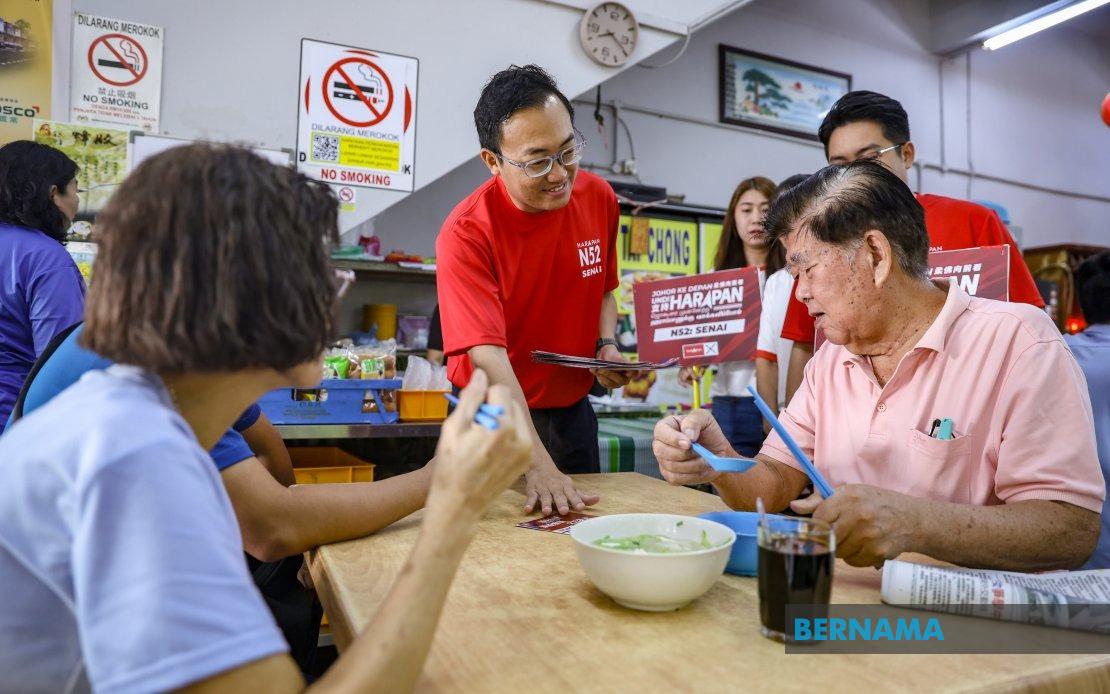
Wong Bor Yang, the Pakatan Harapan assemblyman for Senai, is heading into the July 11 Johor state election with confidence rooted in tangible infrastructure achievements from his previous term. Speaking in Kulai, Wong outlined his strategy to retain the constituency against Barisan Nasional's Tai Chee Chee and independent Bersama candidate Tew Chien How in what promises to be a closely watched three-cornered contest across the 66,635-registered-voter seat.
The former journalist's pitch centres on a transition from opposition activism to delivery-focused governance. Between 2014 and his election as state assemblyman, Wong accumulated experience across multiple political configurations—serving as a special officer in the Kulai MP's office, joining local government as a councillor in 2018, and eventually securing the Senai mandate. This patchwork of roles forms the foundation of his argument that he brings practical problem-solving credentials rather than ideological rigidity to constituency work.
Flood management emerges as Wong's flagship achievement. The Senai constituency has historically struggled with seasonal inundation, a perennial frustration for residents in a region vulnerable to flash flooding. Wong's approach combined parliamentary advocacy with ground-level coordination. Even while Pakatan Harapan was in opposition during his early tenure, he utilised state assembly debates and petitions to maintain pressure on government agencies. This persistence yielded state funding of RM1 million for drainage upgrades in Taman Aman, channelling stormwater into Sungai Skudai. More significantly, a partnership with Kulai MP Teo Nie Ching secured an additional RM3 million for two drainage improvement projects in Peladang Kulai Besar and Saleng—works substantial enough to remove both localities from the district's official flood-risk register.
Beyond technical infrastructure, Wong has positioned heritage preservation and community amenities as part of his broader development narrative. He converted a defunct cinema into a community operations centre and rehabilitated a two-decade-old badminton court into a recreational facility branded Tiny Lake under the Sejati MADANI programme. These initiatives reflect a softer dimension of constituency representation—acknowledging that electoral politics increasingly demands visible symbols of progress alongside functional improvements.
Healthcare shortages now dominate Wong's second-term agenda. A graduate of Shih Hsin University in Taiwan, Wong has adopted the language of capacity planning and demographic forecasting to strengthen his case for hospital expansion. Kulai Hospital's current 93-bed inventory, he argues, becomes inadequate as the district's projected population approaches 500,000 by 2030. This argument connects local grievances to broader development trajectories, framing healthcare as an infrastructure imperative rather than a sectoral complaint. He has also flagged a stalled Health Clinic project in Taman Mewah, attributing delays to state-level land-administration bottlenecks that obstruct the Health Ministry's construction timeline.
Wong's campaign strategy relies heavily on appealing to what he characterises as a politically discerning Johor electorate. He contends that voters in the state have matured beyond susceptibility to rhetorical flourishes, preferring candidates with demonstrable records. This framing implicitly acknowledges the competitive environment created by three-cornered contests, where vote-splitting can determine outcomes. In a constituency where around 66,000 voters hold decisive power, Wong's emphasis on concrete achievements—RM1 million plus RM3 million in approved drainage work, heritage site conversions, recreational facility upgrades—serves as a quantifiable counter to unspecified promises.
The timing of the 16th Johor state election reflects the broader political calendar shaping Malaysia's electoral landscape. Scheduled for July 11 with early voting on July 7, the contest occurs as federal politics remains fluid following the 2022 general election. Johor, as the nation's second-most-populous state and a historically significant political battleground, attracts national attention. The presence of three major contenders in Senai mirrors broader fragmentation in Malaysian electoral politics, where Pakatan Harapan, Barisan Nasional, and various independent or splinter-group candidates compete for legitimacy.
Wong's narrative also reflects generational shifts within Malaysian political representation. His experience spanning opposition and government roles, combined with technical expertise rooted in journalism and administrative background, positions him within a cohort of younger-generation assemblymen attempting to redefine constituency representation around delivery metrics rather than party loyalty. This approach carries particular resonance in urban and semi-urban constituencies like Senai, where voters increasingly expect granular responsiveness to local infrastructure deficits.
The flood-management emphasis gains additional significance within the Southeast Asian context. As climate science forecasts intensified precipitation patterns across the region, constituency-level drainage infrastructure becomes a tangible policy differentiator. Wong's detailed recitation of RM4 million in approved projects signals to voters that he understands the political economy of resource allocation and possesses the political networks necessary to translate constituent grievances into budgetary approvals. This contrasts with candidates relying purely on electoral promises.
Looking ahead, Wong's healthcare reform agenda suggests that Johor state-level governance will increasingly grapple with service-delivery expectations aligned to population growth projections. The argument that Kulai Hospital requires expansion to accommodate a projected 500,000-strong district population reflects rational planning discourse gaining traction among Malaysian voters fatigued by vague political rhetoric. By anchoring healthcare demands to demographic data, Wong attempts to transcend partisan frameworks and position himself as a technocratic operator capable of navigating state and federal bureaucracies.
The contest arrives at a juncture when Malaysian political observers are scrutinising whether Johor's traditionally dominant Barisan Nasional coalition retains sufficient electoral machinery to command state politics or whether Pakatan Harapan can consolidate recent gains. Wong's candidacy offers a test case: a sitting assemblyman with documented infrastructure achievements, facing new challengers in a three-way race across a constituency where no candidate enjoys overwhelming predisposition. The July 11 outcome will signal whether Senai voters reward incumbency based on record, or whether they opt for alternative candidates promising fresh approaches to long-standing regional challenges.

