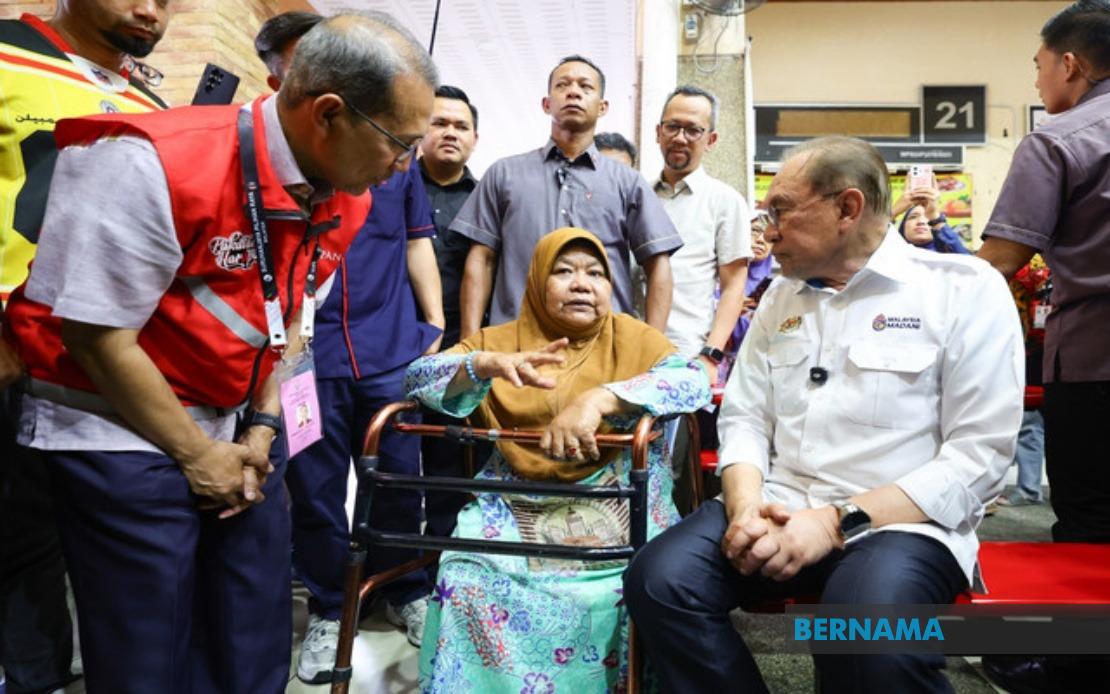
Determination and hope overcame the obstacles of weather and physical limitation when 68-year-old Jumaah Mohd Alif navigated her three-wheeled motorcycle from Kampung Gedung Lalang to Benteng Ampangan in Seremban on July 22, defying drizzle to realise a deeply personal ambition. The encounter marked a watershed moment for the woman who has lived with significant physical challenges, having lost her left leg in an accident three decades earlier, yet remained resolved to seize an unexpected opportunity when it presented itself.
Jumaah's spontaneous journey was prompted by word from fellow villagers that Prime Minister Datuk Seri Anwar Ibrahim would be visiting Ampangan as part of Pakatan Harapan's sustained push to consolidate electoral momentum during the Negeri Sembilan state election campaign. What began as neighbourhood gossip crystallised into action for someone whose previous encounters with the nation's leader had been limited to distant sightings or television broadcasts. The decision to venture out in unfavourable conditions underscored the significance of this particular moment in her life, something she acknowledged she would treasure indefinitely.
For Jumaah, the prospect of face-to-face engagement with Malaysia's highest-ranking elected official represented far more than a ceremonial handshake or photograph. She articulated her perspective with clarity to news reporters, noting that her vision had finally transitioned from fantasy into lived experience. The contrast between her prior relationship with Anwar—mediated through screens and distance—and the immediacy of personal interaction encapsulated a shift from passive observation to active participation in the nation's political narrative. In contemporary Malaysia, where citizens often feel disconnected from leadership structures, her determination to bridge that gap carried symbolic weight.
Anwar's presence in Negeri Sembilan was strategically timed within the state election cycle, serving the coalition's broader organisational objectives rather than occurring in isolation. As both Prime Minister and chairman of Pakatan Harapan, his campaign appearances functioned on multiple levels: reinforcing the coalition's commitment to the state, demonstrating national leadership engagement with local constituencies, and providing the visual imagery that contemporary electoral politics demands. The unscheduled encounter with Jumaah, while unplanned from the campaign's perspective, exemplified the unpredictability that sometimes accompanies grassroots political engagement.
Jumaah's circumstances deserve particular attention within Malaysia's ongoing conversation about disability inclusion and welfare provisions. At 68 years old, she occupies an intersection of vulnerabilities—advancing age, physical disability, and presumably limited economic resources given her rural residence. Her continued reliance on a three-wheeled motorcycle for mobility speaks to both her independence and the practical realities facing many Malaysians with disabilities who lack access to more sophisticated transportation solutions. The rain-dampened journey itself became a metaphor for the obstacles that persons with disabilities navigate routinely, often without public recognition or acknowledgment.
Beyond the personal narrative, Jumaah's encounter raises substantive questions about government responsiveness to marginalised communities. Her articulated hope that the administration would prioritise welfare for senior citizens and persons with disabilities reflected not merely personal aspiration but broader concerns within these demographic groups about their place in national policy priorities. Malaysia's aging population and growing disability advocacy movements have prompted increased parliamentary discussion about pension adequacy, healthcare accessibility, and social support infrastructure, yet gaps remain between policy rhetoric and ground-level reality. Jumaah's presence at Ampangan served as an implicit reminder that political messaging must translate into tangible improvements in lived experience.
The Election Commission's scheduling of early voting for July 28 and election day for August 1 established the temporal framework within which Anwar's campaign activities occurred. These dates maintained momentum during what Malaysian observers recognised as a consequential state-level contest that would test the governing coalition's resilience in a competitive electoral environment. Negeri Sembilan had historically hosted competitive elections, and the state-level campaign represented a microcosm of broader political dynamics shaping the Malaysian electoral landscape in 2024. Anwar's active participation in on-ground campaigning signalled the national significance attributed to these state-level contests.
Jumaah's agency in seeking out the Prime Minister rather than waiting passively for political mobilisation demonstrates an understated but important characteristic often overlooked in coverage of political campaigns: the initiative that ordinary citizens sometimes exercise in engaging with leadership structures. Rather than remaining in her village waiting for politicians to visit, she made a deliberate choice to expend effort and overcome discomfort to participate in this moment. This active engagement, however modest in scale, contradicts narratives suggesting that Malaysian voters are purely passive recipients of political messaging.
The rural-urban dimension merits consideration as well. Kampung Gedung Lalang, as a village locality, presumably lies outside the metropolitan corridors where national political engagement concentrates disproportionately. Jumaah's necessity to travel to Ampangan to encounter the Prime Minister underscores persistent geographic inequities in political access. Rural constituencies in Malaysia often experience reduced frequency of high-level political engagement, meaning that when national leaders do visit, the occasions carry heightened significance for residents. Her willingness to navigate distance, weather, and physical challenge reflected an awareness that such opportunities might not recur frequently.
The broader implications for Malaysian electoral politics extend beyond this single encounter. Jumaah's story resonates with ongoing debates about inclusive governance, the accessibility of political processes for citizens facing multiple disadvantages, and the symbolic dimensions of political leadership. When a woman with significant physical limitations makes considerable effort to meet the Prime Minister, it prompts reflection on whether contemporary political structures adequately facilitate such engagement or whether the burden of access remains primarily on citizens rather than on institutions. The Negeri Sembilan state election, like all electoral contests, would ultimately depend on aggregated decisions by voters like Jumaah, whose motivations and expectations shaped the political landscape they inhabited.

