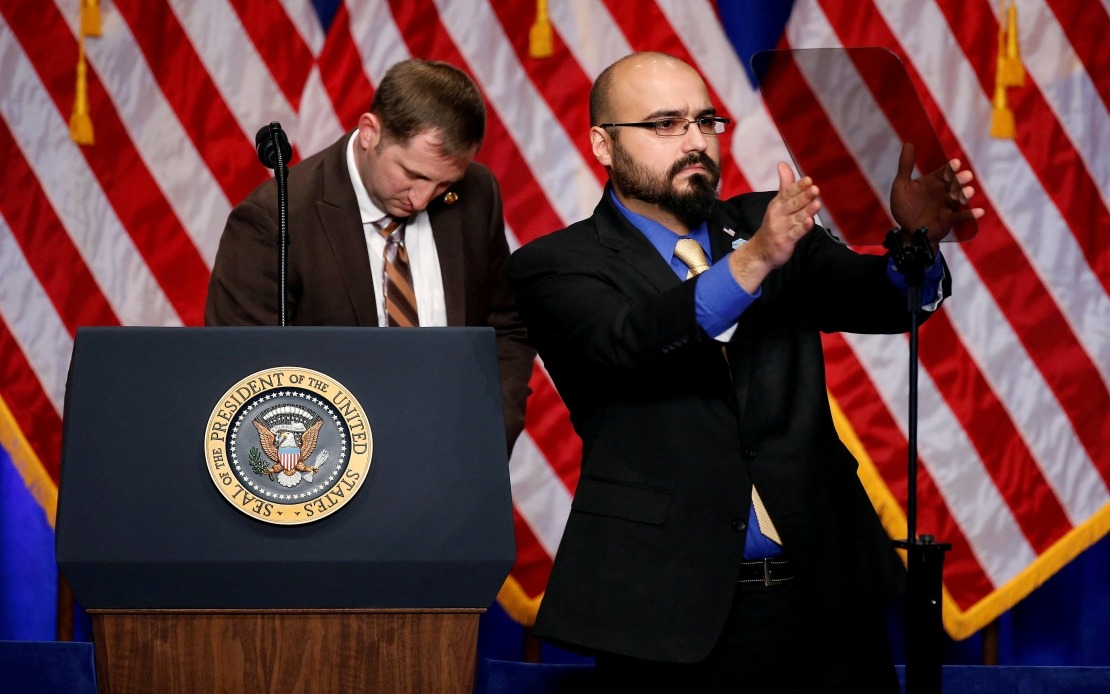
The White House has placed a long-serving teleprompter operator on unpaid leave after discovering he allegedly used confidential information about President Donald Trump's speeches to place lucrative bets on prediction markets, according to announcements made on Thursday. White House press secretary Karoline Leavitt characterised the matter as troubling, stating that Trump had been informed of the situation and describing it as both "deeply unfortunate and frankly a disgrace." The development raises serious questions about operational security within the highest levels of American government and highlights the evolving risks posed by online betting platforms.
The operator, who has managed Trump's teleprompter since 2016, stands accused of leveraging his privileged position to place wagers exceeding $100,000 on the Kalshi platform, a prediction market service that allows users to gamble on the outcomes of real-world events. Access to advance knowledge about presidential speech content—including major policy announcements, tone, and delivery—represents extraordinarily valuable insider information that could dramatically influence betting outcomes. The scheme, if verified, represents a stark breach of the trust placed in individuals who work in such intimate proximity to executive decision-making and communication.
Kalshi, the platform hosting these transactions, moved swiftly to address the impropriety. Robert DeNault, the company's lawyer and head of enforcement, disclosed that Kalshi had promptly detected the suspicious trading patterns, conducted its own investigation, and referred the matter to the Commodity Futures Trading Commission (CFTC), the federal regulator overseeing prediction markets and derivatives trading. DeNault stated on X that the platform had "promptly" flagged, investigated, and forwarded all available evidence to authorities, emphasising that Kalshi maintains protocols for identifying and reporting potentially illicit trading activity.
The involvement of the CFTC signals the seriousness with which federal authorities are treating the allegations. Prediction markets have grown substantially in recent years, offering Americans a legal outlet for wagering on political outcomes, sporting events, and other real-world developments. However, this case demonstrates a critical vulnerability: individuals with access to non-public information can exploit these platforms in ways that undermine market integrity and constitute potential insider trading violations. The CFTC must now determine whether criminal statutes or regulatory penalties apply, and whether the individual exploited protected information in violation of federal law.
For Malaysian observers and Southeast Asian policymakers, the incident underscores the complex regulatory challenges posed by digital betting and prediction platforms. As such services expand their global reach, questions arise about how emerging markets should oversee these platforms and protect their citizens from fraudulent or manipulative trading. Malaysia's own regulatory environment for online wagering remains tightly controlled, with state-sanctioned lottery operators dominating legal betting activities. This American case demonstrates why jurisdictions maintaining stricter oversight may have good reasons for doing so—the convergence of real money, inside information, and digital markets creates opportunities for abuse that require vigilant enforcement.
The teleprompter operator's tenure dating to 2016 means he has held access to sensitive White House communications across multiple administrations and policy cycles. His proximity to speeches representing everything from economic announcements to security decisions makes the breach particularly consequential. Teleprompter operators occupy a unique position in modern political communication, present for the technical delivery of major addresses but typically viewed as invisible technical staff. This case reveals that even support roles in government require robust vetting, ongoing monitoring, and clear ethical guardrails regarding personal financial activities.
The scale of alleged winnings—exceeding $100,000—suggests this was not an isolated betting flutter but rather a systematic effort to monetise insider access. Prediction markets typically require accurate forecast models and information advantages to consistently generate such substantial returns. The operator's apparent success in accumulating such winnings over time points to repeated exploitation of his knowledge rather than chance or isolated incidents. Such patterns would naturally trigger algorithmic alerts at any responsible betting platform, explaining how Kalshi detected the activity.
The suspension without pay represents an immediate consequence, but the investigation by CFTC and potentially other agencies will determine whether criminal prosecution or civil penalties follow. Depending on the applicable statutes, the operator could face charges related to wire fraud, theft of government information, money laundering, or violation of insider trading principles adapted to the prediction markets context. The outcome will likely establish important precedent for how federal law applies to insider information exploited through digital betting platforms.
This incident also raises questions about workplace vetting and ongoing compliance monitoring across government. Employees with access to confidential information, particularly those in roles requiring discretion, typically undergo background checks and sign agreements acknowledging their obligations regarding classified or sensitive material. Whether those protections extended adequately to this operator and whether supervisory systems detected warning signs remains unclear. The White House will likely conduct broader reviews of security protocols surrounding sensitive communications and the individuals granted access to advance knowledge of major presidential statements.
For international observers, the case demonstrates that sophisticated insider trading schemes continue evolving in tandem with technology. As prediction markets proliferate and traditional financial markets modernise, regulators worldwide must maintain corresponding sophistication in detecting and prosecuting manipulation. The cooperation between Kalshi and the CFTC reflects best practices in financial regulation—private platforms identifying problems and promptly involving authorities. However, countless other platforms and jurisdictions may lack comparable compliance infrastructure, creating gaps that bad actors might exploit.

