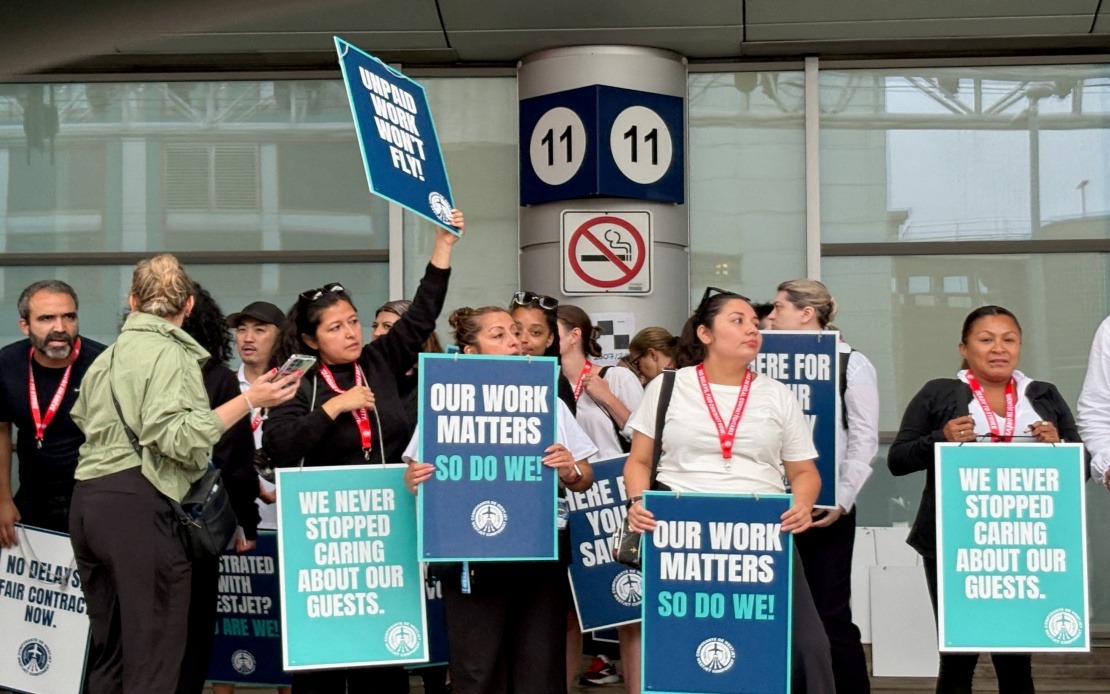
Canada's aviation sector faced significant disruption this week as WestJet, the country's second-largest carrier, came to a standstill following a strike action initiated by its flight attendants. Beginning on Sunday, the walkout involved more than 4,000 members of the Canadian Union of Public Employees, immediately grounding approximately 600 daily flights and cascading into chaos for roughly a quarter million travellers whose journeys hung in the balance.
The timing of the strike could hardly have been more consequential. Monday marks a civic holiday in Canada, transforming the weekend into one of the year's busiest travel periods when Canadians traditionally embark on summer vacations and long-distance journeys. Airlines typically operate at peak capacity during such windows, making the sudden halt to WestJet's operations particularly damaging not only to passengers but to tourism operators, hospitality businesses, and connecting services across multiple regions.
Financially, the impact on WestJet is expected to be severe. Industry analysts anticipate the airline will incur losses running into millions of dollars with each passing day of disruption. Beyond immediate revenue loss from cancelled flights, the carrier faces potential compensation obligations to stranded passengers, operational inefficiencies when services resume, and damage to customer confidence and brand reputation during a critical summer travel season.
At the heart of the dispute lies a compensation question that has become increasingly prominent across North American aviation. Flight attendants are demanding payment for work performed on the ground, specifically during the periods immediately before aircraft departure and following landing. Historically, many airlines have not compensated crew members for these ground duties, treating them as ancillary to the main flight operation. However, this position is shifting as industry standards evolve and labour unions successfully negotiate improved terms.
The precedent for such payments already exists in the North American aviation landscape. Delta Air Lines became a pioneer in this regard during 2022, introducing compensation structures for ground work that challenged the conventional industry model. Air Canada, Canada's largest carrier, subsequently adopted similar provisions in February of this year following successful contract negotiations with its own flight attendants. These developments have effectively established a new benchmark for compensation in the sector, placing WestJet under pressure to align its offerings with competitor terms.
Under WestJet's current compensation framework, flight attendants earn hourly rates spanning from $28.88 to $53.61 per credit hour, depending on seniority and other factors. By contrast, Air Canada's recently negotiated agreement provides flight attendants with compensation reaching up to 70 per cent of their hourly rate for the hour preceding takeoff, effectively recognising pre-flight work as remunerated labour rather than unpaid preparation time.
The union's perspective on the impasse reflects frustration accumulated over an extended negotiating period. Alia Hussain, representing the Canadian Union of Public Employees, indicated that the union would not have pursued strike action had WestJet management demonstrated genuine responsiveness to crew concerns throughout the bargaining process. The union's statement pointed to nearly 11 months of negotiations without reaching an acceptable agreement, suggesting that fundamental disagreement remained unresolved and that management had not treated worker demands with appropriate seriousness.
For Malaysian and Southeast Asian observers, this labour dispute carries relevance beyond the Canadian context. The region's rapidly expanding aviation sector has experienced similar tensions between airlines seeking to control operational costs and flight crew unions advocating for improved working conditions and fair compensation. The precedents being established in North America regarding ground work compensation may eventually influence labour negotiations in Southeast Asia, where airline workforces are increasingly organised and aware of international standards.
WestJet's management acknowledged the operational and reputational damage while defending its position. Chief Executive Officer Alexis von Hoensbroech expressed disappointment at the failure to reach agreement, emphasising how the strike affected not only passengers but also the airline's own staff and the broader business ecosystems dependent on the carrier's operations. The airline committed to processing refunds for affected passengers, a necessary step to maintain customer relations during the disruption.
Federal Jobs Minister Patty Hajdu responded to the strike by voicing disappointment that negotiators from both labour and management failed to achieve a settlement through what she characterised as serious bargaining efforts. Her intervention reflected the Canadian government's concern about labour disputes affecting essential transportation infrastructure and significant numbers of citizens during peak travel periods.
The resolution of this strike carries implications for Canada's aviation landscape beyond WestJet. Should the airline ultimately concede on ground work compensation to bring attendants back to work, it would validate the union's negotiating position and potentially trigger similar demands across the sector. Conversely, if WestJet successfully resists such demands, it may strengthen the airline's cost position but risks provoking prolonged labour unrest and further passenger disruptions.
For passengers and the broader travel industry, the dispute underscores the interconnected nature of modern aviation, where labour relations directly translate into operational disruptions affecting millions. Travel agents, tour operators, and hospitality providers throughout Canada faced cascading cancellations and the complex task of rebooking clients on alternative carriers, many of which were themselves facing surge demand as passengers fled WestJet.
As negotiations continue, the fundamental question remains unresolved: whether ground work constitutes compensable labour or remains part of flight attendants' unpaid responsibilities. The answer will likely shape working conditions and compensation structures for aviation crews across North America in coming years, making this relatively specific labour dispute consequential for the broader sector.

