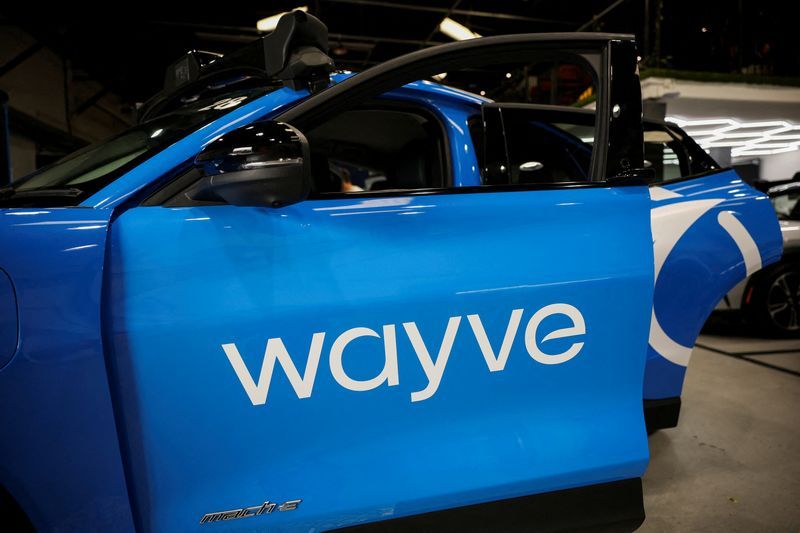
Wayve, a London-based autonomous-driving startup, is capitalising on a surge of investor enthusiasm by securing $2.8 billion in funding from a constellation of heavyweight partners spanning technology and automotive sectors. The backing includes support from chip maker Nvidia, German luxury carmaker Mercedes-Benz, and Japanese automaker Nissan, underscoring confidence in the company's approach to self-driving vehicles. Most recently, Wayve announced plans to integrate its driving system into robotaxis developed by Stellantis, which will operate on Uber's ride-hailing platform—a partnership that signals real-world deployment is accelerating.
At the heart of Wayve's competitive advantage lies its reliance on end-to-end machine learning, an artificial-intelligence methodology that processes sensor data and converts it directly into driving commands, mirroring how human drivers assess and respond to road conditions in real time. This contrasts sharply with traditional autonomous-driving architectures that combine AI with extensive software coding and high-definition mapping to establish predetermined rules governing vehicle behaviour across various scenarios. The conventional approach requires engineers to anticipate and programme responses to countless driving situations, a labour-intensive process that struggles with unforeseen circumstances.
Wayve's technology philosophy shares common ground with Tesla's autonomous-driving strategy, which similarly embraces end-to-end learning. However, the companies diverge fundamentally in their sensor architecture. Tesla's system relies exclusively on cameras for environmental perception, whereas Wayve has designed its platform to integrate seamlessly with diverse sensor suites and multiple AI chip types. This flexibility is strategically significant: it enables Wayve to license its technology to virtually any autonomous-vehicle developer, regardless of their existing hardware infrastructure. CEO Alex Kendall, a 33-year-old New Zealand-born founder who established Wayve in 2017 immediately after completing his doctorate in AI deep learning at Cambridge University, has articulated an ambitious vision. "We want to make full self-driving possible for any vehicle, any brand, and anywhere around the world," he stated during a demonstration in San Francisco Bay Area neighbourhoods, where Wayve maintains substantial technical operations.
The autonomous-driving sector has experienced a meaningful inflection point following years marked by missed timelines and overstated capabilities. Alphabet's Waymo has catalysed renewed investor optimism through its methodical expansion, now offering commercial robotaxi services across approximately a dozen cities after more than a decade of development. This demonstrated progress has rekindled market appetite for autonomous-vehicle companies. A decade earlier, end-to-end learning was confined to academic corridors, pursued by scattered researchers including Kendall himself. Today, numerous autonomous-driving firms have incorporated elements of end-to-end learning into their operational systems.
Yet the shift toward AI-centric driving architectures introduces a significant technical and regulatory challenge: the opacity inherent in end-to-end systems. These algorithms function as "black boxes," making it extraordinarily difficult to trace the logical chain behind specific driving decisions. Earlier-generation autonomous vehicles relying on rule-based software coding provided substantially greater interpretability—engineers could readily articulate why the system selected a particular driving trajectory. Wayve addresses this concern through its proprietary safety framework, which generates dynamic safety maps of evolving traffic scenarios and identifies safe pathways for vehicle navigation. The company's engineering team contends that conventional, programming-intensive safety paradigms actually constrain an AI system's capacity to respond adaptively to highly unusual situations, precisely because humans cannot feasibly code rules anticipating every conceivable edge case.
Vijay Badrinarayanan, Wayve's vice president of AI, articulated this perspective to Reuters: when unanticipated scenarios materialise, pre-programmed safety logic "becomes brittle." Human drivers maintain safety by adopting conservative behaviour when confronted with uncertainty—a principle end-to-end systems attempt to replicate. By contrast, Waymo, despite now incorporating end-to-end learning, continues deploying rules-based architectures alongside AI components. The company maintains that "end-to-end models aren't enough to guarantee safety at scale," reflecting lingering industry scepticism about pure end-to-end approaches.
This safety debate extends into real commercial partnerships. Nissan, planning to deploy Wayve's technology in Japan on its Elgrand people-mover van by March 2028, remains carefully evaluating the system's safety methodology. Eiichi Akashi, Nissan's chief technology officer, acknowledges Wayve's system as "the most advanced" currently available, yet emphasises the challenge: "difficult to peer into it and see how it makes decisions." Such hesitation reflects broader automotive-industry concerns about regulatory acceptance and insurance liability when deploying systems whose decision pathways resist straightforward explanation.
Wayve's commercial model hinges partly on a critical operational advantage: its technology does not require the laborious preliminary step of mapping geographical regions and encoding local road peculiarities into software. Kendall contends this capability enables rapid market expansion into new territories. The company asserts it has successfully validated its system across hundreds of cities worldwide without such preparatory groundwork. With major operations established in Tokyo, Stuttgart, and Vancouver, Wayve is positioned to accelerate deployment across diverse regulatory environments and driving cultures—a potential competitive edge in markets beyond North America.
Academic perspectives on end-to-end learning versus traditional approaches reveal nuanced trade-offs. Siddartha Khastgir, a safe autonomy specialist at the University of Warwick, suggests end-to-end models could accelerate commercial deployment timelines relative to conventional architectures. However, he resists declaring one approach categorically safer than alternatives. Phil Koopman, a Carnegie Mellon University computer-engineering professor and autonomous-vehicle safety expert, notes that Wayve's methodology for managing unusual traffic situations represents one viable pathway among several potential approaches. Yet he projects a decade-long minimum timeline before driverless systems achieve widespread safe deployment across the United States, necessitating continued technological innovations beyond current capabilities. This sobering assessment, from respected safety scholars, contextualises both the genuine progress Wayve and competitors have achieved and the formidable challenges remaining before autonomous vehicles become ubiquitous across global markets.

