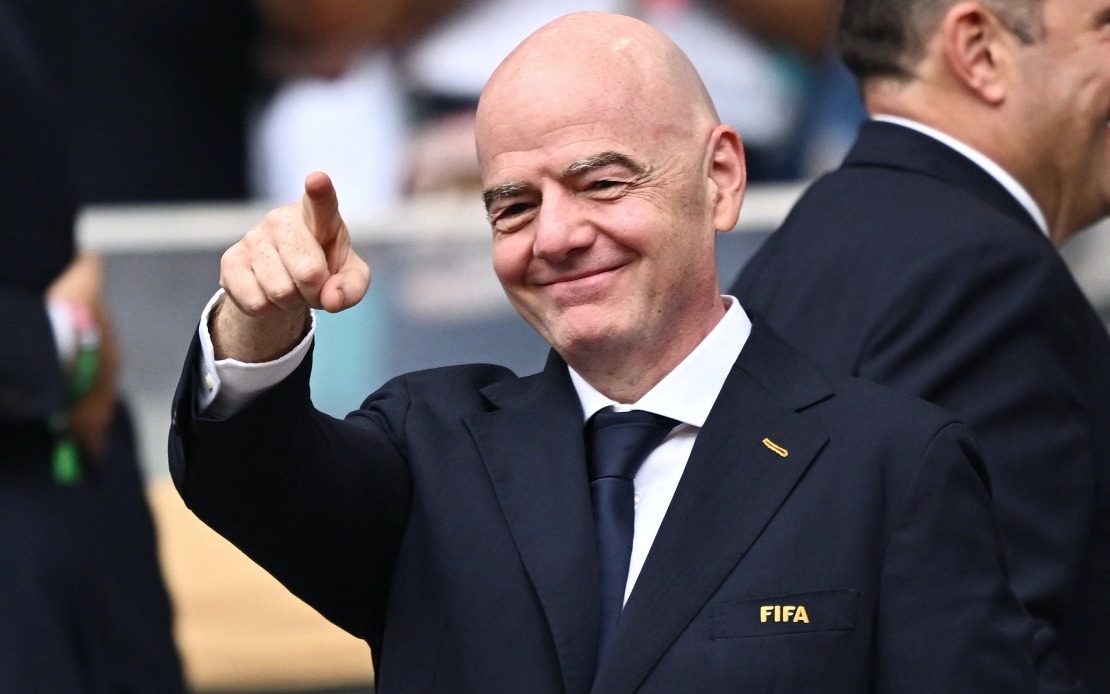
The Football Association of Wales has joined growing international pressure on FIFA president Gianni Infantino by formally withdrawing its backing for his bid to secure another term leading world football's governing body. The decision follows Infantino's failed attempt to establish FIFA Forward Enterprise, a controversial scheme that would have partially privatized the World Cup by selling stakes to private investors. Although Infantino shelved the proposal last week after facing rejection from three continental confederations, the damage to his political standing has proven irreversible among key stakeholders across the sport's global hierarchy.
Infantino's troubled tenure, now in its second decade at FIFA's helm, has come under intense scrutiny from multiple directions. The FAW's formal statement outlined a damning assessment of his leadership, emphasizing that recent failures spanning governance standards, institutional processes, and stakeholder communication had fundamentally eroded trust. The Welsh association specifically noted that Infantino's inability to prioritize the broader interests of global football represented a critical failure they could no longer overlook or tacitly accept through their continued public backing.
The withdrawal represents a significant symbolic blow, particularly given that the FAW had previously indicated conditional willingness to support Infantino's re-election campaign before the FIFA Forward Enterprise controversy erupted into public consciousness. This reversal demonstrates how rapidly political coalitions within international football can shift when governance concerns become prominent enough to overshadow other considerations. The FAW's decision also reflects broader concerns among smaller federations about whether FIFA's institutional direction genuinely serves their interests or primarily benefits larger, wealthier footballing nations.
England's Football Association has similarly moved to distance itself from Infantino, having privately communicated to FIFA that it no longer supports the president's continuation in office. On Saturday, the English FA issued a statement explicitly backing the position taken by UEFA, European football's continental governing body, which emphasized that Infantino had lost the confidence necessary to lead the global sport. This transatlantic alignment between British and European football authorities suggests a coordinated response rather than isolated criticism, amplifying the diplomatic pressure on FIFA's current leadership.
UEFA's response has been particularly significant, as it represents Europe's 55 member associations and maintains considerable influence within FIFA's decision-making structures. The European confederation deliberately avoided categorical language in its Saturday statement, instead noting that "no option should be off the table," a careful phrasing that deliberately preserves the possibility of triggering an extraordinary FIFA Congress through a formal vote of no confidence. Such a vote would require just 43 associations among FIFA's 211 total membership to demand a special assembly where Infantino's presidency could be directly challenged and potentially terminated through democratic process.
The mechanics of FIFA's internal politics suggest that while triggering such a vote remains technically straightforward, actually securing sufficient support to remove Infantino would demand far greater coordination. Political observers within international football recognize that assembling enough votes to initiate an extraordinary Congress represents only the first hurdle; the real challenge would involve convincing an outright majority of FIFA's membership that replacement was genuinely preferable to continuity. This mathematical reality explains why confederations including CONCACAF have called for comprehensive leadership reviews rather than immediately pursuing formal removal procedures.
CONCACAF's intervention carries particular weight given that it represents nearly 50 football associations spanning North America, Central America, and the Caribbean. The confederation's call for a thorough examination of Infantino's leadership has been accompanied by indications from close sources that CONCACAF's president Victor Montagliani, who simultaneously serves as a FIFA vice-president, would potentially offer himself as an alternative presidential candidate should circumstances evolve toward competitive elections. This dual signaling—public criticism combined with private positioning—reflects the careful tactical approach major confederations typically employ when navigating FIFA's politically sensitive dynamics.
Countering this negative momentum, several associations from Africa and Asia have publicly maintained support for Infantino during this turbulent period. Morocco, Egypt, and Qatar have each issued statements of backing, suggesting that Infantino retains meaningful support among developing football nations. This geographic split in positions reflects longstanding patterns within FIFA whereby wealthier European and North American federations often prioritize governance and transparency standards, while associations from less-developed footballing regions sometimes view incumbent leadership more favorably, particularly if that leadership has directed financial resources toward their development priorities through FIFA's various support programs.
For Malaysian readers and Southeast Asian football observers, this institutional crisis within FIFA carries tangible implications for regional governance and development. Across Asia, the evolution of FIFA's leadership directly influences resource allocation, technical support provision, and strategic direction for youth development and women's football initiatives. The debate surrounding FIFA's internal conduct also mirrors broader questions about governance standards that resonate within ASEAN sports administration, where balancing development priorities against institutional transparency remains perpetually contentious.
The timing of this leadership challenge also intersects with FIFA's broader agenda regarding the global club calendar, international competition scheduling, and commercial partnerships that affect clubs and associations worldwide. Infantino's tenure has been marked by ambitious attempts at institutional reform and revenue expansion, some of which proved far more popular than the ultimately abandoned privatization scheme. As confederations and associations weigh their positions on his continued tenure, they simultaneously evaluate whether his departure would accelerate necessary reforms or instead install less reform-minded leadership that prioritizes stability over institutional change.
The ultimate trajectory of Infantino's presidency remains uncertain, dependent significantly on political developments over coming months and whether dissatisfied confederations translate rhetorical criticism into formal procedural challenges. The FAW's withdrawal of support, combined with similar moves by English and European authorities, establishes clear pressure while simultaneously falling short of the organized procedural challenge that would force an immediate reckoning. Football observers across Asia and globally will watch closely to determine whether Infantino's governance difficulties prove sufficiently severe to trigger formal removal procedures or instead gradually subside as political attention shifts toward other FIFA controversies.

