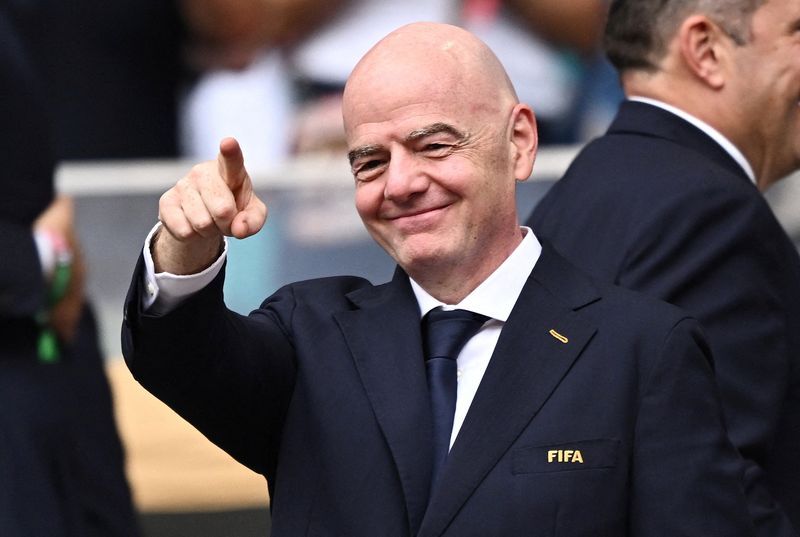
FIFA President Gianni Infantino faces mounting pressure on his anticipated re-election campaign after the Football Association of Wales became the first national federation to formally rescind its backing, citing governance failures and a loss of confidence in his leadership. The Welsh announcement follows the dramatic collapse of Infantino's flagship privatisation scheme, which aimed to raise up to $4.2 billion by selling approximately 20% of a newly created commercial entity to oversee international competitions including the World Cup.
The ambitious financial initiative, which had been positioned as a transformative revenue-raising mechanism for global football, crumbled last Friday under sustained opposition from key stakeholders across the sport's governance structure. Rather than securing the broad institutional support that Infantino had apparently anticipated, the proposal triggered a coordinated backlash that exposed deeper fractures within FIFA's organisational ecosystem. The speed with which the scheme unravelled suggests that Infantino significantly misjudged the appetite among football's governing bodies for such a radical restructuring of commercial arrangements.
In its formal statement withdrawing support, the Welsh FA explicitly condemned what it characterised as systemic failures spanning governance practices, procedural integrity, leadership capability, ethical standards, stakeholder engagement, and strategic communication. The federation's language — referencing Infantino's apparent inability to prioritise football's genuine interests — signals a principled rather than purely tactical withdrawal, suggesting deeper dissatisfaction with the presidential administration's overall direction and decision-making processes. This distinction matters because it frames the dispute not simply as disagreement over a single policy proposal, but as a loss of fundamental confidence in Infantino's stewardship of world football.
Infantino's predicament has intensified dramatically as regional powerhouses have joined the fray. The Union of European Football Associations (UEFA) and the Confederation of North, Central America and Caribbean Association Football (CONCACAF) both announced they had lost confidence in his leadership, with UEFA notably leading the organised resistance to the privatisation plan. The European confederation's subsequent issuance of a document preservation order — a legal manoeuvre that prevents the destruction of correspondence, files, and electronic data pending formal investigation — suggests the possibility of future litigation against FIFA over the handling of the commercial rights initiative.
For Malaysian and Southeast Asian observers, Infantino's troubles carry particular significance given that Asian football remains comparatively underrepresented in FIFA's decision-making hierarchy compared to its global population and football participation rates. The current institutional crisis offers a potential opportunity for Asian confederations to recalibrate their positioning within FIFA's governance structure and demand greater voice in major strategic decisions affecting global football's commercial future. Any succession process triggered by Infantino's weakened position would create space for alternative candidates whose vision might better reflect emerging football nations' interests.
Infantino's path to anticipated re-election has undergone a profound transformation. When he declared his candidacy for a fourth term in April, his position appeared essentially unassailable — he had successfully completed two previous re-election campaigns unopposed since assuming the presidency in 2016, inheriting the role from Sepp Blatter. The Swiss administrator had consolidated significant power and appeared to command majority support among FIFA's membership across most confederations. Yet the failed privatisation gambit has essentially exposed this support as considerably more fragile and conditional than his previous tenure suggested.
Exerts tracking FIFA politics have cautioned that the backlash, despite the proposal's withdrawal, has fundamentally altered the dynamics surrounding the presidency. The March Congress scheduled to convene in Morocco now looms as a significantly more complicated and unpredictable gathering than observers had anticipated merely weeks earlier. Rather than a ceremonial re-election, the Congress could witness genuine contestation around leadership direction, governance reform, and FIFA's commercial strategy — scenarios that seemed implausible when Infantino's dominance appeared complete.
The institutional damage extends beyond immediate political calculations. The privatisation proposal's failure reveals that FIFA's decision-making processes remain opaque and inadequately consultative, with senior leadership apparently capable of advancing major structural changes without securing genuine buy-in from confederations and member associations. This governance breakdown has emboldened federation leaders previously reluctant to challenge presidential authority, creating momentum for substantive institutional reform. The Welsh FA's pointed criticism of leadership, values, and stakeholder management suggests that underlying grievances extend well beyond the specific commercial proposal.
UEFA's position carries particular weight given European football's economic dominance and the confederation's established track record of enforcing its interests within FIFA's structure. The document preservation order represents a particularly significant escalation, moving beyond rhetorical criticism toward potential legal accountability. This development signals that European leadership views the matter not simply as a policy disagreement but as a governance failure with potential legal and fiduciary implications. Other confederations observing UEFA's assertiveness may feel emboldened to pursue their own accountability mechanisms.
The broader context involves how FIFA manages its relationship with commercial interests and member federations as global football's commercial value has expanded exponentially. The failed privatisation plan apparently represented Infantino's attempt to capture additional revenue streams at a moment when he perceived window of opportunity. The plan's collapse instead demonstrates the limits of unilateral presidential authority when key constituencies perceive their interests threatened. This rebalancing of power dynamics may produce more cautious, consultative approaches to future commercial initiatives.
As speculation swirls regarding potential alternative candidates and the possibility of contested elections, the March Congress in Morocco will inevitably attract unprecedented scrutiny. Whether other federations will formally withdraw support remains uncertain, but the Welsh precedent has broken an important psychological barrier. Infantino's challenge now involves not merely securing re-election but attempting to rebuild credibility and confidence among an increasingly restive membership base. The coming months will test whether his accumulated institutional advantages can overcome the accumulated damage from the failed privatisation scheme and subsequent governance crisis.

