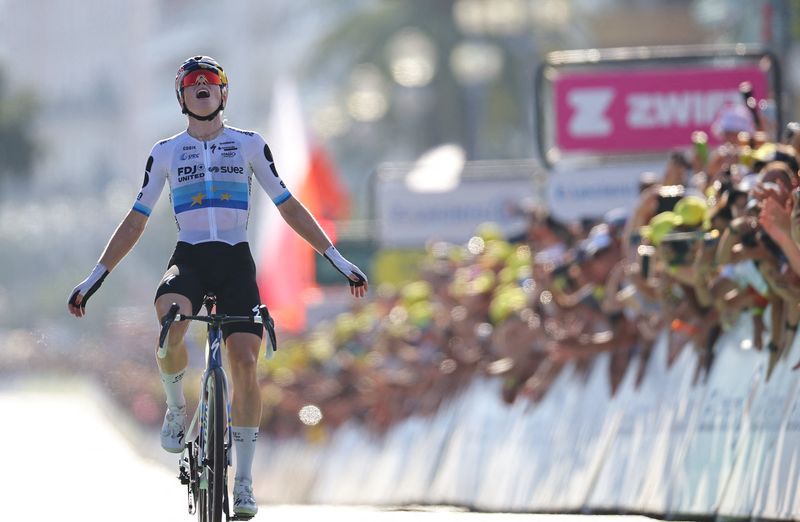
Demi Vollering of the Netherlands has assumed command of the Tour de France Femmes following a commanding display on the eighth stage, a gruelling 171.9-kilometre mountain trek from Sisteron to Nice on Saturday. The FDJ United-Suez cyclist's victory moves her eight seconds ahead of Poland's Kasia Niewiadoma-Phinney in the general classification heading into Sunday's concluding stage, fundamentally reshaping the dynamics of the women's Grand Tour with the finish line now in sight.
The dramatic shift atop the standings comes on a day marked by significant upheaval even before racing commenced. Pauline Ferrand-Prevot, the defending champion and Visma-Lease a Bike's lead rider, withdrew from the competition due to illness, removing one of the race's most formidable contenders from contention during the decisive final days. This development underscored the physical and mental toll that major stage races exact on elite cyclists, even those accustomed to competing at the sport's highest echelon.
Vollering's tactical execution on the road proved decisive. As the peloton tackled the demanding Chemin de l'Arieta climb with six kilometres remaining, she unleashed an acceleration that immediately distanced her principal rivals. The manoeuvre separated Niewiadoma-Phinney and Italy's Elisa Longo Borghini from the Dutch rider, who subsequently consolidated her advantage during the technical descent into Nice. This crushing attack represented a reversal of fortune following Saturday's stage seven, when Vollering lost one minute and sixteen seconds to Niewiadoma-Phinney on Mont Ventoux, illustrating how quickly momentum can shift in stage racing.
The victory represents Vollering's fifth stint wearing the yellow jersey throughout this edition of the race, and positions her as the fifth different rider to occupy that position during the 2026 Tour de France Femmes. Such fluidity at the summit of the standings demonstrates the competitive depth and closely matched calibre of the field, where stage performance and tactical precision can rapidly alter the hierarchy.
Longo Borghini secured second place after prevailing in a sprint finish against Niewiadoma-Phinney, leaving the Polish cyclist to settle for third position and the painful reality of relinquishing her race leadership. The UAE Team ADQ rider's strong showing demonstrated her capacity to emerge as a contender on mountain terrain, positioning her potentially as a factor in the final stage if circumstances permit.
Niewiadoma-Phinney's post-stage remarks revealed considerable frustration regarding the tactical conduct of FDJ United-Suez. The Polish competitor alleged that rider Celia Gery had deliberately blocked her near the barriers at the climb's base, forcing her to cease pedalling during a critical moment. Such accusations of unsporting conduct highlight the intense competition and occasional ethical grey areas that emerge when the Tour's most prestigious prize hangs in the balance.
The incident sparked broader commentary about the acceptable boundaries of cycling tactics. Niewiadoma-Phinney expressed disappointment not merely with the tactical manoeuvre itself, but with what she characterised as the deteriorating standards of fair competition within professional cycling. Her criticism suggested that while aggressive racing remains intrinsic to the sport, deliberate physical obstruction constitutes conduct that fundamentally undermines the spirit of athletic competition.
Vollering's reflections following her triumph captured the psychological resilience required to succeed in multi-day racing. She acknowledged the emotional difficulty of experiencing setbacks, as she had done the previous day when losing significant time on Mont Ventoux, while emphasising the necessity of mental reset between stages. Her reference to adopting "a new mask" suggests the psychological compartmentalisation elite cyclists employ, moving beyond disappointment to approach each day as a fresh competition.
The Dutch rider's confidence heading into the final stage carries real substance. With the yellow jersey now in her possession and a narrow but meaningful advantage, Vollering enters Sunday's finale as the favourite to secure overall victory. However, her own acknowledgment that "everything can happen on the last day" reflects the inherent unpredictability of stage racing, where mechanical failures, tactical miscalculations, or simply stronger legs on any given morning can fundamentally alter outcomes.
For Malaysian and Southeast Asian cycling enthusiasts, this Tour de France Femmes edition has demonstrated the sport's global reach and the compelling narratives that emerge when cycling's most prestigious stage races capture international attention. The 2026 edition showcases not merely athletic excellence but the complex interplay of tactics, psychology, and athletic preparation that define modern professional cycling at its pinnacle.
The final stage around Nice will determine whether Vollering can convert her narrow advantage into overall victory or whether Niewiadoma-Phinney can mount a successful challenge to reclaim the yellow jersey. The compressed timeframe and minimal time gaps ensure maximum drama as the race heads toward its conclusion.

