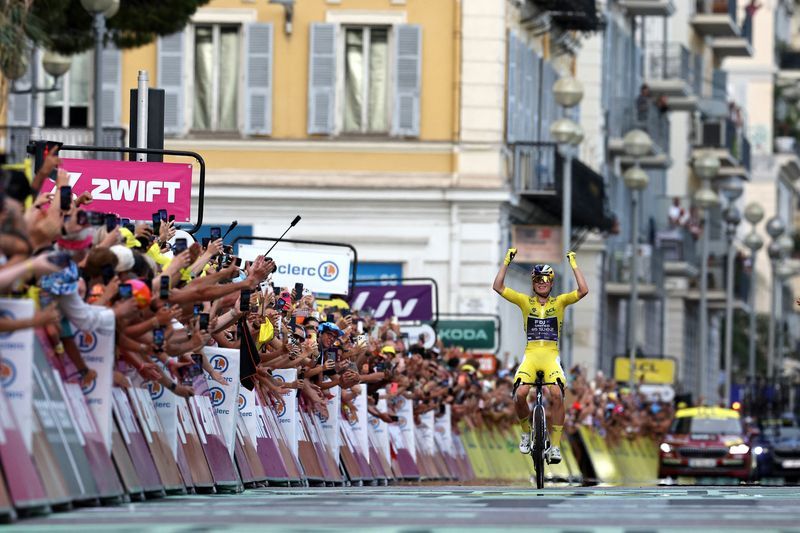
Demi Vollering of the Netherlands has cemented her status as one of the sport's elite riders by capturing her second Tour de France Femmes title on Sunday, the Dutch cyclist delivering a commanding performance in the race's concluding stage near Nice. The 29-year-old rider of FDJ-Suez team punctuated her victory with a stage win over the 99.2-kilometre finale, crossing the finish line with authority after mounting a powerful attack on the final ascent of Col d'Eze.
Vollering's triumph marks a defining moment in a career already laden with substantial achievements across women's professional cycling. Her palmares include a previous Tour de France Femmes victory in 2023, the 2026 Giro d'Italia Women title, and consecutive La Vuelta Femenina triumphs in 2024 and 2025, establishing her among the most accomplished stage racers of the current generation. The magnitude of her consistency at grand tours underscores why cycling observers regard her as a generational talent capable of competing at the sport's highest echelon.
Entering Sunday's decisive stage, Vollering carried an eight-second advantage over Polish challenger Katarzyna Niewiadoma-Phinney, a margin that proved sufficient but hardly insurmountable over a demanding 99-kilometre mountain stage. She had reclaimed the yellow jersey the previous day, wresting control of the race from Niewiadoma-Phinney in the penultimate stage to position herself for the final act. The tension surrounding the conclusion remained considerable, as the narrowness of the gap and the mountainous terrain of the concluding kilometres presented opportunities for dramatic reversals.
The decisive moment arrived as the riders tackled the fourth and final climb of Col d'Eze, a climb that loomed large in the psychological and physical calculus of the stage. It was here that Vollering made her move against the 31-year-old Niewiadoma-Phinney, launching an aggressive acceleration that the Polish-Canadian competitor could not match. Vollering's superior strength on the gradient allowed her to establish a gap that she extended methodically toward the finish, crossing the line with sufficient cushion to signal unambiguous dominance.
In the final general classification, Vollering established a winning margin of one minute and 18 seconds, a substantial advantage that underscored the effectiveness of her tactical approach across the three-week race. Niewiadoma-Phinney's silver medal position confirmed her status as a formidable competitor despite falling short of the ultimate prize. Italy's Elisa Longo Borghini rounded out the podium in third position, providing an interesting geographic spread among the race's elite performers.
Vollering's emotional remarks after her victory revealed the mental intensity required to succeed in grand tours, particularly when defending a narrow advantage on the final day. She spoke of the significance of winning in yellow, acknowledging the collective effort invested by her support network including teammate Celia Gery, who had experienced a difficult previous evening. Her reflections centred on the shared sacrifice and passion that characterises professional cycling teams, emphasising that the achievement extended beyond individual performance to embrace the collaborative framework upon which stage racing success depends.
The FDJ-Suez rider's determination to "make it clear" through a commanding attack and solo finish reflected a deliberate strategy to eliminate ambiguity about the race outcome. Rather than merely managing a narrow lead, Vollering chose to attack and extend her advantage decisively, a psychological gesture intended to communicate her superiority and her team's deservingness of the victory. This approach resonates within professional cycling culture, where dominant performances carry greater prestige than narrow victories achieved through conservative tactics.
Vollering's stage-hunting prowess manifested throughout the race, as Sunday's success represented her third stage victory of this edition and her sixth Tour de France Femmes stage win across her grand tour career. Her ability to win not only the overall title but also individual stages demonstrates a rounded palmarès that encompasses both sustained consistency across three weeks and the capacity to produce explosive performances on demanding terrain. This breadth of achievement distinguishes Vollering from competitors who excel primarily in one dimension of grand tour racing.
The context of women's professional cycling has evolved considerably over recent years, with the Tour de France Femmes now established as the sport's marquee event following its rebranding and restructuring. The prominence accorded to this race and the quality of competition it attracts ensures that Vollering's victories carry substantial weight in the cycling canon. Her back-to-back success positions her among the few riders capable of dominating the women's grand tour landscape across multiple editions.
For Malaysian and Southeast Asian cycling enthusiasts, Vollering's dominance provides a instructive example of consistency and strategic excellence at the highest level of professional sport. While the Tour de France occupies a somewhat distant position in the regional cycling consciousness compared to Asia-focused events, the technical mastery and psychological resilience demonstrated by Vollering and her peers offer valuable lessons in sporting excellence applicable across disciplines and regions.
The juxtaposition of Vollering's second title with the recent men's race, where Slovenia's Tadej Pogacar claimed a record-equalling fifth Tour de France crown in July with a third successive victory, highlights divergent trajectories among cycling's elite. Pogacar's unprecedented achievement in the men's race underscores the evolving competitiveness of professional cycling while simultaneously validating Vollering's status as a dominant force within her category. Both riders exemplify the peak of contemporary grand tour racing, demonstrating the physical and mental capabilities required to prevail in cycling's most demanding competitions.

