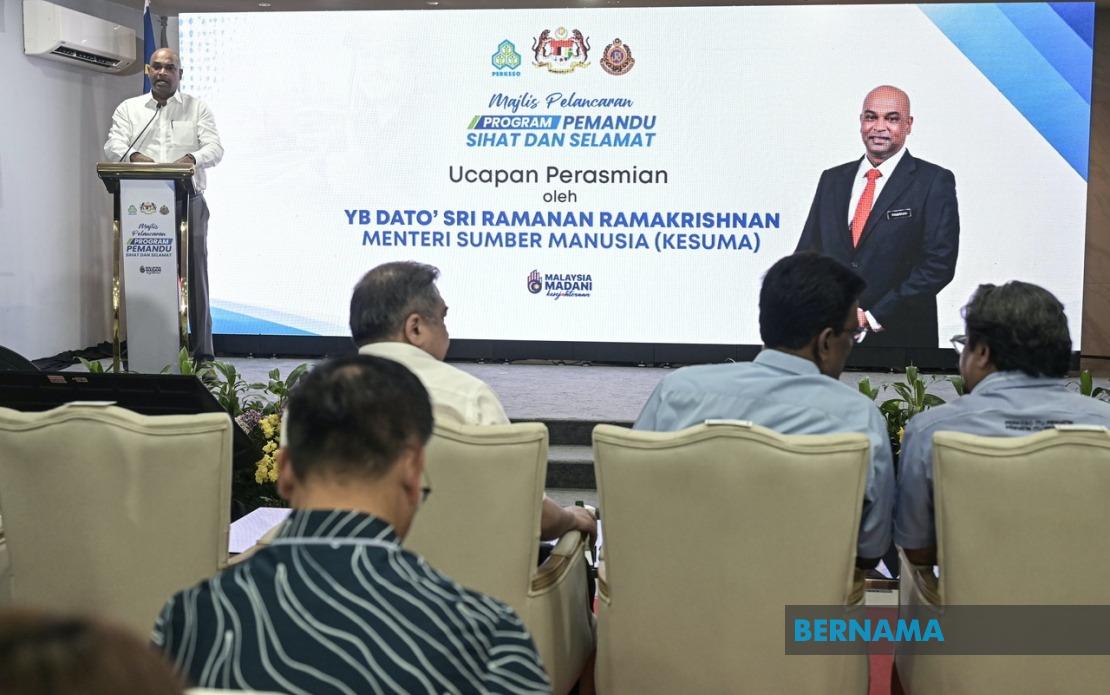
Malaysia is implementing a landmark health screening requirement for all vocational drivers seeking to renew their professional licences, marking a significant shift in the country's approach to road safety. Human Resources Minister Datuk Seri R. Ramanan announced the initiative on June 30, launching the Healthy and Safe Driver Programme (PSS) across 500 panel clinics nationwide. The move reflects growing concerns about occupational road safety and represents a coordinated effort between the Ministry of Human Resources and the Ministry of Transport to protect the thousands of professional drivers who form the backbone of Malaysia's transport and logistics sectors.
The health screening encompasses a broad range of medical assessments designed to identify potential hazards before they translate into accidents. Drivers will undergo physical examinations alongside vision and hearing tests, two of the most critical factors in safe vehicle operation. The programme also includes screening for sleep disorders, particularly obstructive sleep apnea—a condition that has emerged in recent years as a significant contributor to driver fatigue and accidents among professional drivers who spend extended hours behind the wheel. Additionally, the screening evaluates core bodily systems including cardiovascular, respiratory, and neurological function, recognising that conditions affecting these areas can impair a driver's capacity to respond to emergencies on the road.
The cost structure reflects the government's commitment to making the initiative accessible while spreading financial responsibility. Drivers will pay only RM30 for the full screening, with the government subsidising the remaining RM55 through the Social Security Organisation (Socso). This arrangement means that professional drivers—many of whom operate on tight profit margins—will not face prohibitive expense in complying with the new requirement. The pricing structure also signals that the government views driver health as a public health matter warranting subsidy, similar to other preventive health programmes.
Ramanan emphasised that the programme targets early detection rather than creating obstacles for drivers. By identifying health issues before they become critical, the initiative aims to enable prompt medical intervention and treatment. This preventive approach contrasts with reactive measures and reflects international best practices in occupational health and safety. The screening is particularly important for identifying conditions that may develop gradually, such as cardiovascular disease or vision degradation, which drivers themselves might not immediately recognise as safety risks.
The government has set ambitious expansion targets for the programme, aiming to grow from the current 500 panel clinics to 3,000 clinics nationwide. This scaling-up phase is crucial for ensuring equitable access, particularly in rural and semi-urban areas where vocational drivers may currently face long travel times to reach screening facilities. The expansion timeline will be critical in determining whether the programme becomes a genuine national standard or remains concentrated in urban centres where clinics are already concentrated.
The initiative arrives against a backdrop of concerning road safety statistics. In 2025 alone, 115 workers were killed in road accidents—a worrying 22 percent increase from the 94 fatalities recorded in 2024. These figures encompass lorry drivers, bus operators, van drivers, car drivers, and motorcyclists who depend on roads for their livelihoods. The data underscores that road accidents represent a significant occupational hazard for Malaysian workers, with consequences extending beyond individual families to impact economic productivity and logistics reliability.
Lorry drivers have emerged as the most vulnerable group, accounting for 62 of the 115 fatalities in 2025—roughly 54 percent of all work-related road deaths. This concentration reflects the demanding nature of heavy vehicle operation, the long hours lorry drivers typically work, and the potential severity of collisions involving large commercial vehicles. The high fatality rate among this group has likely provided significant impetus for implementing the PSS programme, as any intervention that reduces these deaths would have substantial economic and humanitarian benefits.
The programme reflects evolving thinking about road safety in Malaysia. Rather than relying solely on enforcement, vehicle inspection standards, and road infrastructure improvements, policymakers are now incorporating occupational health screening into the regulatory framework. This represents recognition that driver fitness—encompassing physical health, mental alertness, and medical stability—is as important as vehicle condition and road design in preventing accidents. The approach aligns with recommendations from the World Health Organisation and other international bodies that emphasise the role of driver health in road safety strategies.
For the transport and logistics industry, the PSS programme introduces new compliance requirements that operators will need to factor into their licence renewal processes. While the cost to individual drivers is modest, the administrative burden of scheduling appointments, attending clinics, and obtaining certification will require coordination. Industry bodies may need to adjust operational planning to accommodate drivers undergoing screening, and fleet operators might consider scheduling these appointments during planned maintenance periods or rostering systems.
The programme also has implications for how Malaysia addresses workplace health surveillance more broadly. If the PSS model proves effective in reducing road accidents among vocational drivers, policymakers may consider extending similar health screening requirements to other occupational groups facing significant accident risks. The success or challenges encountered in scaling to 3,000 clinics will provide valuable lessons for other public health initiatives targeting specific occupational populations.
For Malaysian drivers themselves, particularly those in the vocational sector, the screening programme represents both a regulatory obligation and a potential health benefit. Early detection of conditions like sleep apnea or cardiovascular problems could enable lifestyle modifications or medical treatment that improves not only road safety but also overall health outcomes. However, drivers who discover health issues may face difficult decisions about whether their conditions require them to cease or modify their work temporarily while undergoing treatment, creating potential financial hardship despite government support.
The success of this initiative will ultimately depend on consistent implementation across clinics, clear communication to drivers about requirements and benefits, and evidence that the screening genuinely reduces accident rates among participating drivers. Monitoring and evaluation mechanisms will be essential to determine whether the programme achieves its road safety objectives, and whether the investment in screening yields measurable improvements in occupational safety outcomes across Malaysia's transport sector.

