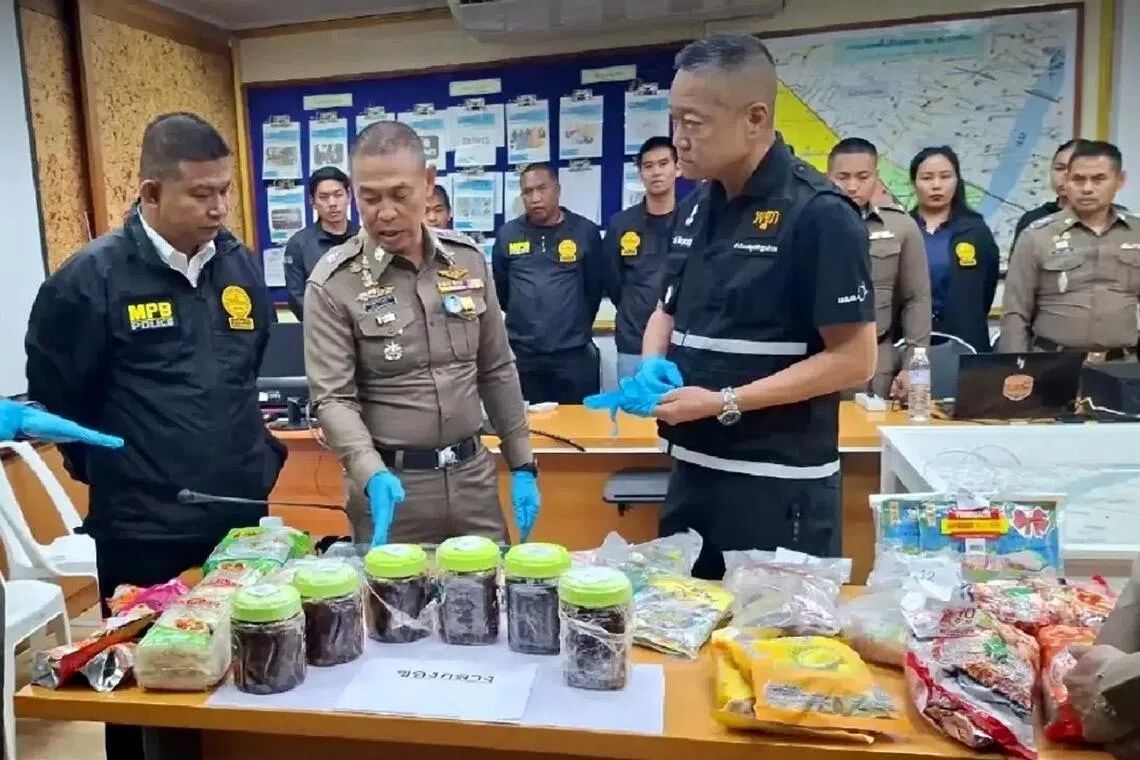
Thai police have exposed an elaborate transnational drug trafficking network operated by Vietnamese nationals that exploited Thailand's geographical position as a smuggling corridor to Japan. The operation, which authorities announced on July 17, represents a troubling evolution in Southeast Asian drug smuggling methods, where criminal syndicates increasingly rely on concealment within legitimate food products to evade detection at international borders.
Metropolitan Police Bureau commissioner police lieutenant-general Siam Boonsom, alongside police major general Chaiya Phetpanya, commander of Metropolitan Police Division 7, revealed details of the operation following intensive investigations that began when a courier became suspicious of unusually heavy jars allegedly containing tamarind paste bound for Tokyo. The breakthrough came when the transport worker, whose job was to deliver goods across borders, reported the suspicious shipment to police on July 13, setting in motion a chain of discoveries that would unravel the entire network's operational structure.
Upon examination, investigators discovered six foil-wrapped packages concealed within the tamarind containers, containing more than two kilograms of crystal methamphetamine, a highly potent synthetic stimulant that commands premium prices in Japan and other developed markets across East Asia. The discovery highlighted how criminal organisations have grown increasingly sophisticated in adapting their concealment methods, moving beyond crude hiding places to exploit the hundreds of thousands of food shipments that cross regional borders daily, making detection exponentially more challenging for customs and border authorities.
What makes this operation particularly concerning for security agencies throughout Southeast Asia is its multi-layered organisational structure, designed specifically to insulate senior organisers from direct involvement in any stage of the trafficking chain. Vietnamese nationals allegedly based in Hanoi directed the entire operation remotely, using anonymous Facebook accounts to recruit motorcycle delivery riders operating in Thailand who had no knowledge of the packages' true contents. These riders would collect items from residential properties occupied by Vietnamese nationals scattered across Thailand, then pass deliveries to Thai couriers hired specifically for international transport duties.
This compartmentalisation strategy reflects lessons learned from previous drug enforcement operations across the region. By creating multiple handoff points and deliberately employing couriers of different nationalities at different operational stages, the syndicate aimed to frustrate investigators' ability to establish a coherent chain connecting organisers to contraband. Police lieutenant-general Siam Boonsom noted that such arrangements deliberately obscure the financial and operational trails, making it substantially harder for law enforcement to construct prosecutable cases against the network's architects.
Investigators traced financial flows through a Thai bank account registered to Sompong, a suspect arrested in connection with the network. The account served as a clearing house through which Vietnamese nationals would periodically withdraw cash sums ranging between 20,000 and 50,000 baht before departing Thailand for Vietnam. This rotating withdrawal pattern, authorities believe, was intentionally designed to avoid triggering the financial monitoring systems that banks employ to detect suspicious large transactions, while simultaneously reducing the period any individual operative remained exposed to arrest within Thai jurisdiction.
The use of Thailand as a primary transit point underscores the country's vulnerability to being co-opted by international drug syndicates. Thailand's extensive borders with multiple nations, its substantial undocumented migrant population, and its role as a regional logistics and transportation hub make it an attractive staging ground for smuggling operations targeting Japan, South Korea, and other wealthy markets where methamphetamine commands prices five to ten times higher than in manufacturing regions. For Vietnamese criminal organisations, Thailand offers the geographic advantage of plausible deniability—the drugs can be portrayed as originating from Thai sources rather than Vietnam.
Police have issued arrest warrants for four individuals: Sompong, the primary suspect on Thai soil, and three Vietnamese nationals allegedly responsible for various operational roles ranging from managing social media recruitment accounts to supervising cash withdrawals and directing overall strategy. However, investigators acknowledge significant gaps in their understanding of the network's full scope, with evidence suggesting at least four additional individuals participated in ways not yet fully mapped by authorities. Sompong has categorically denied involvement in the operation, though this denial carries limited weight given the financial evidence traced through his account.
Additional investigative leads have emerged regarding Sompong's girlfriend, whose name does not appear on any arrest warrant but whom police believe possessed operational knowledge of the smuggling arrangement. Authorities are examining the extent of her potential involvement and complicity, recognising that intimate relationships often provide cover for criminal operations in which participants share living spaces and financial interests. The decision to withhold charges against her at this stage suggests investigators are still gathering evidence to determine whether she actively participated or merely failed to report suspected criminal activity.
For Malaysia and the broader Southeast Asian security framework, this case illuminates how transnational criminal syndicates operate across porous regional borders with minimal coordination between national law enforcement agencies. Vietnamese drug trafficking organisations have become increasingly sophisticated operators within regional illicit markets, often working in partnership with local facilitators in transit countries who provide essential logistical support. The successful identification and partial dismantling of this particular network represents a rare victory, but authorities acknowledge that numerous similar operations likely continue undetected.
The incident also demonstrates why food and agricultural products merit particular scrutiny at customs checkpoints throughout Southeast Asia. With tamarind paste and similar condiments representing legitimate high-volume trade items between region and Japan, smugglers have calculated that these products attract minimal inspection compared to more obviously suspicious cargo. Customs agencies across Thailand, Malaysia, and other countries must enhance detection capabilities targeting common concealment methods while avoiding the delays that would cripple legitimate commerce.
Looking forward, the case underscores the necessity for intelligence sharing and coordinated enforcement between Thai, Vietnamese, Japanese, and Malaysian authorities. No single national police force can adequately address drug trafficking networks that deliberately span multiple jurisdictions. The involvement of a senior organiser allegedly operating from Hanoi suggests that Vietnamese law enforcement should be approached for parallel investigations, though cooperation between Southeast Asian neighbours on drug matters remains inconsistent and sometimes complicated by diplomatic tensions unrelated to narcotics control.

