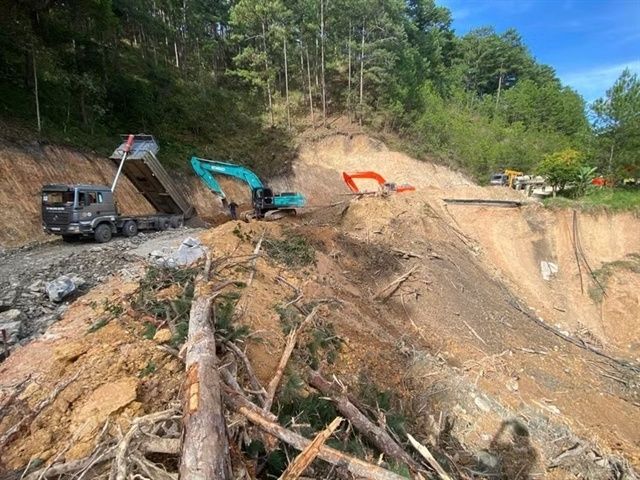
Vietnam's Ministry of Construction has formally declared a natural disaster emergency affecting a critical section of Ho Chi Minh Road that traverses Tuyen Quang Province, marking an official recognition of the severity of damage inflicted by a month-long deluge that threatens one of Southeast Asia's major transport arteries. The declaration targets the road at kilometre position 115+000, where Ho Chi Minh Road intersects with National Highway 2C, a junction falling under the operational purview of Road Management Zone I. This formal emergency status underscores government concern that damage to the road's structural integrity poses genuine risks to the safety of both vehicle operators and passengers dependent on this crucial north-south corridor.
The underlying cause stems from an exceptional sequence of heavy rainfall events that battered the region throughout June, with meteorological data collected by both the Tuyen Quang Provincial Hydrometeorological Station and the National Centre for Hydrometeorological Forecasting documenting multiple intense precipitation episodes spanning the entire month. Such sustained and concentrated rainfall patterns are characteristic of seasonal monsoon systems affecting northern Vietnam, though the cumulative impact appears to have exceeded typical thresholds for infrastructure resilience along this route. The concentrated bombardment of moisture translated into visible deformation of the road surface, creating safety hazards that compelled authorities to escalate their response from routine maintenance protocols to formal disaster declaration procedures.
For Malaysian readers and broader Southeast Asian observers, the significance of this emergency extends beyond Vietnam's borders, as Ho Chi Minh Road serves as a critical artery linking Thailand, Laos, and Vietnam through the heart of mainland Southeast Asia. The route functions as a vital commercial corridor facilitating cross-border trade and regional connectivity. Damage to transportation infrastructure in this zone creates cascading impacts across supply chains and logistics networks that depend on reliable passage through northern Vietnam. The emergency declaration therefore signals potential disruptions to regional commerce and highlights the vulnerability of major transport infrastructure to climate-driven extreme weather events increasingly common throughout the region.
Responding to the crisis, the Ministry of Construction has mobilized multiple layers of administrative and technical authority to coordinate remedial action. The Department for Roads of Vietnam and Road Management Zone I have been assigned responsibility for conducting comprehensive assessment of structural damage, developing viable repair strategies, and issuing formal Emergency Construction Orders that authorize expedited construction protocols outside normal bureaucratic constraints. This delegation of authority demonstrates standard Vietnamese emergency response architecture, where central ministry guidance flows through specialized departments to operational field units capable of executing physical work.
The emergency declaration process itself follows Vietnam's established natural disaster response framework, wherein formal status triggers legal mechanisms enabling faster procurement, resource allocation, and construction authorization. Once emergency remediation works reach completion, the Department for Roads of Vietnam must report findings to the Ministry of Construction, providing the documentary basis for determining whether emergency conditions have sufficiently ameliorated to warrant termination of the emergency status. This structured reporting requirement ensures ministerial oversight throughout the recovery cycle and maintains accountability for resource deployment.
Beyond the primary damage location at kilometre 115+000, authorities have identified a secondary zone of concern stretching from kilometre 124+600 to kilometre 128, where Ho Chi Minh Road overlaps with National Highway 2 and flooding has created congestion challenges threatening traffic flow. This extended problem area suggests that rainfall damage was not localized to a single point but rather distributed across multiple sections of the corridor. Managing congestion through this flooded segment requires both emergency drainage initiatives and traffic management coordination to maintain economic and social connectivity despite degraded road conditions.
Accountability mechanisms embedded within the emergency declaration assign explicit responsibility to senior officials for ensuring proper execution of response activities. The Director General of the Department for Roads of Vietnam and the Director of Road Management Zone I face direct accountability to the Minister of Construction for damage assessment accuracy and timely completion of repair works at the primary damage location. Such high-level accountability structures reflect the importance Vietnamese authorities attach to maintaining this strategic transport corridor and demonstrate political commitment to rapid restoration.
The Transport and Road Safety Division of the Ministry of Construction has been tasked with supervisory and coordination functions across the disaster response, including urging relevant government agencies and specialized units to implement comprehensive measures addressing both immediate infrastructure damage and ongoing traffic management requirements. This division operates as the ministry's enforcement mechanism, ensuring that various departments and road management entities execute their assigned responsibilities according to emergency protocols rather than standard operating procedures that might prove too slow given the urgency of the situation.
For Malaysia's transport and logistics sectors, the Ho Chi Minh Road emergency carries practical implications worth monitoring. Malaysian companies operating cross-border supply chains through Vietnam should anticipate potential delays traversing Tuyen Quang Province during the repair period. Insurance and logistics planning frameworks may require adjustment to account for route disruptions or diversions. Additionally, the incident underscores broader Southeast Asian vulnerabilities regarding climate resilience of critical transport infrastructure, a concern increasingly relevant as monsoon rainfall intensifies across the region due to evolving climate patterns.
The emergency declaration process in Vietnam typically spans several months from initial formal recognition through completion of remedial construction and final emergency termination, suggesting that Ho Chi Minh Road disruptions may persist through the coming months. Regional businesses dependent on reliable passage through northern Vietnam should develop contingency strategies addressing potential route alternatives, though limited options exist for bypassing this corridor. The incident also highlights why Southeast Asian governments and development institutions increasingly prioritize infrastructure resilience upgrades, particularly for facilities serving cross-border transportation functions essential to regional integration and economic cooperation.

