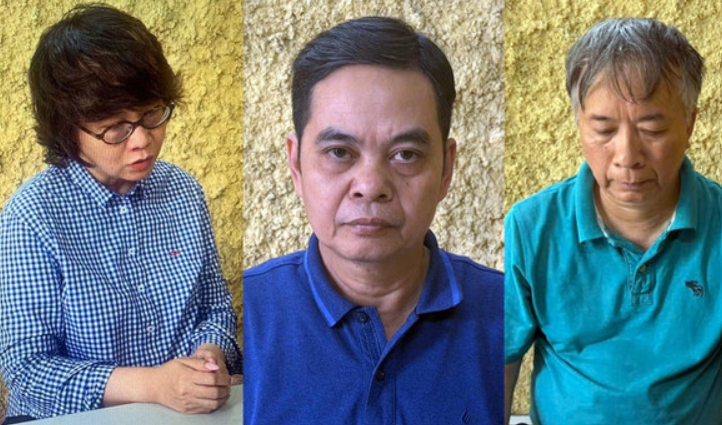
Vietnamese police have moved swiftly against what officials characterise as a coordinated effort to spread what the government deems misinformation about Ho Chi Minh, the revered founder of the country's Communist Party. The operation, which unfolded in mid-July, saw the detention of three senior figures at the Vietnam Writers' Association Publishing House, the firm responsible for releasing "Stories with Thanh -- A New Account of Light" in May. The arrests signal a broader enforcement action that has ensnared the book's author, media organisations, and social media personalities accused of amplifying its contents.
The detained publishing house executives—the director, editor-in-chief, and head of the editorial board—now face charges relating to the creation and dissemination of materials deemed hostile to the Socialist Republic of Vietnam. According to official statements, the trio participated directly in the book's entire lifecycle, from editing and revision through to publication and subsequent promotion. Investigators allege the work fundamentally misrepresents both the historical record of Vietnam's revolutionary movements and the ideological positions held by the Communist Party hierarchy. The specificity of these accusations underscores official concern about narratives that deviate from state-sanctioned interpretations of pivotal national figures and events.
Author Nguyen Thanh Nam, a former telecommunications executive who penned the biography, had already been apprehended in early July on similar charges. He was joined in custody by an online influencer who leveraged social media platforms to market the book to broader audiences. The timing of Nam's arrest preceded the publisher detentions by approximately two weeks, suggesting a methodical approach to dismantling what authorities viewed as a coordinated information operation. Nam's background in the private sector rather than academic or journalistic circles may have heightened scrutiny, presenting a case where a non-establishment figure attempted to shape public discourse around a historically sensitive personality.
The content of the disputed book itself focuses on Ho Chi Minh's formative decades spent abroad, during which he developed and refined the strategic thinking that would eventually guide Vietnam's national liberation struggle. Rather than presenting a celebration of this period, officials contend the narrative distorts both historical fact and the ideological coherence of party doctrine. The vagueness surrounding specific factual claims within the government's allegations reflects a pattern in Vietnamese enforcement where authorities often prioritise political narrative control over precise documentation of disputed details. This opacity makes independent evaluation of the book's actual contents difficult for outside observers.
Under intense governmental pressure, the publisher voluntarily recalled the book from circulation, effectively limiting its potential readership. This capitulation did not, however, spare the publishing house from criminal prosecution. The decision to proceed with arrests despite the recall demonstrates that Vietnamese authorities view the publication itself as sufficient grounds for action, regardless of subsequent remedial measures. Such enforcement approaches differ sharply from Western legal traditions emphasising proportionality and the mitigating effect of voluntary compliance.
The crackdown extended into the media landscape when the culture ministry sanctioned twenty-three news outlets for having published articles that praised or promoted the book. These organisations and their staff members faced financial penalties totalling nearly twenty-five hundred dollars in aggregate, with more than a dozen journalists experiencing reassignment, suspension, or termination. The ministry's statement claimed the affected outlets subsequently acknowledged errors and demonstrated renewed commitment to source verification protocols. This framing transforms editorial judgment into a disciplinary matter, collapsing the distinction between factual accuracy and political alignment.
In a nationally televised address, Nam recanted his own work, articulating an apologetic statement that characterised the book as containing both factual errors and false contentions contradicting party guidelines. His public mea culpa depicted the biography as having tarnished Ho Chi Minh's historical reputation and fostered public confusion regarding official positions. The orchestrated nature of this confession, coupled with its broadcast reach, served multiple purposes: demonstrating state power to compel compliance, signalling to other potential critics the consequences of deviation, and attempting to restore the official narrative framework surrounding the founding figure.
This episode reflects broader patterns of information control within Vietnam's political system. Human Rights Watch documents that the country currently detains more than one hundred and sixty individuals on charges related to dissent and criticism of state policies. The treatment of Nam, the publishers, and supporting media figures represents not an anomaly but rather a systematic approach to managing public discourse around historically and ideologically sensitive topics. For a regional audience, particularly those in Malaysia and neighbouring Southeast Asian democracies, Vietnam's enforcement mechanisms illustrate the stark distinctions in approaches to freedom of expression and intellectual inquiry across the region's diverse political systems.
The implications extend beyond literary and media spheres to encompass the broader environment for civil society and intellectual freedom. That publishing house employees could face criminal charges for performing their professional duties—editing, revising, and printing manuscripts—signals that operational decisions within cultural institutions remain subject to political vetting. This institutional vulnerability creates a chilling effect discouraging independent thinking within organisations nominally positioned to nurture creative and intellectual endeavours. Foreign observers monitoring Vietnam's governance trajectory will likely view this sequence as evidence of tightening rather than liberalising tendencies within the communist system.
For Malaysia and other Southeast Asian nations grappling with their own questions surrounding press freedom and civil liberties, Vietnam's approach offers a cautionary model of how state control mechanisms can expand incrementally. The involvement of multiple enforcement agencies—police, the culture ministry, and implicit party oversight—demonstrates the comprehensive nature of censorship apparatus. Whether other regional governments gravitate toward similar models or maintain alternative frameworks will substantially influence the region's long-term trajectory regarding democratic development and pluralistic discourse.

