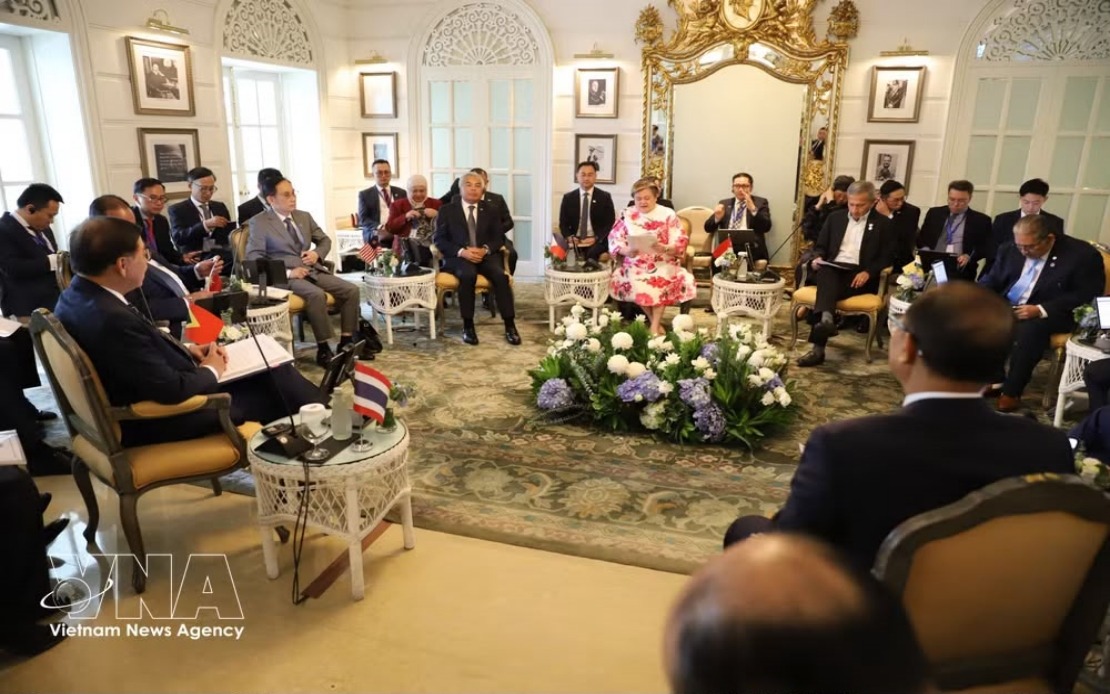
Vietnam's top diplomat has reaffirmed his country's unwavering commitment to Myanmar's membership within ASEAN and pledged to work collaboratively with fellow member states to support the embattled nation's path toward stability and economic recovery. Foreign Minister Le Hoai Trung made these remarks during an informal gathering of ASEAN foreign ministers and their Myanmar counterpart in Bangkok on July 12, underscoring Vietnam's view that the Five-Point Consensus remains the essential blueprint guiding the bloc's engagement with Myanmar as it navigates its ongoing transition.
The meeting, convened under Philippine leadership—the country assuming ASEAN's rotating chairmanship for 2026—marked a significant moment in regional diplomacy. Under the leadership of Philippine Secretary of Foreign Affairs Maria Theresa P. Lazaro, the talks represented the first substantial in-person diplomatic gathering involving multiple ASEAN foreign ministers and Myanmar officials since 2021, signalling the region's determination to maintain channels of communication despite the complexities surrounding Myanmar's internal affairs and previous international isolation.
Vietnamese officials acknowledged tangible progress that Myanmar's authorities have undertaken in recent months. These developments encompass attempts to restore political equilibrium following years of turbulence, initiatives to revitalise economic activity that has languished under sanctions and conflict, improvements in governmental administration, intensified operations against cross-border criminal networks particularly those involved in narcotics distribution, and enhanced security measures in frontier regions prone to instability. Such recognition from Vietnam, a country with its own security concerns along shared borders, carries particular weight within ASEAN deliberations.
However, Trung's remarks also contained an implicit call for acceleration. While acknowledging Myanmar's efforts, he emphasised that ASEAN must expand its practical interventions beyond merely endorsing the Five-Point Consensus framework. Vietnam's foreign minister advocated for prioritising sustained, regular diplomatic engagement—a seemingly straightforward prescription that nonetheless reflects the delicate balancing act ASEAN must perform when dealing with Myanmar's military-dominated administration, which remains isolated in international forums yet retains significant support from powerful neighbours.
Vietnam's positioning is strategically significant for Southeast Asia's stability equation. As a nation sharing border concerns and maritime interests with Myanmar, and as a member state increasingly assertive within ASEAN discussions, Hanoi's offer to facilitate Myanmar's economic rehabilitation while simultaneously combating transnational organised crime addresses multiple regional anxieties. The twin challenges of drug trafficking and cybercrime—phenomena that transcend national boundaries and destabilise entire subregions—demand coordinated responses that ASEAN as a bloc is theoretically positioned to provide.
The bilateral and subregional cooperation framework that Trung referenced extends beyond Myanmar itself. Economic recovery in Myanmar would benefit the broader Mekong region, where Vietnam maintains significant investments and development projects. Moreover, stability along Myanmar's borders directly affects Vietnam's own security calculations, making its engagement fundamentally aligned with enlightened self-interest rather than purely altruistic support. This convergence of interests explains why Vietnam positions itself as committed to Myanmar's success within the ASEAN framework.
The Five-Point Consensus, which emerged from the 2021 ASEAN Summit following Myanmar's military takeover, functions as the region's common denominator on Myanmar policy. It calls for cessation of violence, dialogue among all stakeholders, humanitarian assistance, non-interference from external actors, and appointment of an ASEAN special envoy. Trung's insistence that the consensus requires concrete implementation rather than mere symbolic endorsement reflects growing frustration within ASEAN capitals that diplomatic statements have produced limited tangible results on the ground.
Myanmar's own presentation at the July 12 meeting, delivered by Foreign Minister Tin Maung Swe, outlined a 100-day action plan focusing on peace promotion, national reconciliation, and stability restoration. ASEAN's receptive engagement with this outline demonstrates the bloc's desire to work with Myanmar's administration rather than isolate it—a pragmatic approach that contrasts with Western strategies but reflects ASEAN's commitment to non-interference and consensus-building methodologies.
The ministerial discussions operated within what participants described as a frank yet constructive atmosphere, indicating ASEAN members maintained candid disagreement on specific issues whilst maintaining their fundamental commitment to collaborative problem-solving. This diplomatic demeanour—critical feedback delivered within a framework of solidarity—represents the operating philosophy that enables ASEAN to function despite profound internal differences among member states regarding Myanmar policy and other regional questions.
The broader context illuminates why Vietnam's statements matter. With the Philippines assuming ASEAN's chair for 2026, member states are positioning themselves within what promises to be a consequential year for Myanmar-ASEAN relations. Vietnam's proactive role signals that mid-sized powers within ASEAN intend to shape the agenda rather than defer entirely to larger economies or the sitting chair. This assertiveness reflects the complexity of regional power dynamics where consensus-building demands active participation from multiple stakeholders.
For Malaysian observers and policymakers, Vietnam's commitment carries implications. ASEAN's collective response to Myanmar determines whether the bloc can meaningfully influence outcomes in a crisis situation, thereby affecting ASEAN's credibility and utility as an institution. Malaysia, like other member states, has interests in Myanmar's stability that extend across humanitarian, security, and economic dimensions. Understanding how Vietnam and other major players propose to operationalise the Five-Point Consensus provides insights into whether ASEAN's Myanmar strategy can evolve beyond diplomatic statements toward measurable achievements.
The path forward remains uncertain. Myanmar's internal divisions run deep, and external pressures from major powers create competing loyalties that complicate ASEAN's mediation efforts. Yet Vietnam's renewed commitment to engagement, combined with the Philippines' incoming chairmanship and the gathering of senior diplomats in Bangkok, suggests the bloc recognises that isolation of Myanmar serves no constructive purpose. Whether such engagement can translate into meaningful improvements in governance, human rights, and peace-building remains the central question shaping ASEAN's Myanmar strategy for the coming years.

