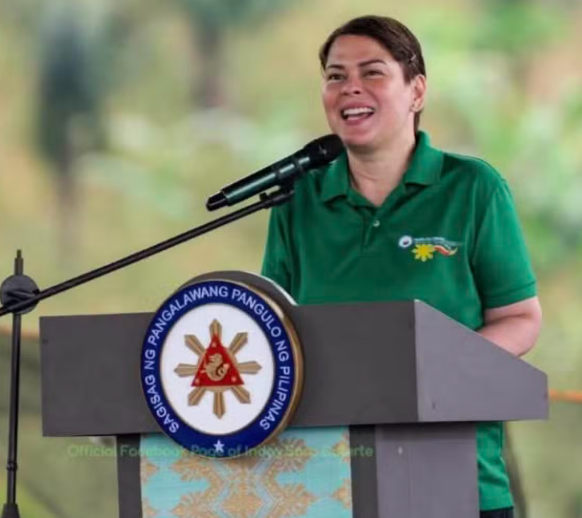
Vice President Sara Duterte has categorically dismissed mounting speculation about a potential resignation, insisting such a move would constitute a profound betrayal of the electoral mandate she received. Speaking during an impromptu interview that was subsequently shared on pro-Duterte social media channels, the vice president expressed her unwavering commitment to remaining in office, framing her continued tenure as a matter of personal honour and democratic accountability to those who placed their faith in her candidacy.
Duterte's emphatic denial comes at a particularly sensitive juncture for her political standing, as she currently navigates a formal impeachment proceeding in the Philippine Senate. The charges levelled against her encompass serious allegations including the alleged misappropriation of confidential funds, unexplained accumulation of wealth, and accusations related to grave threats. These developments have naturally fuelled public discussion about whether the embattled vice president might opt for a graceful exit from office, particularly given the political and personal pressures inherent in such a proceeding.
However, the vice president's categorical rejection of resignation talk signals her determination to fight the impeachment charges through the proper institutional channels rather than abandon her position. By explicitly invoking the figure of 32.2 million voters who elected her in the previous presidential election, Duterte has reframed the impeachment debate in terms of democratic legitimacy and popular mandate. This rhetorical strategy positions any potential resignation as fundamentally illegitimate, since it would undermine the collective democratic choice of millions of Filipinos who voted her into office.
In a particularly confrontational move, Duterte directly addressed President Ferdinand Marcos Jr, essentially challenging him to exercise whatever constitutional or executive powers he might possess to remove her from office. Her statement—that Marcos "can do everything to remove me" if he wishes—appears designed to expose any perceived reluctance or inability on the president's part to take such drastic action. The comment reflects the broader tension between the two leaders, whose political relationship has visibly deteriorated since Duterte's election as vice president in 2022.
The vice president's legal team has also weighed in on the speculation, providing additional support for her public declarations. Her defence counsel explicitly stated that the possibility of resignation has never been discussed or contemplated in their consultations with their client, effectively closing off that option from a strategic perspective. This coordinated messaging from both Duterte and her lawyers suggests a unified front committed to contesting the impeachment charges rather than seeking an off-ramp through resignation.
The impeachment proceedings themselves have progressed methodically through the Senate, with prosecutors completing their presentation of evidence related to the fourth article of impeachment against the vice president. This procedural development indicates that the trial is advancing toward subsequent phases, where Duterte's defence will have the opportunity to present its counter-arguments and challenge the government's case. The continuation of these proceedings suggests that both sides are girding for an extended legal battle rather than anticipating a swift resolution.
For Malaysian and regional observers, the Duterte impeachment saga underscores the ongoing volatility within Philippine politics and the persistent tensions between different political factions competing for influence. The Philippines, as Southeast Asia's largest democracy, continues to experience cycles of institutional conflict that mirror broader struggles between executive and legislative branches, and between competing visions of governance and accountability. The vice president's defiant stance reflects a political culture in which high-stakes personal and institutional conflicts are frequently resolved through confrontation rather than compromise.
Moreover, Duterte's explicit rejection of resignation signals that Philippine political actors remain willing to absorb significant reputational and institutional costs rather than surrender contested positions. This pattern has implications for the stability and functionality of democratic institutions in the region, where the concentration of political power often encourages intense struggles over control of key executive and legislative offices. The refusal to exit gracefully, even in the face of serious allegations, reflects broader dynamics in Southeast Asian politics where political survival frequently trumps concerns about institutional integrity.
The situation also illuminates the complex relationship between the Duterte family political machine and the Marcos administration. Despite both representing conservative and nationalist political currents in Philippine politics, their relationship has fractured significantly since Duterte's election as vice president. This rupture has created space for institutional accountability mechanisms like impeachment to move forward, something that would have been virtually impossible under a Duterte presidency when the same political family controlled both the executive and legislative branches.
As the impeachment trial progresses through subsequent phases, observers will watch closely to determine whether the Senate possesses sufficient votes to convict and remove Duterte from office. The threshold for removal in Philippine impeachments requires a two-thirds supermajority, a high bar that protects officials from casual or purely partisan removal attempts. Duterte's confidence in declaring that resignation will "never" occur suggests she either possesses sufficient senatorial support to survive a conviction vote, or she is prepared to weather a political storm and remain in office even if the Senate ultimately votes to convict her on some charges.

