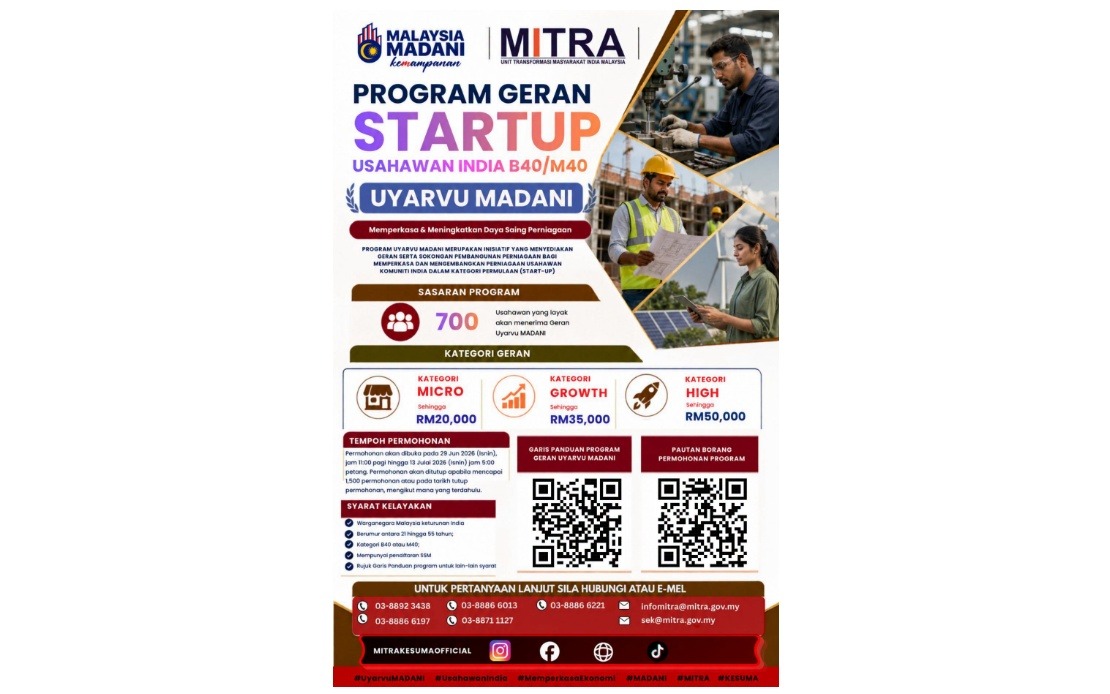
The Malaysian Indian Transformation Unit (MITRA) has opened applications for the Uyarvu MADANI Startup Accelerator Grant Assistance Programme, welcoming submissions from today through 5 pm on July 13. The initiative represents a targeted effort to uplift entrepreneurship within the Indian community, specifically reaching out to individuals and business owners operating within the B40 and M40 income brackets who seek to launch or expand their ventures.
The grant structure offers financial support ranging from RM20,000 to RM50,000 per recipient, designed to provide meaningful capital injection for startup operations and business development activities. Rather than simply distributing funds, MITRA has positioned Uyarvu MADANI as a comprehensive support mechanism, complementing financial grants with dedicated business development assistance aimed at enhancing competitive capacity and facilitating business expansion across the Indian entrepreneurial community.
MITRA projects that approximately 700 entrepreneurs will ultimately benefit from the Uyarvu MADANI programme. However, the unit has implemented an early closure mechanism to manage application volume efficiently. Should the programme receive 1,500 applications before the July 13 deadline, submissions will be closed at that point, effectively creating a first-come, first-served dynamic for prospective applicants. This dual-closure arrangement—either by deadline expiration or application quota—underscores the significant anticipated demand for such targeted support.
Uyarvu MADANI constitutes one component of a broader six-initiative package that MITRA has unveiled for 2026, representing a comprehensive approach to Indian community transformation and economic empowerment. The collective allocation supporting these six initiatives totals RM65.5 million, positioning the Indian entrepreneurship agenda as a substantive priority within Malaysia's broader inclusive growth framework. This investment level demonstrates governmental commitment to addressing economic participation disparities and creating pathways for underrepresented communities.
For Malaysian context, the programme's targeting of B40 and M40 income groups reflects recognition that barriers to startup financing disproportionately affect lower and middle-income households. By directing support specifically toward these segments within the Indian community, MITRA addresses a documented challenge in Malaysia's entrepreneurial ecosystem: limited access to initial capital and structured business mentorship among economically disadvantaged populations. The RM20,000 to RM50,000 grant range aligns with realistic funding requirements for small-scale service sector and retail enterprises that commonly characterize startup attempts within this demographic.
The business development support component accompanying financial grants carries particular significance for first-time entrepreneurs often lacking formal business training or professional networks. While capital remains essential, sustained business success requires operational knowledge, market positioning strategy, and access to supply chains—domains where structured mentorship programmes deliver measurable impact. MITRA's bundled approach addresses this multi-dimensional challenge rather than treating capital access as a standalone solution.
Regionally, Malaysia's Uyarvu MADANI initiative situates the country within Southeast Asia's growing focus on community-specific entrepreneurship programmes. Thailand, Indonesia, and the Philippines have similarly implemented targeted grant schemes for minority and lower-income entrepreneurial populations, recognizing that inclusive economic growth requires deliberate policy intervention. Malaysia's Indian community, comprising approximately 1.2 million persons with particular concentration in urban and semi-urban areas, historically has participated less robustly in formal entrepreneurship compared to other demographic groups—a pattern that targeted initiatives like Uyarvu MADANI aim to reverse through structural support.
Applications can be submitted through MITRA's official channels, though the exact application process and specific eligibility documentation requirements warrant careful review for prospective candidates. Interested entrepreneurs should gather relevant business planning documentation, financial records demonstrating current economic status, and preliminary business concept details ahead of submission. Given the early-closure possibility should applications reach 1,500, prompt completion of the application process proves advisable for serious candidates.
The timing of this announcement and application window carries political significance within Malaysia's broader discourse around inclusive development and minority economic empowerment. With parliamentary attention increasingly focused on equitable wealth distribution and community-specific assistance programmes, Uyarvu MADANI exemplifies policy mechanisms translating such commitments into concrete financial instruments. The programme's visibility and accessibility will likely influence not only direct beneficiary outcomes but also broader political perceptions regarding governmental responsiveness to specific community economic priorities.
Beyond immediate funding implications, Uyarvu MADANI participants will join an ecosystem of supported entrepreneurs whose collective success generates multiplier effects across their communities. Successful startup outcomes create visible role models, demonstrate feasibility pathways, and build cultural confidence in entrepreneurship within communities where formal business ownership previously seemed inaccessible. These social dynamics prove as important as capital injection itself in reshaping long-term entrepreneurial participation patterns.
Prospective applicants should note the July 13 deadline and the potential for earlier closure if application numbers reach 1,500. Early submission remains strategically prudent, and contacting MITRA directly for clarification on specific eligibility criteria, required documentation, and submission procedures will facilitate smoother application processes. For Malaysia's Indian entrepreneurial community, this programme represents a significant opportunity to access startup financing and professional business guidance during a critical period of economic recovery and growth focus.

