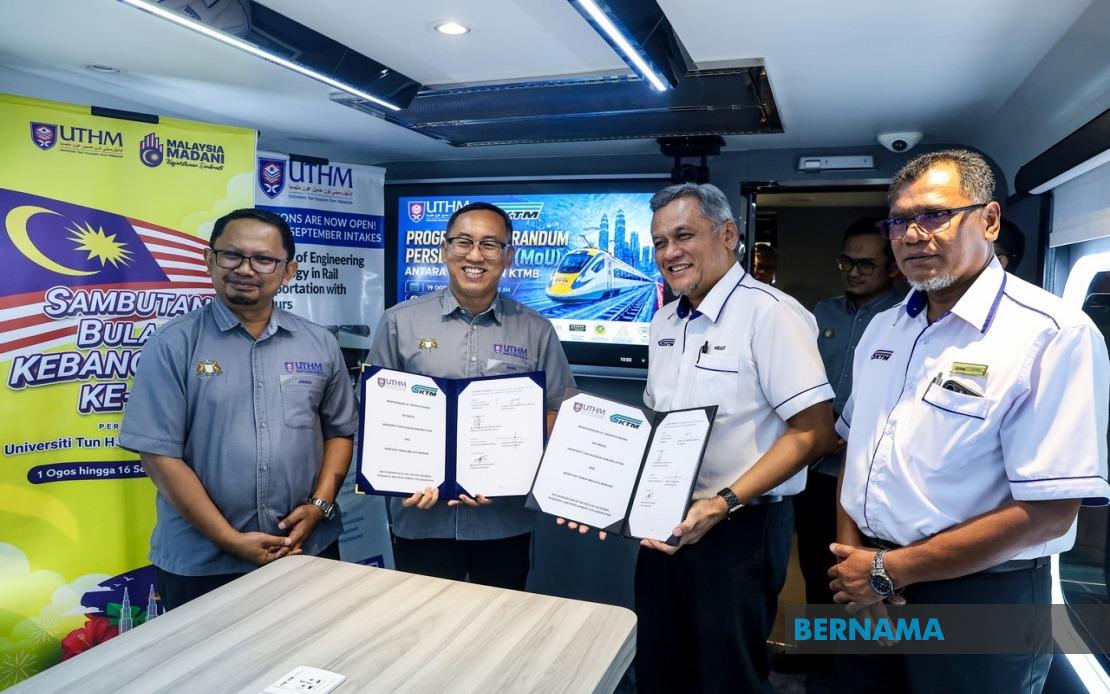
Malaysia's push to develop a skilled workforce in rail transportation has taken a significant step forward with the renewal of a strategic partnership between Universiti Tun Hussein Onn Malaysia (UTHM) and Keretapi Tanah Melayu Bhd (KTMB). The collaboration, which runs from October 2026 through July 2029, represents a continuation of the original 2019 agreement and demonstrates the growing importance of academia-industry cooperation in shaping the country's transport infrastructure capabilities.
The renewed partnership brings together UTHM's research infrastructure and academic expertise with KTMB's operational knowledge and real-world rail experience, creating a comprehensive ecosystem for talent development. This approach addresses a critical gap in Malaysia's transportation sector, where the demand for technically skilled professionals in rail technology continues to outpace the supply of graduates with hands-on industry experience. By formalising this collaboration over three years, both institutions signal their commitment to building sustainable pathways from education to employment in this strategically important field.
Work-based learning forms the cornerstone of this renewed agreement, providing UTHM students with direct immersion into the operational realities of Malaysia's national rail network. Rather than learning rail engineering principles solely in laboratories and lecture halls, students gain practical exposure to the challenges, technologies and procedures that define modern rail operations. This experiential education approach has already proven its value, with nearly 200 graduates from UTHM's Bachelor of Rail Transportation Engineering Technology with Honours programme now working in the rail sector domestically and internationally, including positions in Singapore and Saudi Arabia.
The partnership extends well beyond student placements into structured research collaboration. UTHM's academic facilities and research capabilities combine with KTMB's operational data and technical infrastructure to create a platform for developing practical solutions to real-world challenges. Rather than pursuing research in isolation, both parties can identify pressing technical issues within Malaysia's rail system and deploy academic rigour to address them. This creates a feedback loop where cutting-edge research directly improves service delivery and operational efficiency for one of Southeast Asia's oldest and most important rail operators.
KTMB's commitment to the partnership extends to investing in its own staff development. The operator has nominated five employees to pursue master's degrees in rail-related fields at UTHM, reflecting recognition that technical advancement requires continuous upskilling even among experienced professionals. This commitment to staff education within KTMB signals confidence in UTHM's programmes and demonstrates how public enterprises can invest in developing their own talent pipelines rather than relying solely on external recruitment.
The collaboration also encompasses curriculum development and academic guidance, with KTMB contributing industry consultation to UTHM's diploma, bachelor's and postgraduate programmes in rail transportation engineering technology. Additionally, the partnership extends to KTM Academy (MyRA), the dedicated training arm for rail professionals, where UTHM expertise will inform curriculum design and delivery. This ensures that training across multiple education levels—from vocational diplomas to advanced postgraduate study—remains aligned with evolving industry requirements and technological developments.
For UTHM specifically, this partnership supports the institution's strategic vision of becoming a Global Technopreneur University 2030 (GTU2030). This framework prioritises integrating knowledge, technology, innovation and entrepreneurship into how the university develops talent. The KTMB collaboration demonstrates this integration in practice, moving beyond theoretical techno-entrepreneurship to create a model where academic institutions actively contribute to solving operational challenges facing major industrial employers. Students develop not only technical competencies but also entrepreneurial mindsets capable of identifying opportunities within established industries.
The timing of the partnership renewal carries significance for Malaysia's broader transportation strategy. As the nation continues to invest in rail infrastructure modernisation and expansion, the availability of locally-trained engineers and technicians becomes increasingly critical. Rather than importing expertise or relying on foreign technical consultants, building domestic capacity through sustained collaboration between universities and operators ensures that Malaysia develops sovereign capability in rail technology. This has direct implications for project costs, decision-making speed and the sustainability of rail infrastructure improvements.
Geographically, Malaysia's position as a regional economic hub means that rail engineering skills developed locally through UTHM and KTMB find application beyond national borders. The fact that graduates are working in Singapore and Saudi Arabia demonstrates that Malaysian rail education meets international standards and is valued in competitive regional and global markets. This creates a positive feedback loop where international recognition attracts stronger student cohorts and enhances UTHM's reputation as a centre of excellence in transportation engineering.
The partnership also reflects broader trends in Southeast Asia toward strengthening academia-industry linkages. Countries throughout the region recognise that isolated university research disconnected from practical industry needs produces limited value, while work-based learning programmes without proper academic structure lack the theoretical depth necessary for sustained innovation. The UTHM-KTMB model offers a blueprint for other regional sectors and countries seeking to bridge this gap through formalised, multi-year partnerships with clear deliverables.
For students entering UTHM's rail-focused programmes over the next three years, the renewed partnership offers tangible advantages. Rather than graduation representing a transition from academic to professional environments, work-based learning creates a graduated entry into professional practice. Students develop networks within KTMB, understand the operator's strategic priorities and existing challenges, and may find employment pathways already partially defined during their studies. This reduces friction in labour market entry and increases the likelihood that engineering graduates transition quickly into productive roles.
The exchange of the partnership agreement aboard a KTMB chartered train, conducted in conjunction with Malaysia's 69th National Month Celebration, carried symbolic weight beyond the administrative formality. The setting emphasised that rail technology remains central to Malaysia's infrastructure narrative and national identity. It also highlighted KTMB's continued operational importance and the government's confidence in renewing institutional partnerships that support long-term capability building in critical sectors.
Looking forward, the three-year timeline allows both institutions to demonstrate concrete results—research outputs, graduate employment rates, competency assessments and operational improvements attributable to the partnership. Success in this cycle will likely establish foundations for further extensions, deepening integration and potentially expansion to other Malaysian universities and rail-related organisations. For Malaysia's broader transport sector, the UTHM-KTMB partnership represents an investment in human capital and institutional capacity that should yield dividends across multiple decades of rail operations and infrastructure development.

