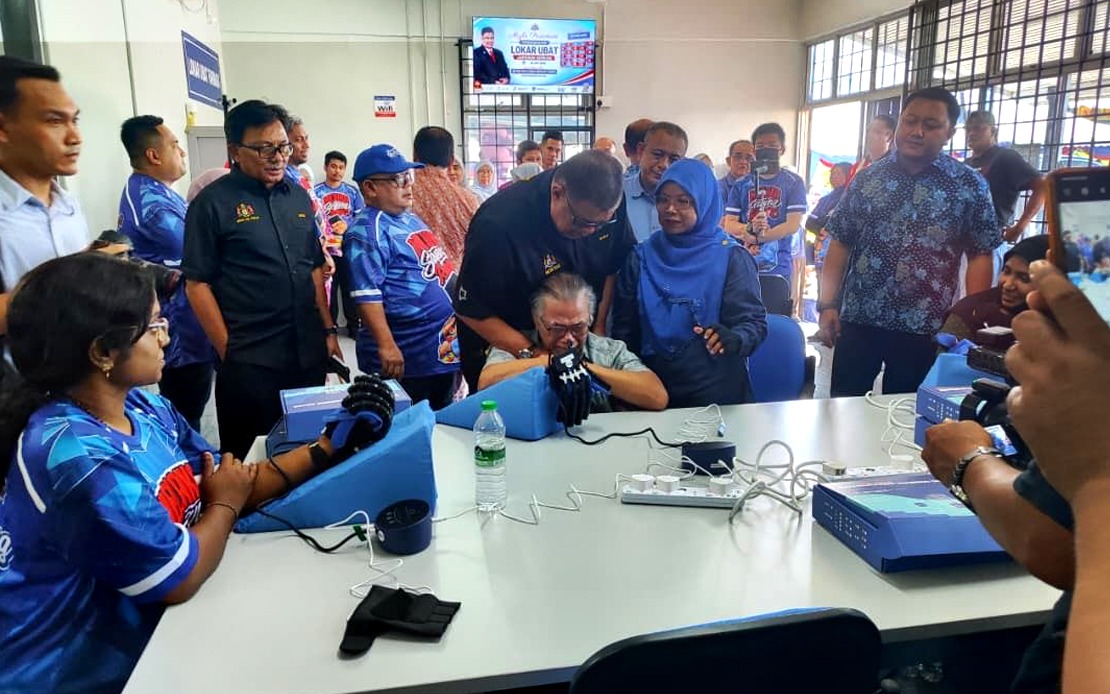
Universiti Teknikal Malaysia Melaka (UTeM) has opened an innovative rehabilitation facility in Serkam, Jasin, that harnesses technology to deliver recovery services to patients struggling with stroke, injury-related mobility issues and limb weakness. The MADANI Community Rehabilitation Centre and Gymnasium represents a significant step forward in bringing advanced treatment options to communities beyond major urban centres, addressing a critical gap in accessible physiotherapy and rehabilitation services across Melaka and potentially the wider region.
Funded through the Finance Ministry's UniMADANI 2024 Grant, the facility integrates technologies developed entirely by UTeM researchers, transforming the landscape of community-based healthcare delivery. Rather than relying solely on traditional physiotherapy methods, the centre deploys what amounts to a suite of robotics and assistive systems that enable patients to undertake structured rehabilitation protocols with precision and consistency. The approach reflects growing global recognition that technology-enabled recovery can accelerate healing while reducing the burden on overstretched physiotherapy professionals.
Among the innovations deployed at the facility is the Roboglove, a hand-rehabilitation device that assists patients in regaining fine motor control and grip strength through guided, repetitive training protocols. The system represents years of engineering refinement to ensure safety while maximising therapeutic benefit. Complementing this is the Assistive Lower Limb Chair (ALLC), which automates lower limb exercise routines, allowing patients with mobility constraints to engage in consistent training that would otherwise be physically demanding or impossible to perform independently. These devices address two of the most common challenges faced by stroke survivors and individuals with severe injuries: restoring hand function and rebuilding leg strength.
The centre's third major technological component is an exoskeleton system designed to enhance movement training effectiveness by providing mechanical support while guiding limbs through correct movement patterns. Exoskeleton technology has demonstrated substantial promise in rehabilitation settings internationally, yet remains largely unavailable in Malaysian public healthcare facilities due to cost and technical expertise requirements. By housing the system within a community centre, UTeM has made the technology accessible to patients who would ordinarily lack access to such advanced tools. The psychological impact of regaining mobility through such systems often translates into improved patient motivation and adherence to rehabilitation programmes.
Chief Minister Datuk Seri Ab Rauf Yusoh officially opened the facility as part of the Public University Community Empowerment Programme (Komuniti @UniMADANI), underscoring the project's alignment with state-level development priorities. The timing reflects heightened government attention to bridging healthcare disparities between urban and rural populations, a recurring challenge across Southeast Asia where specialist services concentrate in metropolitan areas. By establishing the facility in Serkam rather than central Melaka city, planners recognised the genuine need within surrounding communities while reducing travel burdens on vulnerable patients.
UTeM Vice-Chancellor Prof Datuk Dr Massila Kamalrudin characterised the centre as a catalyst for expanding access to technology-enabled rehabilitation across Malaysia, framing it as evidence of universities fulfilling their societal responsibility to convert research into tangible community benefit. Her statement reflects a deliberate institutional strategy to position UTeM not merely as an academic body but as a practical partner in addressing pressing healthcare challenges. This reorientation towards community-focused research outcomes carries particular significance for Malaysian public universities, which increasingly face expectations to justify public funding through demonstrable social impact.
The centre emerged through multi-stakeholder collaboration spanning UTeM, the Serkam State Constituency Development and Coordination Committee (Japerun) Office, the Kampung Pulai Village Development and Security Committee, the Social Welfare Department and the Social Security Organisation (PERKESO). This partnership architecture reflects the reality that sustainable rehabilitation infrastructure requires coordination across academic institutions, local governance structures, social welfare systems and occupational safety bodies. The involvement of PERKESO, which manages workplace injury compensation, suggests the facility will serve not only stroke patients but also workers recovering from industrial accidents—a substantial patient population across Malaysia's manufacturing-dependent economy.
The facility's establishment carries implications extending beyond immediate patient care. It demonstrates that sophisticated rehabilitation technology need not remain confined to private hospitals serving affluent urban populations. By housing such systems within a community centre framework, the model potentially reshapes expectations regarding what rehabilitation capacity should exist in secondary towns. For other Malaysian states and for ASEAN neighbours grappling with similar healthcare distribution challenges, the UTeM model offers a replicable template combining university research capabilities with pragmatic community deployment.
Prof Massila emphasised the university's aspiration to expand this collaborative model to additional locations, a statement reflecting recognition that single facilities, however innovative, cannot address regional rehabilitation deficits comprehensively. Scaling the approach requires sustained funding, consistent technical support, and trained personnel capable of operating sophisticated equipment—prerequisites that demand ongoing institutional commitment rather than one-off project cycles. The Finance Ministry's UniMADANI grant structure potentially enables such expansion, though subsequent rounds of funding will prove crucial to realising the ambition of distributed rehabilitation capacity.
From a policy perspective, the MADANI Centre exemplifies how targeted university-government partnership can address healthcare equity without requiring massive capital expenditure on infrastructure duplication. Rather than building parallel rehabilitation hospitals, anchoring advanced services within university-managed community facilities leverages existing research expertise and institutional legitimacy. This approach holds particular resonance for Southeast Asian nations where healthcare budgets remain constrained despite rising demand from ageing populations and persistent non-communicable disease burdens including stroke.
The patient experience at such facilities likely differs materially from traditional physiotherapy settings. The combination of objective feedback from robotic systems, consistent exercise protocols, and the psychological motivation of engaging with visible technology may enhance compliance and therapeutic outcomes. Longitudinal data tracking patient recovery trajectories through the MADANI Centre will be essential to validating whether technology-enabled rehabilitation produces superior functional outcomes compared to conventional approaches, a question that remains incompletely resolved despite growing international deployment of such systems.
Moving forward, the facility's success will depend partly on patient awareness and referral pathways. Healthcare workers and clinicians must understand the centre's capabilities and know how to connect patients who would benefit most from technology-enabled rehabilitation. Equally important is developing sustainable financing mechanisms, as the initial UniMADANI grant funding must eventually transition to operational budgets that do not compromise accessibility for patients unable to afford private rehabilitation services. These practical implementation questions will ultimately determine whether the MADANI Centre remains a pioneering showcase or evolves into a template for genuine healthcare system transformation across Malaysia.

