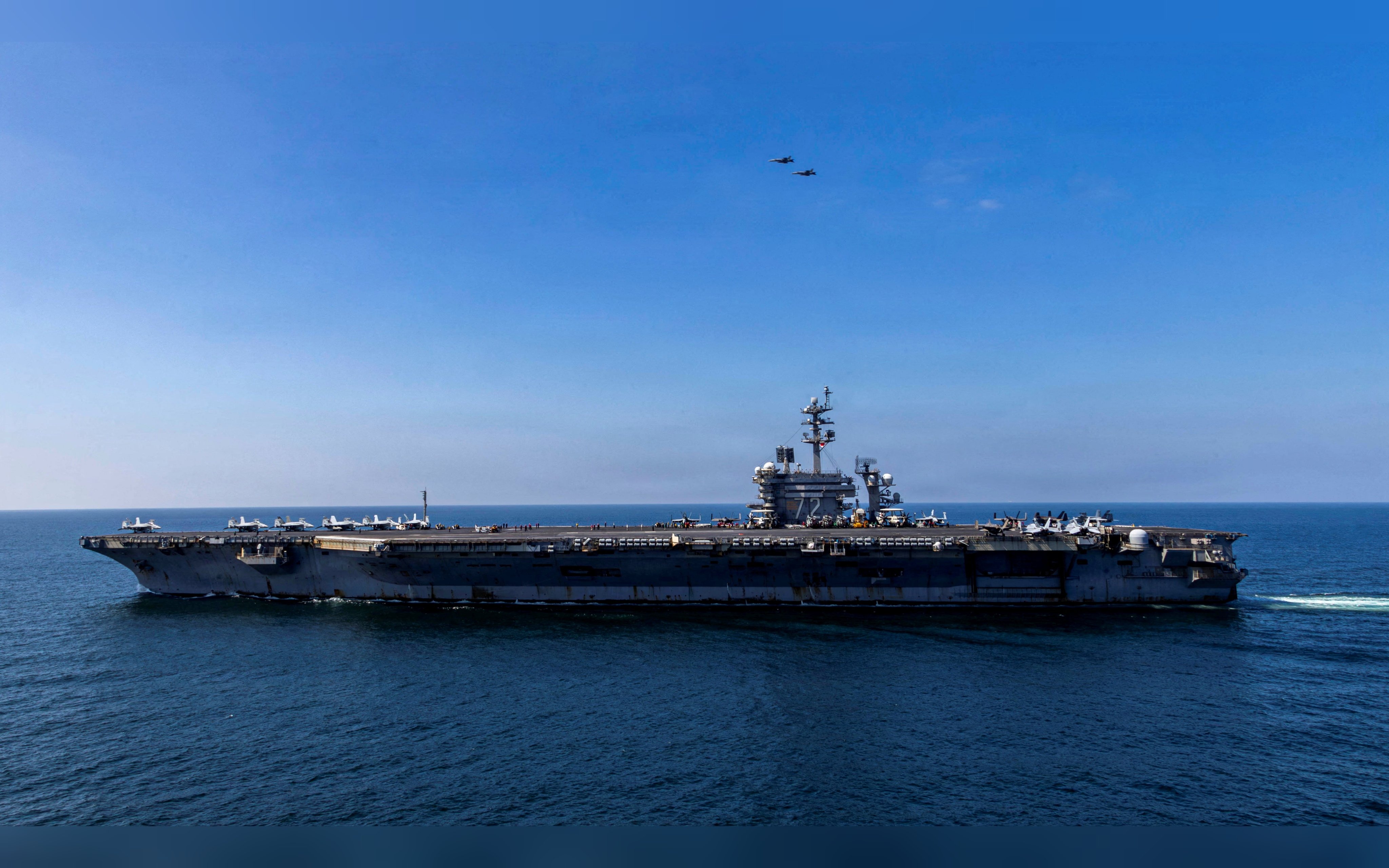
The United States has initiated a planned carrier rotation in West Asia, with President Donald Trump confirming on Friday that the USS Abraham Lincoln will be relieved by another vessel as part of standard military deployment schedules. The decision follows mounting concerns about the prolonged deployment conditions endured by the carrier's crew, whose families have raised alarm over a range of welfare issues that accumulated during the ship's extended mission in the region.
Trump's announcement came in response to questions from journalists regarding the strain placed on American sailors serving aboard the Lincoln. While acknowledging the replacement, the president characterised the deployment duration differently from those raising concerns, stating that from his perspective the mission duration had not exceeded operational requirements. The USS George Washington, a sister carrier of comparable capabilities, will assume responsibility for regional operations as Washington maintains its security posture in West Asia.
The Lincoln's current deployment cycle has extended beyond typical operational schedules, with the vessel remaining at sea for more than 250 consecutive days. Most significantly, the carrier has not made a port call for the past 200 days, severely limiting opportunities for crew rest, resupply, and morale maintenance. The deployment commenced in November, but the vessel's trajectory shifted dramatically in January when it was redirected to West Asia amid escalating tensions and military operations in the region.
Senator Richard Blumenthal of Connecticut brought the crew's predicament to public attention through correspondence with Defence Secretary Pete Hegseth and acting Navy Secretary Hung Cao. The senator's letter detailed a deteriorating situation aboard the carrier, documenting shortages of basic supplies, water contamination affecting shipboard systems, plumbing failures, widespread mental health concerns among personnel, and safety hazards on flight operations decks. Additionally, disruptions to mail delivery had delayed care packages by months, further isolating crew members from family connections.
Acting Navy Secretary Hung Cao framed the return announcement within the context of operational success, emphasising that the Lincoln had completed its assigned mission and would soon return home as part of a scheduled rotation cycle. In his statement, Cao stressed that sailor and Marine safety constituted the Navy's paramount concern, positioning the replacement decision as evidence of institutional commitment to personnel welfare. He articulated the challenge of sustaining operational readiness while managing the human toll of extended combat deployments, acknowledging the inherent difficulty in balancing mission accomplishment with crew wellbeing.
Cao provided detailed metrics regarding the Lincoln's operational output. The carrier accumulated 266 days of total deployment, of which 200 days were spent in active combat zones. During this period, the carrier's air wing executed more than 10,000 sorties—individual aircraft missions—and delivered more than 1.5 million pounds of ordnance on targets. These figures underscore the intensity and scale of the Lincoln's contribution to regional military operations, helping contextualise why the extended deployment was deemed necessary by military planners.
The deployment extension itself resulted directly from operational demands rather than administrative oversight. Cao explained that the mission requirements mandated prolonging the Lincoln's presence in theatre, necessitating adjustments to originally planned timelines. He acknowledged that warfare fundamentally disrupts normal routines and creates circumstances beyond what standard planning can accommodate, a reality that military personnel and their families must navigate when combat operations expand in scope or duration.
Welfare challenges emerged predictably from the extended confinement and operational stress. Cao disclosed that a small number of sailors and Marines received mental health treatment during the deployment, though he stressed that no deaths resulted from these cases. This disclosure provides some reassurance regarding the most severe outcomes while simultaneously confirming that psychological strain affected personnel across the carrier's complement. The acknowledgment represents an unusually transparent statement from Navy leadership about the mental health implications of sustained combat operations.
The carrier rotation represents a crucial juncture in West Asian military operations, particularly given the region's strategic importance and the frequency with which carrier deployments have been extended or interrupted by crises. The USS George Washington's arrival will ensure continuity of American naval presence and capabilities in the region, maintaining the ability to project power and respond to emerging threats. For Southeast Asian nations, continued American naval operations in the broader region carry implications for regional stability and freedom of navigation in crucial sea lanes.
The Lincoln's experience illustrates the practical challenges of sustaining extended military operations, particularly for capital ships like aircraft carriers that serve as floating military bases requiring constant maintenance and crew rotation. The vessel's extended deployment without port calls created cascading problems—supply shortages, maintenance backlogs, and psychological stress—that collectively degraded the crew's quality of life and potentially affected operational efficiency. These challenges have prompted renewed discussion within defence circles about optimal deployment cycles and the sustainability of current operational tempos.
For Malaysian policymakers and defence observers, the Lincoln case study offers insights into the strains that extended military commitments impose on personnel and institutions. As regional countries consider their own defence postures and security partnerships, understanding the human costs of sustained deployments becomes relevant to force planning and personnel management decisions. The incident also underscores the importance of adequate supply chains, infrastructure support, and psychological services for military personnel engaged in prolonged operations.
The replacement decision ultimately reflects a pragmatic acknowledgment that military effectiveness ultimately depends on personnel wellbeing and morale. While operational demands necessitated the Lincoln's extended presence in West Asia, that extension created welfare conditions that eventually required corrective action. The USS George Washington's deployment represents not a retreat from regional commitments but rather a sustainable approach to maintaining military presence while respecting the physiological and psychological limits of the personnel who crew these vessels. This approach suggests an evolution in how the American military services balance mission accomplishment with the welfare of their service members.

