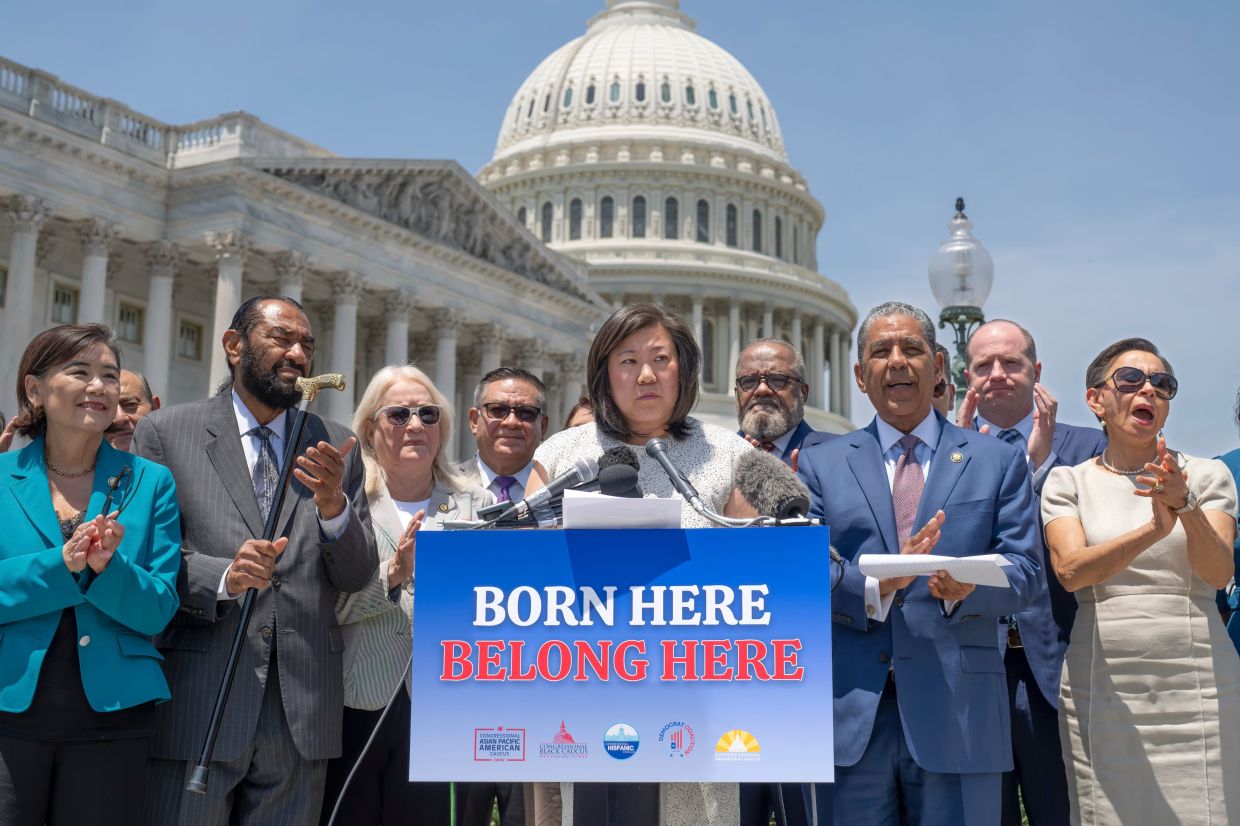
The United States Supreme Court has dealt a significant blow to one of President Donald Trump's flagship immigration policies, voting 6-3 to invalidate an executive order that would have stripped birthright citizenship from children born to undocumented immigrants and those on temporary visas. The decision in Trump vs Barbara reaffirms that birthright citizenship remains a foundational constitutional right for nearly all children born on American soil, regardless of their parents' legal status.
Trump had signed the controversial executive order in early 2025, attempting to curtail citizenship entitlements for children whose parents were either unlawfully present in the United States or temporarily residing there on visas. The policy was scheduled to take effect the following month before legal challenges halted its implementation. The Supreme Court's ruling now makes clear that such executive action exceeds presidential authority and conflicts with the 14th Amendment's Citizenship Clause, a provision rooted in the post-Civil War Reconstruction era.
The order had cast an unexpectedly wide net that extended far beyond the rhetoric surrounding undocumented immigration. It would have affected children born to lawfully present foreigners on highly skilled work visas such as H-1B and L-1 classifications, as well as those on student visas, temporary labour visas, achievement visas, and dependent visas—all categories officially classified as "lawful but temporary" by US Citizenship and Immigration Services. The only protection in the order came if one parent held US citizenship. This broader targeting of legally present immigrants represented a notable departure from the public discussion about the policy, which had focused predominantly on unlawful entry.
Chief Justice John Roberts articulated the majority's constitutional reasoning in sweeping terms, emphasizing that citizenship historically represented "the right to have rights—to freely participate in our political community." He noted that the framers of the 14th Amendment, adopted in 1866 and ratified in 1868, deliberately extended that promise to "every free-born person in this land" specifically to protect the rights of former enslaved people and other minorities. This historical context proved determinative in the court's analysis, grounding the decision in original constitutional intent rather than purely contemporary policy preferences.
The legal foundation for modern birthright citizenship traces to the landmark 1898 Supreme Court case United States v. Wong Kim Ark, which established that nearly all persons born on US soil automatically acquire citizenship regardless of their parents' nationality or immigration status. Wong Kim Ark himself had been denied re-entry to America after travelling to China, with officials claiming he was not a citizen under the Chinese Exclusion Act because of his parents' status as Chinese immigrants. The Supreme Court overturned this discrimination, recognizing that birthright citizenship was constitutionally protected. Descendants of Wong Kim Ark responded to this week's ruling with evident emotion. Norman Wong, a great-grandson, reflected that his ancestor "was one man, only a cook, and yet he stood up for what was right, and I believe that it has made a difference."
Reacting to the Supreme Court decision, Trump took to social media to express frustration and chart a legislative path forward. He claimed the ruling was detrimental to the nation but insisted Congress could "easily make it up through Legislation" without requiring a "long and unwieldy Constitutional Amendment." Trump called on Congress to immediately commence work on ending what he characterized as the "expensive and unfair" practice of birthright citizenship, pledging his "Complete and Total Support" to such legislative efforts. His statements suggested the administration intends to pursue congressional action as an alternative strategy, though such an approach would face formidable constitutional and political obstacles.
Interestingly, Trump also directed congratulations toward China and President Xi Jinping regarding what he framed as their "massive Birthright Citizenship WIN," a rhetorical move that highlighted how birth tourism had become increasingly central to the administration's framing of the citizenship issue. While illegal immigration has traditionally dominated birthright citizenship debates, allegations concerning so-called birth tourism—particularly involving Chinese nationals—had gained prominence in recent political and policy discussions. This shift reflected Trump's broader immigration campaign narrative, which positioned foreign nationals from potentially adversarial countries as exploiting American maternity wards to obtain citizenship for their children.
The Trump administration doubled down on birth tourism enforcement even as the Supreme Court rejected the broader citizenship order. In an afternoon memo distributed on Tuesday, the US Department of Justice directed federal prosecutors to prioritise investigations of birth tourism schemes. Colin McDonald, a senior Justice Department official, wrote that the department would "zealously protect the sanctity of United States citizenship by investigating and prosecuting those who fraudulently exploit our immigration system." The DOJ memo cited a concrete example: a 2024 case in which Michael Wei Yueh Liu and Jing Dong were each sentenced to 41 months in prison for operating a birth tourism scheme that charged Chinese clients tens of thousands of dollars to facilitate births in the United States.
The Trump administration's Solicitor General, D. John Sauer, had argued during Supreme Court oral arguments in April that birthright citizenship "has spawned a sprawling industry of birth tourism" and claimed that "uncounted thousands of foreigners from potentially hostile nations" had come to give birth in America. This framing sought to recast the constitutional question as a matter of national security and immigration fraud rather than a clash over fundamental rights. However, the court's majority rejected this reframing, viewing the constitutional principles at stake as transcending contemporary immigration disputes.
For Asian-American communities and civil rights advocates, the Supreme Court's decision carries particular resonance and historical weight. Stop AAPI Hate, an organisation tracking discrimination against Asian-Americans and Pacific Islanders, emphasized that the ruling held special significance for these communities given Wong Kim Ark's Chinese heritage and the enduring legacy of the Chinese Exclusion Act era. The organisation argued that "birthright citizenship has shaped America into the uniquely diverse and democratic nation it is today" and that "because of this right, the Asian-American community and other communities of colour have been able to grow in size and political power—and that is precisely why the Trump administration attempted to end it."
Krish O'Mara Vignarajah, president of Global Refuge, a non-profit organisation working with refugees, characterised the ruling as a triumph for constitutional rights. Vignarajah noted that birthright citizenship had survived historical challenges including the Chinese Exclusion Act and the Jim Crow era, and had now survived an executive order that would have effectively transformed American maternity wards into customs checkpoints. The language employed by advocates underscores how the birthright citizenship debate intersects with broader questions about American identity, immigration law, and the nation's historical reckoning with racial discrimination.
The Supreme Court's decision creates immediate uncertainty about whether Trump and his administration will pursue the legislative avenue he has endorsed, potentially submitting a constitutional amendment proposal to Congress or pursuing standalone legislation to restrict birthright citizenship. Any legislative approach would require either a super-majority in Congress to pass a constitutional amendment—an extraordinarily difficult threshold—or creative legislative workarounds that courts would likely scrutinise closely. The ruling thus represents not an endpoint in the birthright citizenship debate but rather a temporary legislative barrier that the Trump administration appears determined to challenge through alternative constitutional and legal mechanisms.

