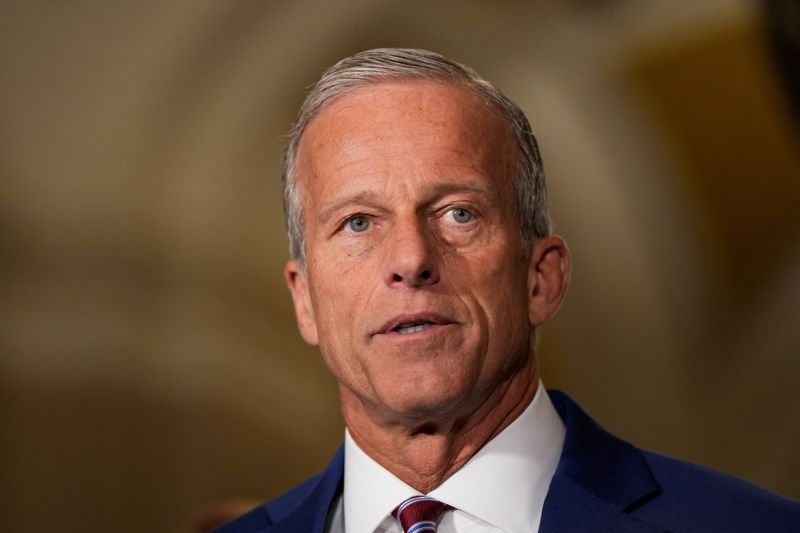
The Republican-controlled U.S. Senate is pressing forward with legislation that would fundamentally reshape how cryptocurrencies are regulated in America. On Saturday, Senate Majority Leader John Thune filed a procedural motion to advance the Clarity Act when Congress reconvenes after its August recess in mid-September, signalling that Senate Republicans believe they can assemble sufficient votes for the bill's passage despite persistent Democratic resistance. The move represents a strategic acceleration of a measure that has become central to the Trump administration's policy agenda and a priority for the crypto industry at large.
For legislation to succeed in an evenly divided chamber, the Clarity Act requires support from all voting Republican senators plus at least eight Democrats, a challenging mathematical equation in a polarized Congress. The filing of the procedural motion suggests that GOP leadership has conducted internal calculations indicating this coalition is achievable, though negotiations remain ongoing. The current Democratic opposition underscores the contentious nature of crypto regulation, with party members expressing concerns about consumer protection, financial stability, and potential conflicts of interest involving senior government officials.
The Clarity Act would represent the first comprehensive federal framework governing digital assets, addressing a significant gap in American financial regulation. The legislation would establish clear criteria for determining whether specific tokens constitute securities or commodities, a distinction with enormous practical implications for how different regulatory agencies exercise jurisdiction. Currently, ambiguity around classification has created a patchwork of regulatory approaches, with the Securities and Exchange Commission, the Commodity Futures Trading Commission, and banking regulators all claiming overlapping authority. Industry advocates argue that this legal uncertainty has hampered innovation and pushed American crypto companies to relocate abroad.
For the cryptocurrency sector, passage would represent a watershed moment. Crypto companies have invested heavily in political advocacy, contributing more than $119 million to pro-crypto candidates during the 2024 election cycle, explicitly targeting the advancement of the Clarity Act and complementary stablecoin legislation. The industry maintains that a clear regulatory framework would facilitate mainstream adoption by providing legal certainty to both companies and consumers, potentially unlocking new use cases and business models. From an international competitiveness perspective, advocates argue that comprehensive American regulation would position the country favourably against other nations developing their own crypto frameworks.
President Donald Trump has made crypto policy a centerpiece of his second administration, viewing it as both an economic opportunity and a political asset. His personal financial interests in digital assets are substantial—he reported over $1.4 billion in family crypto income for the previous year—a fact that Democrats have seized upon when questioning the administration's objectivity on the issue. Trump previously signed stablecoin legislation into law, and securing passage of the Clarity Act would constitute a second major crypto policy victory. The White House has been actively lobbying lawmakers to support the measure, recognizing its importance to the tech-forward segments of his political coalition.
The crypto industry's substantial electoral spending reflects the sector's recognition that regulatory clarity represents a prerequisite for sustainable growth. Unlike emerging industries that might operate in grey zones indefinitely, crypto's deep integration with banking infrastructure and its role in safeguarding consumer wealth create pressure for formal legal status. The 2024 election cycle demonstrated the sector's political sophistication and its willingness to deploy resources across party lines, though it tilted significantly toward pro-crypto Republicans.
Traditional financial institutions, particularly banks, view the legislation with considerable alarm. Banking sector representatives have fought to restrict provisions that would enable crypto companies to compete directly for customer deposits by offering returns on stablecoin holdings. Such competition threatens the traditional deposit-gathering model that underpins bank business models. This dynamic reflects a fundamental tension between technological disruption and incumbent industry protection, a conflict that has only intensified as crypto has matured from a fringe asset class to a consequential segment of the financial ecosystem.
Democratic concerns extend beyond consumer protection to governance questions. Party members want stronger restrictions on government officials' cryptocurrency ventures, viewing potential conflicts of interest as a threat to impartial policymaking. These negotiations remain fluid and represent a potential stumbling block to assembling the requisite eight Democratic votes. Any compromise package would need to address these concerns sufficiently to win support from moderate Democrats while remaining palatable to Trump and his allies, who prioritize regulatory clarity over ethical restrictions.
The timing of the procedural motion, scheduled for mid-September when Congress returns, gives both sides several weeks for intensive negotiation. The outcome will signal whether bipartisan consensus on crypto regulation is achievable or whether the issue remains too politically charged. Passage would align America with other major economies moving toward comprehensive crypto frameworks, while failure would perpetuate the current regulatory fragmentation that both industry players and consumers find frustrating.

