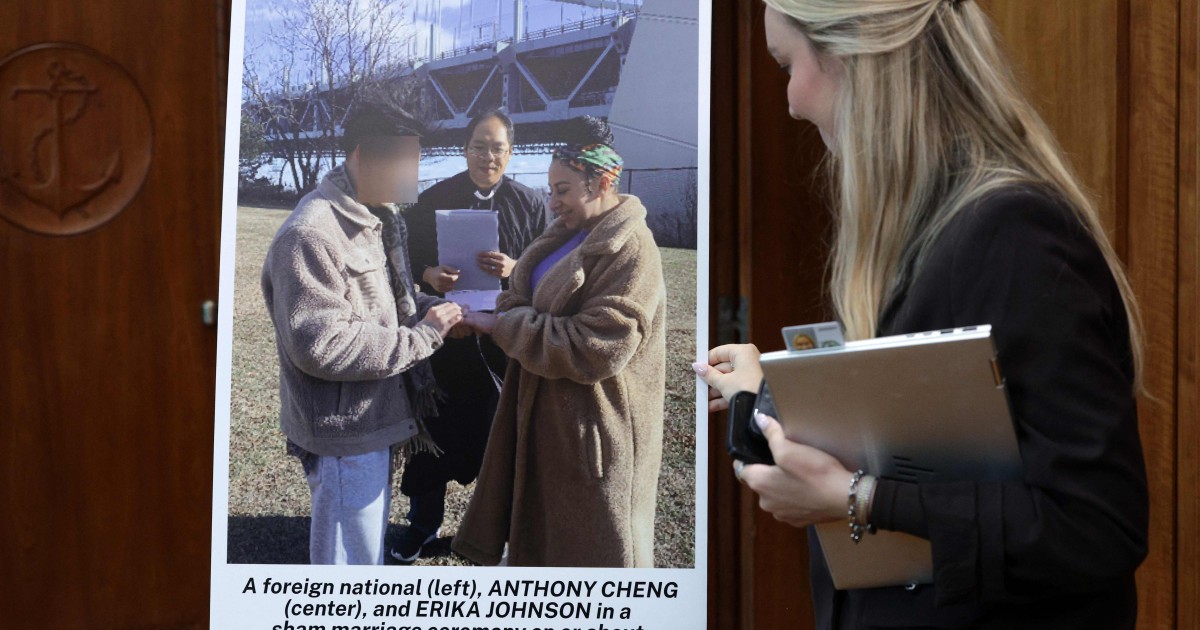
The United States Justice Department has filed charges against eleven individuals accused of orchestrating one of the most extensive marriage fraud conspiracies in recent memory, according to court filings released on Wednesday. The scheme, which operated over ten years, enabled roughly one thousand fraudulent unions designed to circumvent standard immigration procedures and grant legal residency to primarily Chinese nationals seeking to establish themselves in the United States.
This prosecution arrives amid intensifying scrutiny of immigration pathways and enforcement priorities, signalling a toughened stance on visa fraud and irregular entry mechanisms. The timing reflects broader policy debates surrounding immigration control, particularly following recent executive directives emphasising stricter border security and immigration oversight. The charges underscore how determined enforcement agencies have become in dismantling networks that exploit marriage-based immigration categories—a route traditionally considered more straightforward than employment or investment-based visas.
Marriage-based immigration has long presented vulnerabilities within the US legal system. The spousal visa category permits foreign nationals to obtain permanent residency relatively expeditiously if they marry American citizens, a provision designed to keep families intact. However, this accessibility has made the mechanism attractive to fraudsters who manufacture fake unions to sidestep more rigorous vetting required for other visa classifications. Investigators allege the defendants operated an organised enterprise that identified and recruited American citizens willing to participate in contractual marriages with Chinese nationals for compensation, thereby creating thousands of fictitious spousal relationships.
The conspiracy's scale—involving approximately one thousand fraudulent marriages over a decade—suggests sophisticated operational infrastructure. Rather than isolated incidents, the scheme appears to have functioned as a systematic service industry, likely with specialised roles including recruiters who identified American participants, organisers who coordinated matchings and paperwork, and facilitators who guided clients through immigration bureaucracy. Such networks typically exploit gaps between initial visa approval and subsequent immigration examinations, during which genuineness of relationships remains difficult to verify conclusively.
The prevalence of Chinese nationals in this scheme reflects broader immigration dynamics. Many Chinese citizens pursue US residency through multiple channels simultaneously, including employment-based visas, investment schemes, and family reunification routes. Some face lengthy backlogs in employment-based categories, creating incentives to explore alternative pathways. Marriage-based visas, theoretically faster than many other routes, present an appealing option despite associated legal risks. This particular network apparently capitalised on such frustrations, positioning itself as a solution for those unwilling to wait through standard application processes.
For Southeast Asian readers, particularly Malaysians, this prosecution carries instructive implications. While Malaysia maintains its own immigration procedures, transnational marriage fraud schemes occasionally surface across the region. This American case exemplifies how international enforcement cooperation now targets document fraud and marriage manipulation on global scales. Immigration authorities throughout Southeast Asia increasingly share intelligence regarding fraudulent visa marriages, recognising that schemes operating in one jurisdiction often connect to networks across multiple countries. Malaysian immigration officials monitor similar patterns involving citizens attempting to establish false marriages for visa purposes elsewhere.
The enforcement operation demonstrates evolving investigative techniques in immigration fraud cases. Digital forensics, financial tracking of compensation payments to American participants, and interviews with immigration officers who processed the fraudulent applications likely formed investigative cornerstones. US authorities probably collaborated with counterparts in China to trace money flows and identify networks beyond American borders. Such international coordination has become standard practice, as immigration fraud increasingly represents a truly transnational phenomenon.
The consequences for those involved extend far beyond criminal charges. American citizens participating in fraudulent marriages face potential felony convictions, imprisonment, and permanent damage to immigration sponsorship eligibility—they can never sponsor relatives or foreign employees for immigration benefits. For Chinese nationals, criminal convictions and immigration fraud findings trigger permanent deportability and bars from future US entry, even after completing sentences. These severe collateral consequences illustrate why such schemes ultimately prove destructive to all participants despite offering apparent shortcuts.
This prosecution aligns with broader immigration enforcement prioritisation under the current US administration. Executive directives emphasising border security and immigration integrity compliance have translated into intensified investigations into visa fraud categories. The Justice Department has correspondingly increased resources dedicated to immigration crime prosecution, resulting in more sophisticated detection and prosecution of large-scale schemes. What previously might have escaped serious investigation now receives substantial prosecutorial attention and resources.
The case raises persistent questions about marriage-based immigration system integrity. While authorities cannot eliminate all fraudulent applications, better screening mechanisms, extended interview periods, and enhanced verification of relationship authenticity could reduce vulnerabilities. Some immigration advocates argue for reforms balancing security concerns against the principle that legitimate marriages should facilitate family unity. Others contend that current protections remain insufficient and require strengthening despite added processing delays.
For immigration practitioners across Southeast Asia, this case serves as a cautionary example of enforcement consequences. Professional migration agents, notaries, and facilitators who knowingly participate in fraudulent immigration schemes face their own criminal liability. Regulatory bodies in various countries have intensified disciplinary actions against agents assisting fraudulent applications, recognising that individual prosecutions prove insufficient without targeting the intermediaries who coordinate such schemes. Professional licensing bodies now view participation in immigration fraud as grounds for permanent revocation.
The long operational history of this particular scheme—spanning ten years and generating one thousand fraudulent marriages—raises uncomfortable questions about detection delays. How did investigators require a decade to dismantle the network? Answers likely include resource limitations, the decentralised nature of marriage fraud detection which relies partly on individual immigration officers identifying suspicious applications, and the inherent difficulty distinguishing genuinely struggling long-distance relationships from calculated frauds. These challenges persist despite advances in investigative technology and international cooperation.
Moving forward, this prosecution sends unmistakable messages to potential participants throughout the world. American citizens contemplating participation in fraudulent marriages for compensation now face documented examples of federal prosecution with substantial prison sentences. Foreign nationals considering such pathways encounter permanent immigration bars and criminal records that complicate international travel and future relocation. For legitimate visa applicants, the prosecution reinforces that law enforcement maintains robust capacity to investigate and prosecute fraud schemes, encouraging voluntary compliance with honest application procedures regardless of processing delays.

