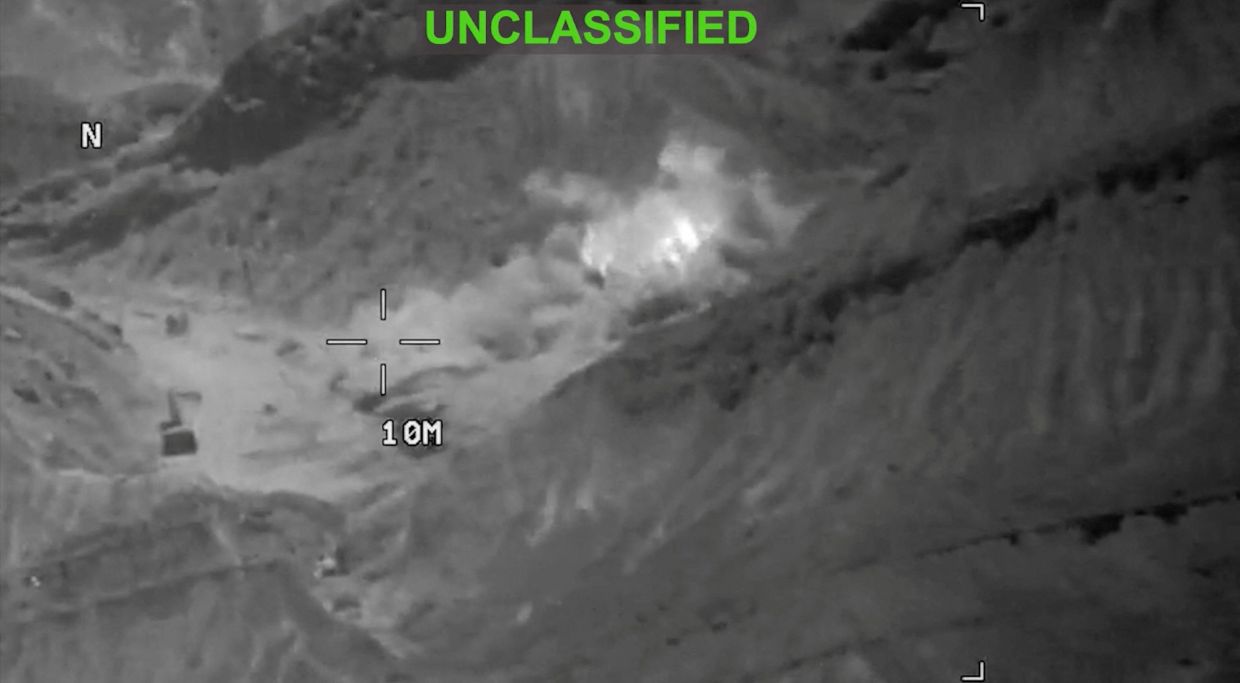
The United States has intensified its military campaign against Iran with an eighth consecutive night of airstrikes, announced shortly after the deaths of two military personnel stationed in Jordan during an Iranian attack. The renewed offensive, launched at 6 p.m. ET on Saturday under orders from President Donald Trump, represents a dramatic escalation in what has become an increasingly volatile cycle of tit-for-tat attacks between Washington and Tehran. A third American service member remains unaccounted for following the Jordan incident, further complicating diplomatic efforts already strained by the collapse of a ceasefire agreement just days earlier.
The Pentagon's Central Command characterised the strikes as targeting Iran's military infrastructure with two strategic objectives: degrading Tehran's capacity to disrupt global shipping routes through the Strait of Hormuz and directly punishing members of the Islamic Revolutionary Guard Corps responsible for the Jordan attack. According to US officials, the operation successfully struck Iranian military coastal surveillance systems and air defence installations across multiple locations. The breadth of these targets indicates a coordinated campaign designed to significantly diminish Iranian military capabilities in the Persian Gulf region, a zone of critical importance for global energy security.
Iranian reports of the strikes, meanwhile, painted a somewhat different picture. State news agencies Mehr and Tasnim reported that American forces targeted locations near Sirik in southern Iran and Shadegan near the Iraqi border, though Iranian authorities claimed no casualties or infrastructure damage resulted from these attacks. More concerning for international observers was an allegation that American forces struck a nuclear power plant facility under construction at Darkhovin, prompting Iran's Atomic Energy Organization to lodge formal condemnation. The targeting of nuclear infrastructure, whether confirmed or not, signals a significant escalation in the scope of military operations and raises immediate concerns about potential radioactive contamination or broader nuclear security implications.
In response to the American strikes, Iran initiated its own attack sequence on Sunday morning, launching unmanned aerial vehicles and missiles against American military installations in Kuwait. Iranian military sources stated that the Kuwait bases Al-Adiri and Ali Salem Air Base were targeted as part of a coordinated campaign against American assets and allied positions throughout the Gulf. Kuwait's defence forces reported intercepting the incoming Iranian weapons, while Bahrain similarly activated its air defence systems to counter another Iranian assault. The fact that no casualties or damage were reported from these Iranian attacks suggests either effective defensive measures or possible restraint in strike intensity, though the strategic messaging remained unmistakable.
The mounting human cost of the conflict has become impossible to ignore. American military deaths have now reached 16 service members since the broader hostilities began following the February 28 initiation of US-Israeli strikes against Iranian nuclear and missile capabilities. More than 420 American troops have sustained injuries in the ongoing campaign. Iran, for its part, claims that 50 civilians and military personnel died in American airstrikes over a three-week period alone, with more than 500 others wounded. These casualty figures, while still relatively modest compared to regional conflicts, underscore the human dimension of an escalating military confrontation that shows few signs of diplomatic resolution.
The confrontation extends beyond direct military exchanges to encompass broader regional instability. Both superpowers have engaged in a struggle to control navigation through the Strait of Hormuz, the critical waterway through which approximately one-fifth of the world's oil supply transits daily. The United States claims to be enforcing a naval blockade on Iran, while Iranian authorities assert that they are enforcing navigational rules within their territorial waters. Last week, the Islamic Revolutionary Guard Corps reported that four vessels attempted to transit the strait via what Tehran characterised as unsafe routes with American backing, resulting in two vessels abandoning the passage and two others becoming involved in undisclosed accidents. This maritime dimension of the conflict carries substantial implications for global energy markets and the economic stability of nations dependent on uninterrupted Gulf shipping.
Regional allies have found themselves unwillingly drawn into the crossfire. Kuwait has endured sustained Iranian attacks over multiple days, requiring repeated activation of its air defence systems. The United States embassy in Jordan ordered the evacuation of the international airport and seaport in Aqaba on Sunday, citing specific and credible threats to civilian infrastructure. However, Jordanian authorities subsequently stated they had detected no actual threats in recent hours and had not independently issued evacuation orders, suggesting possible American overestimation of danger or communication disconnects between Washington and its regional partners. Such discrepancies underscore the friction points that emerge when external powers project military force into sensitive geopolitical spaces.
The diplomatic dimension of the conflict has deteriorated dramatically. Iran's Supreme Leader Ayatollah Mojtaba Khamenei issued a statement through state media asserting that agreements bearing Trump's signature carried no credibility whatsoever, citing American actions as evidence. Khamenei warned of escalating consequences and further humiliation for the United States, escalating rhetorical tensions alongside military operations. The Supreme Leader's continued absence from public view since his father Ali Khamenei was killed in the opening airstrikes of the February 28 campaign adds an additional layer of uncertainty regarding the clarity and consistency of Iranian decision-making during this volatile period. The White House declined to respond to requests for commentary, suggesting either strategic silence or difficulty formulating proportionate responses to Iranian provocations.
For Malaysian observers and Southeast Asian policymakers, this Middle Eastern escalation carries substantial indirect consequences. The disruption to energy supplies flowing through the Strait of Hormuz threatens regional economies dependent on stable oil imports and creates inflationary pressures across global commodities markets. Insurance and shipping costs for vessels traversing the region have elevated sharply, ultimately affecting import prices for goods transiting Malaysian ports. Beyond economic considerations, the erosion of international agreements and the breakdown of conflict resolution mechanisms suggest a more unpredictable global order in which smaller nations lose institutional protections and become increasingly vulnerable to great power competition. Malaysia's strategic interests lie in de-escalation, restoration of the defunct ceasefire agreement, and international mechanisms that prevent the Middle East from becoming a zone of permanent great power confrontation that destabilises Asian commerce and security architecture.

