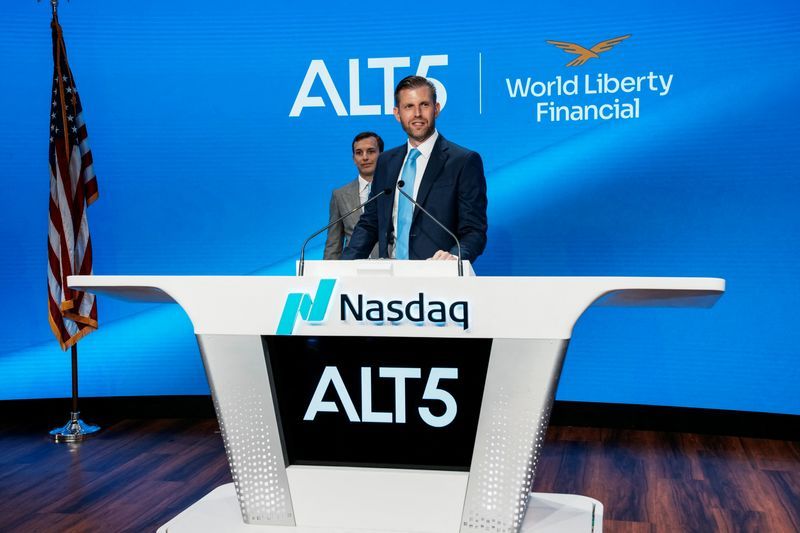
The Office of the Comptroller of the Currency has moved forward with conditional preliminary approval of a national trust charter application submitted by World Liberty Trust Company, marking a significant regulatory milestone for the cryptocurrency venture backed by President Donald Trump and his family. The regulator's decision, announced through a published letter, represents a substantial endorsement of the company's operational framework and positions it for expansion of its stablecoin activities following months of review since the application was filed in January.
The conditional charter approval carries meaningful advantages for World Liberty's business model, though it comes with notable restrictions. Unlike traditional banking charters, a national trust charter does not authorise deposit-taking or conventional lending operations. Instead, it permits the company to hold and manage customer assets on behalf of clients across the United States under unified federal oversight, while also facilitating faster settlement of payments and transactions. For a cryptocurrency enterprise, this regulatory framework represents a pathway to legitimacy and the ability to serve institutional clients with confidence in compliance standards.
The charter approval directly addresses World Liberty's operational bottleneck with its USD1 stablecoin, currently one of the four largest stablecoins globally with approximately USD4 billion in market capitalisation. Presently, both the issuance of USD1 and custody of the US dollar reserves backing it are outsourced to BitGo, a cryptocurrency custodian. Under the new charter, World Liberty Trust Company would consolidate these critical functions in-house, bringing USD1 issuance, asset custody, and reserve management together within a single regulated entity subject to the same supervisory standards applied to traditional banking institutions for generations.
The regulatory environment for cryptocurrency banking has shifted markedly under the current Trump administration, with the OCC under Comptroller Jonathan Gould demonstrating receptiveness to granting preliminary approvals for similar trust charters to crypto enterprises. Both Ripple and Circle, major participants in the digital asset ecosystem, have previously received preliminary approvals for comparable charters. This pattern reflects the administration's stated commitment to creating a more accommodating regulatory landscape for cryptocurrency innovation, a policy stance that has animated the entire crypto industry's strategic approach to Washington.
World Liberty Financial's leadership structure is fundamentally intertwined with Trump administration figures, a reality that has drawn scrutiny from Democratic lawmakers concerned about potential conflicts of interest. Zach Witkoff, who serves as president and chairman of World Liberty Trust, is the son of Steve Witkoff, Trump's special diplomatic envoy. The Witkoffs were among the co-founders of World Liberty Financial alongside Trump and his three sons in late 2024, with Zach Witkoff holding the position of chief executive officer. Robert Witkoff, Steve's brother and a former insurance executive, is positioned as a director of the trust bank, whilst Scott Alper, president of the Witkoff family's real estate enterprise, has been proposed as another director.
The regulatory approval carries multiple conditions that World Liberty must satisfy, including maintaining minimum capitalisation of USD20 million, promptly notifying regulators of significant changes to business plans, and employing a qualified individual in the role of internal audit manager. These requirements reflect the OCC's expectation of compliance with established regulatory protocols, though critics have questioned whether the conditions sufficiently address governance concerns. The regulator's letter also addressed questions about international ownership structures, asserting that foreign investors were not classified as principal shareholders and had provided formal passivity agreements committing them not to seek operational control or influence over the bank.
The involvement of foreign capital in World Liberty Financial's ownership structure has triggered national security scrutiny from Congressional Democrats. In February, two Democratic members of the Senate Banking Committee requested that the Treasury secretary examine potential national security implications following reports of a USD500 million investment stake purchase linked to the United Arab Emirates' national security adviser. Such geopolitical questions reflect broader concerns about the intersection of cryptocurrency enterprise, political power, and international capital flows, issues that carry particular relevance for Southeast Asian financial regulators observing these developments.
The OCC's structure differs from many US financial regulators in lacking a bipartisan governance board, a characteristic that has amplified Democratic objections to the World Liberty approval process. During a February congressional hearing, Democrats pushed Comptroller Gould to share the company's complete, unredacted application with legislators, arguing that the publicly available version omitted crucial details regarding capital structure and operational plans. The regulator's approval letter responded to such critiques by asserting that Gould and OCC staff had fulfilled their statutory and ethical responsibilities, and that the application underwent review by career staff with the bank to be supervised by apolitical examiners.
World Liberty Financial occupies a prominent position within the Trump family's expanding cryptocurrency portfolio, with the venture channelling more than USD1.6 billion to the president and his family as of April according to financial analyses. The USD1 stablecoin specifically has generated approximately USD50 million in earnings for the Trump family through June 2026, demonstrating the commercial significance of this venture beyond its regulatory and ideological dimensions. The company's stated mission centres on democratising financial access by enabling individuals to circumvent what the Trumps characterise as an excessively restrictive traditional banking system.
For Malaysian and Southeast Asian observers, the World Liberty Financial charter approval illuminates broader trends in global financial regulation and the political economy of cryptocurrency adoption. The decision demonstrates how cryptocurrency enterprises with high-level political backing can navigate regulatory frameworks in major jurisdictions, whilst simultaneously revealing the persistent tensions between innovation-friendly policies and concerns about governance, national security, and conflicts of interest. As digital asset adoption accelerates across the region, Malaysian financial regulators and policymakers will likely monitor how the OCC's approach to trust bank charters informs international standards and expectations for cryptocurrency business models.

