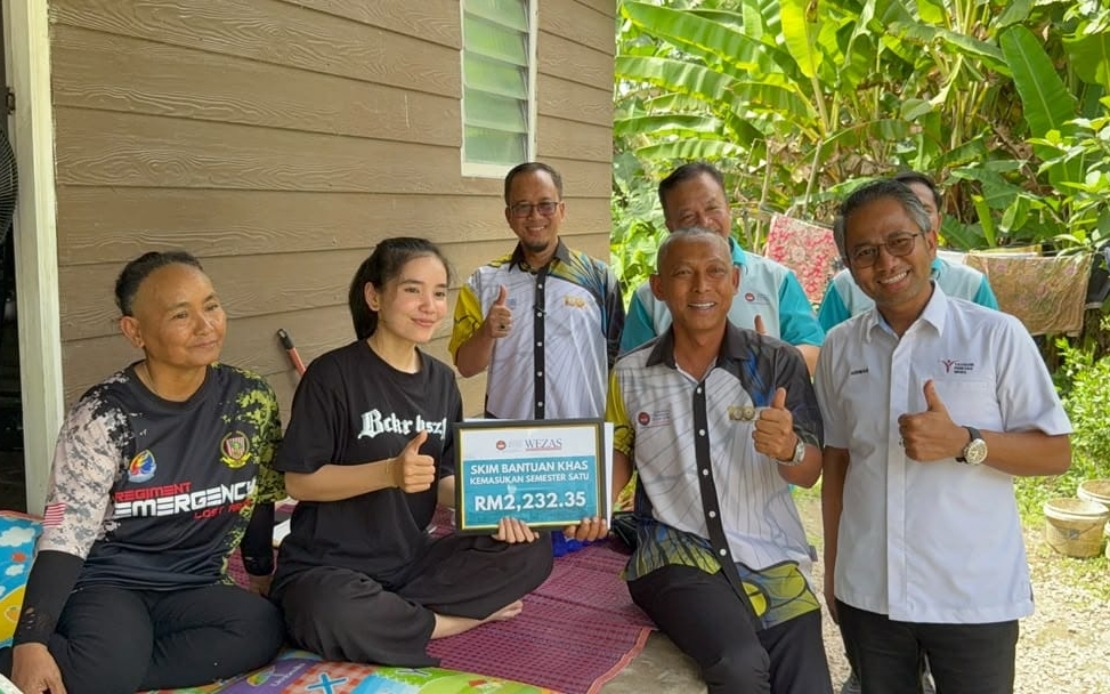
Three promising Malaysian students have overcome financial barriers to begin their higher education journey after receiving assistance packages from Universiti Pendidikan Sultan Idris and government support bodies. Lovely Sabana Augustine, a standout STPM performer, will now enrol at UPSI's Faculty of Human Sciences alongside two other successful applicants, each benefiting from coordinated aid that addresses both immediate registration costs and essential living expenses before campus entry.
Sabana's path to university had appeared blocked by circumstances beyond her control. Living in Tumpat, Kelantan with her mother Mek Kenui, the youngest of four children faced a household where monthly income barely exceeded RM800 from her mother's school cleaning work. Her father, a former soldier, passed away in 2017, leaving the family to navigate financial instability without his income. When Sabana secured her place at UPSI for the 2026/2027 academic session, the prospect of affording registration fees and acquiring necessary study materials suddenly seemed unattainable. Her situation resonated widely after she publicly sought assistance through social media channels, demonstrating how even academically exceptional students encounter systemic barriers to higher education access.
The intervention framework represents a deliberate collaboration between institutional and governmental layers designed to identify and support capable students early in their university transition. UPSI's Centre for Waqf, Endowment, Zakat, Khairat, and Sadaqah (WEZAS) contributed RM500 per student, while Yayasan Perkasa Siswa (YPS) provided RM1,000 to each recipient. This tiered approach ensures that multiple funding sources combine to create meaningful support without placing excessive burden on any single entity. The distribution structure reflects both Islamic principles of communal welfare and contemporary social investment philosophy.
Beyond Sabana, two other students similarly situated experienced comparable disadvantage. Siti Nurdianis Nordin, enrolling in the Faculty of Management and Economics, comes from a family dependent on her mother's irregular daily wages with no secondary income source to provide stability. Muhamad Ilias Danish, destined for the Faculty of Languages and Communication, lost his father and now shoulders responsibility for family finances while attempting to pursue his own education. These circumstances underscore how financial hardship extends across Malaysia's income spectrum and affects individuals regardless of academic merit or potential contribution to society.
Hirman Awang, director of the Department of Higher Education's Student Affairs Division, characterised the assistance as tangible expression of the Higher Education Ministry's foundational commitment. His statement emphasised that MOHE regards financial constraint as an unacceptable impediment to capable students' educational advancement. Awang portrayed Yayasan Perkasa Siswa as operating in a frontline capacity, actively intercepting situations where economic factors threaten to derail promising academic trajectories. The framing reflects institutional recognition that intervention at entry points—when students face immediate registration hurdles—proves more effective than remedial support after students encounter crisis mid-semester.
UPSI's deputy vice-chancellor for student affairs, Prof Dr Norkhalid Salimin, elaborated on the university's proactive identification methodology. Rather than waiting for students to approach university administration with difficulties, UPSI's Student Affairs and Alumni Department (JHEPA) and WEZAS actively scan incoming cohorts for individuals displaying financial vulnerability. This anticipatory approach acknowledges that students experiencing economic hardship often hesitate to seek help directly, potentially suffering in silence until crises force intervention. Salimin characterised the financial provision as secondary to a broader message: UPSI functions as institutional ally committed to supporting students throughout their academic journey from orientation onwards.
The assistance programme carries particular significance within Malaysia's higher education landscape, where access disparities between socioeconomic groups remain pronounced. While government funding supports Malaysia's public university system, ancillary costs—accommodation deposits, textbooks, technology, transportation—accumulate for students from lower-income backgrounds. For families where monthly household income derives from single low-wage employment sources, these supplementary expenses create genuine obstacles. By targeting such costs directly, the RM1,500 packages address the specific friction points that transform academic achievement into insufficient qualification for university participation.
The collaboration framework itself merits examination as model for future interventions. Institutional resources (UPSI's WEZAS infrastructure), philanthropic capacity (YPS's endowment), and governmental coordination (JPT oversight) converge to create sustainable support mechanisms without creating dependency relationships. This tripartite structure distributes financial responsibility while maintaining clear accountability. Universities retain agility to respond rapidly to individual circumstances, philanthropic bodies deploy capital toward verified need, and government agencies ensure systemic consistency and alignment with broader equity objectives.
For prospective students throughout Southeast Asia observing Malaysian higher education dynamics, these interventions signal evolving institutional expectations. Universities increasingly view student welfare as core operational responsibility rather than peripheral charitable function. UPSI's designation of September 13 as Sabana's formal registration date, coupled with advance financial resolution, demonstrates commitment to removing logistical barriers that might otherwise consume attention during critical early semester adjustment periods. Sabana and her peers arrive on campus unburdened by the immediate crisis that might otherwise compromise academic engagement during formative weeks.
The broader implications extend to workforce development and national competitiveness. Students like Sabana—academically exceptional but economically vulnerable—represent unutilised talent when financial barriers prevent university participation. Malaysia's aspiration toward high-income developed economy status depends substantially on expanding skilled workforce capacity. Removing educational access barriers for capable individuals regardless of family circumstance represents targeted investment in human capital rather than charity provision. As Sabana proceeds through Faculty of Human Sciences coursework, her eventual professional contributions will compound the initial RM1,500 investment manifold.
Looking forward, this assistance model invites consideration of scalability. While UPSI's initiative serves three immediately identified students, Malaysia's tertiary-enrolled population numbers in hundreds of thousands. Systematic mechanisms for identifying and supporting marginalised capable students earlier—during secondary school or pre-university phases—might prevent crises altogether. Regional partnerships between Malaysian universities and other Southeast Asian institutions could also facilitate knowledge-sharing about effective intervention models, particularly relevant for neighbouring countries experiencing comparable demographic and economic patterns.
The story of Lovely Sabana Augustine ultimately exemplifies how structural support, when deployed strategically, transforms individual circumstance into collective opportunity. Her eventual graduation and professional trajectory will vindicate institutional faith in removing barriers to capable students' advancement. The collaborative commitment demonstrated by UPSI, WEZAS, YPS, and government bodies establishes precedent suggesting that Malaysian higher education increasingly recognises merit deserves cultivation regardless of economic accident of birth. For the three students now preparing to enrol, September 13 represents not obstacle-laden transition but supported beginning of their university experience.

