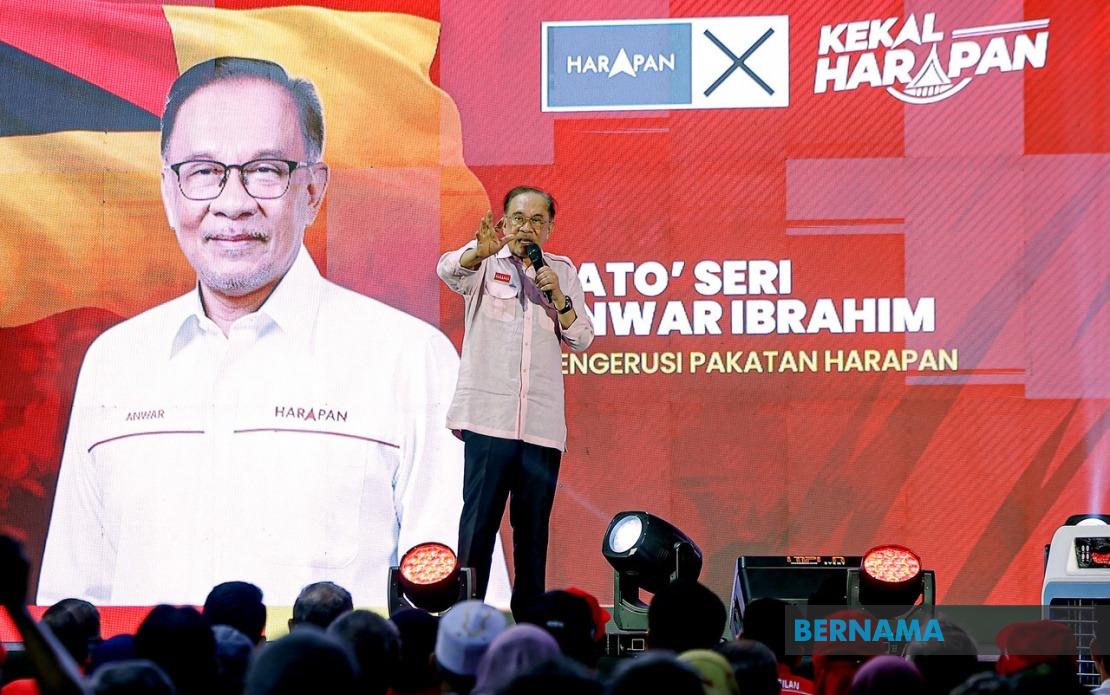
Prime Minister Datuk Seri Anwar Ibrahim has reaffirmed his commitment to maintaining the stability of the Unity Government at the Federal level, stressing that inter-coalition cooperation remains robust despite political competition at the state level. Speaking in Seremban on July 22, Anwar emphasised that the stability of the federal administration is critical to sustaining economic momentum and preserving investor confidence in Malaysia's economic prospects.
The Prime Minister outlined how the various component parties of the Unity Government have managed to work cohesively at the national level, evidenced by the regular and efficient execution of Cabinet meetings. This harmonious functioning of the Federal Cabinet demonstrates that ideological and political differences between coalition partners can be set aside in service of national economic interests. Anwar highlighted that this compartmentalisation of politics—maintaining unity federally while competing at state elections—represents a mature approach to coalition governance.
Anwar specifically referenced recent Cabinet sessions where he worked alongside key coalition figures including Minister of Agriculture and Food Security Datuk Seri Mohamad Sabu, Transport Minister Anthony Loke, and Deputy Prime Minister Datuk Seri Dr Ahmad Zahid Hamidi. The presence of these high-profile leaders from different parties in coordinated discussions underscores the functional nature of the federal alliance. The smooth operation of these ministerial gatherings, he suggested, serves as tangible proof that the Unity Government framework is delivering on its core mandate of governance effectiveness.
The Prime Minister acknowledged that tensions and competing interests naturally emerge at the state level, where individual political parties contest elections and seek to expand their territorial influence and representation. However, he drew a clear distinction between state-level political rivalry and federal-level governance, arguing that the latter remains insulated from the electoral pressures that drive competition in the states. This separation of concerns has allowed the Federal Cabinet to maintain focus on national economic priorities without being derailed by regional political considerations.
Anwar's remarks carry particular weight given the challenging political environment that has characterised Malaysian politics since the formation of the Unity Government. The coalition, comprising parties with traditionally divergent political orientations and support bases, has faced scepticism from observers who questioned whether such an ideologically diverse alliance could function effectively. By publicly affirming stability and detailing evidence of operational harmony, Anwar is attempting to counter narratives of potential coalition fragmentation that might undermine business and investor sentiment.
The emphasis on economic stability reflects Anwar's understanding that political uncertainty directly translates into economic hesitation. Foreign and domestic investors require predictable policy environments and confidence that administrations will honour their commitments and maintain coherent long-term strategies. Any perception of governmental instability or coalition breakdown could trigger capital flight, currency volatility, and a recalibration of Malaysia's investment attractiveness relative to competing regional economies. Anwar's reassurance is therefore not merely political rhetoric but an essential signalling mechanism directed at financial markets and the international business community.
The reference to post-election prospects suggests that Anwar anticipates further electoral contests and is signalling his intention to preserve the Unity Government framework through successive election cycles. His invocation of "Insha'Allah" (God willing) indicates both religious conviction and an acknowledgment that political outcomes ultimately depend on voter choices. However, his confidence that federal stability will persist suggests internal polling or coalition discussions may have convinced him that the core partners view the unified federal arrangement as strategically preferable to alternative configurations.
For Malaysian businesses and international investors, Anwar's statement provides reassurance that policy continuity will likely characterise the medium term. Cabinet stability matters greatly for sectors dependent on long-term government contracts, regulatory consistency, or infrastructure investment. The transport, agriculture, and defence sectors particularly benefit from ministerial continuity and predictable inter-agency coordination. Loke's stewardship of transport policy and Mohamad Sabu's agricultural initiatives, for instance, require sustained resource allocation and multi-year planning horizons that political instability would undermine.
The distinction between state and federal stability that Anwar draws reflects an important reality of Malaysian federalism. The Federal level controls national economic policy, foreign investment frameworks, currency and monetary policy through the central bank, and major infrastructure development. State governments, while significant for land development and certain service sectors, operate within parameters largely set by federal policy. This structural reality means that federal stability genuinely does provide more economic protection than state-level competition could undermine, though the psychological effects of visible political tension at any level should not be dismissed.
Anwar's comments also implicitly address concerns within the business community about governance predictability. Malaysia competes with Indonesia, Thailand, Vietnam, and the Philippines for regional investment flows, and investor perceptions of political stability significantly influence location decisions. By publicly committing to federal coherence and demonstrating awareness of how political uncertainty affects economic outcomes, Anwar signals that the administration prioritises the long-term health of Malaysia's investment climate above short-term political scoring.
The Prime Minister's remarks represent a carefully calibrated message balancing acknowledgment of legitimate state-level political competition with firm reassurance about federal-level solidity. This framing attempts to satisfy both coalition partners seeking electoral legitimacy and investors requiring governance stability. Whether this balance can be maintained through successive election cycles and amid inevitable coalition strains remains a critical question for Malaysia's political and economic trajectory over the next two to three years.

