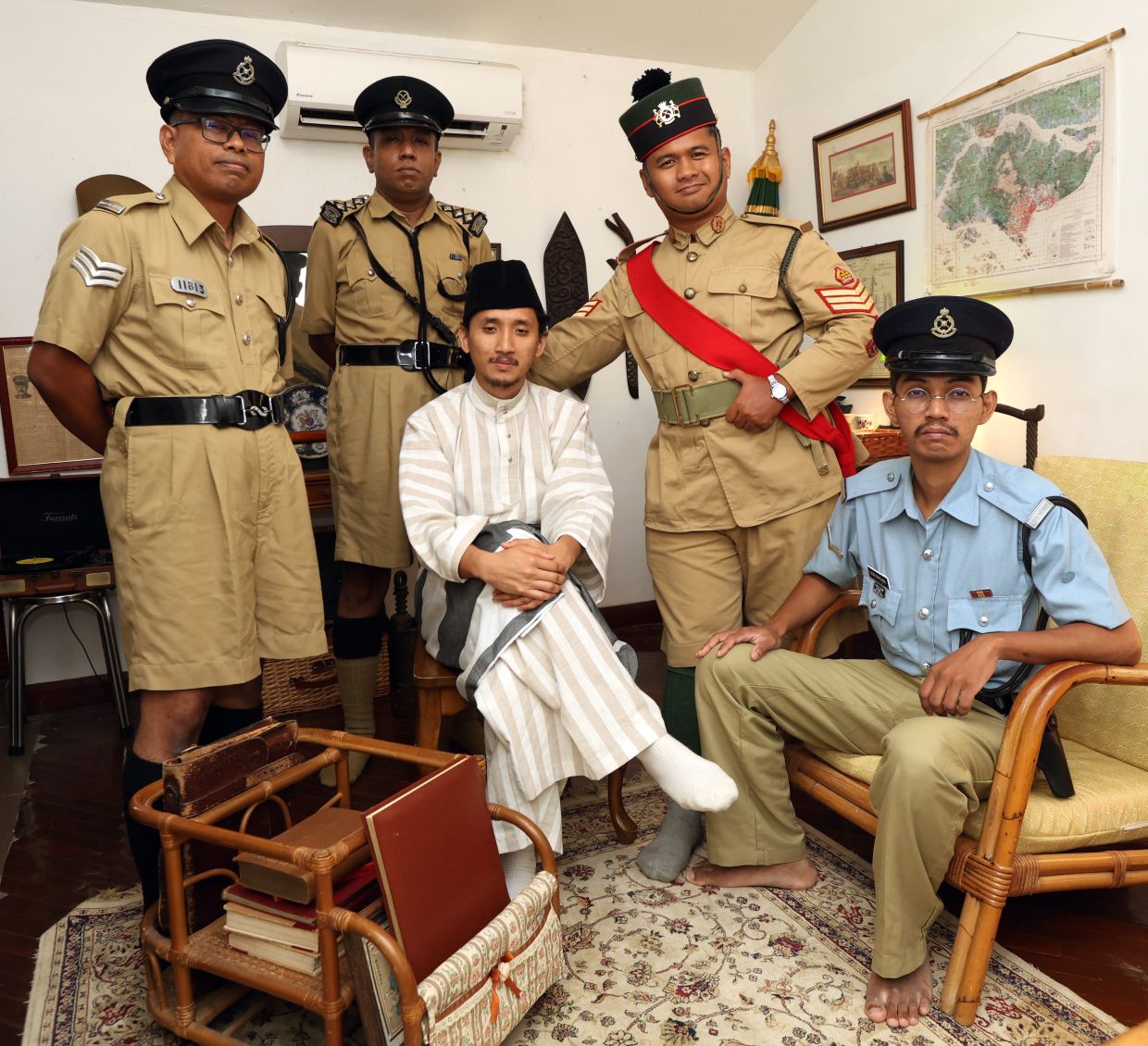
What began as weekend gatherings of vintage military uniform enthusiasts has evolved into a structured mission to reconnect Malaysians—particularly the younger generation—with the nation's complex historical narrative. Persatuan Reka Ulang Sejarah (PRUS), officially registered as a society in 2023, has grown from informal collector meetups into an organized educational force that operates at the intersection of scholarship, performance, and public engagement. Members dressed in meticulously researched historical military attire now appear regularly at schools, museums, and cultural exhibitions, demonstrating that Malaysia's past need not remain confined to dusty textbooks or monochromatic photographs in archives.
The organization traces its founding impulses to the early 2010s, when a community of history enthusiasts and military uniform collectors gathered at events hosted by Port Dickson Army Museum at the decommissioned Royal Malaysian Air Force Base in Sungai Besi, Kuala Lumpur. Initially operating under the informal banner "We Are Re-enactors," the group spent over a decade building a collection of authentic uniforms, conducting research, and honing their craft before taking the step toward formal registration. This transition reflects a broader recognition that historical education in Malaysia faces genuine gaps—particularly surrounding visual literacy and the authentic representation of different eras when military forces across various service branches wore comparable colour schemes and earlier documentation relied on black-and-white photography that obscured crucial distinctions.
Chairman Abdul Hakim Abdul Rani, who works professionally as a tour guide, identifies the confusion surrounding historical uniforms and insignia as a primary motivator for PRUS's establishment and public outreach. He observed widespread misunderstandings about which uniforms belonged to which era and which military service, gaps he believed could be addressed through tangible, visual demonstration rather than theoretical explanation. The society's official registration opened doors previously unavailable to informal groups—permission to conduct workshops at educational institutions, collaborate with museum exhibitions, and organize structured public events. For Abdul Hakim and his colleagues, this legitimization represented validation of their conviction that hands-on historical engagement constitutes a legitimate pedagogical approach complementary to conventional classroom instruction.
What distinguishes PRUS from casual cosplay or military enthusiast groups lies in the granular level of historical accuracy they pursue. Members recognize that each historical period carried distinct protocols governing not merely uniform appearance but also body language, marching techniques, verbal communication patterns, and military etiquette. Achieving authentic representation demands exhaustive research into period-specific manuals, training documents, and archival materials—work that occupies considerable time beyond the public-facing re-enactments. The group treats these details as non-negotiable because they operate from an explicitly educational framework rather than entertainment-driven motivation. Abdul Hakim emphasizes that accuracy functions as both scholarly responsibility and pedagogical tool; audiences learn more effectively when they encounter historically faithful portrayal rather than anachronistic approximations.
This commitment to authenticity manifested prominently during a two-day, one-night jamboree PRUS conducted in July, where members trained intensively in period-appropriate marching formations, map reading, navigation techniques, and basic combat manoeuvres drawn from pre-Independence military manuals. Abdul Hakim, leveraging his background service in the Territorial Army (Askar Wataniah), designed and led these sessions to illuminate how soldiers of different eras actually operated in practical terms. Rather than glorifying combat, the jamboree functioned as historical simulation designed to generate embodied understanding of military life during specific periods. Significantly, PRUS adapted equipment protocols to comply with modern regulations, substituting sticks for weapons during combat sequences—a pragmatic compromise that preserves educational value while respecting contemporary legal frameworks.
The society's engagement with Malaysia's film and television industry illustrates how historical re-enactment contributes expertise beyond formal educational contexts. PRUS members serve as consultants ensuring visual fidelity to particular periods, advising productions on uniform accuracy, insignia placement, and authenticity of material culture. Vice chairman Mohd Fadzreeq Mokti emphasizes that this role transcends acting; members carry their commitment to historical accuracy into every frame, viewing their contributions to entertainment media as extensions of the same educational mission that animates their museum exhibitions and school presentations. By maintaining standards in popular cultural production, PRUS influences how millions of Malaysians encounter and internalize historical imagery, potentially shaping generational understanding of national heritage.
The organization demonstrates particular intensity during National Month and Malaysia Day activities, when members deploy their collections to exhibitions targeting youth audiences who might otherwise encounter history exclusively through textbook passages. Abdul Hakim has observed with concern that some Malaysian students lack familiarity with pivotal historical figures and events—a knowledge gap he attributes partly to the abstractness of conventional historical pedagogy. He regards schools as essential entry points for early historical engagement, contending that visceral encounter with authentic uniforms, trained personnel, and knowledgeable educators creates impressions more durable than passive reading. This perspective reflects a sophisticated understanding of pedagogical psychology: visual and tactile engagement catalyzes deeper learning, particularly among younger demographics conditioned by multimedia environments to expect interactive rather than purely receptive education.
Mohd Fadzreeq, who works as a school teacher, witnesses this engagement principle firsthand in his own institution. When he appears before classes in historical uniform—an arrangement approved by his school's administration—students demonstrate dramatically heightened enthusiasm and curiosity compared to conventional lessons. He reports that children consistently inquire when he will wear the uniform again, indicating the memorable impact created by embodied historical presentation. His students, he observes, possess genuine interest in learning national history but often lack access to museums or opportunities for hands-on engagement with historical artifacts. The constraints of formal education—standardized curricula, limited field trip budgets, crowded schedules—create structural barriers to the experiential learning that PRUS facilitates through school visits and exhibitions.
Mohd Fadzreeq conceptualizes PRUS members as "walking museums"—mobile repositories of historical knowledge embodied in authentic appearance and supported by rigorous research. Their function transcends aesthetic display; instead, they constitute accessible educators who invite spontaneous questioning and dialogue. When observers encounter uniformed PRUS members in public contexts, they frequently initiate conversations, and members commit to addressing inquiries with accuracy grounded in extensive study of primary sources and secondary scholarship. This model of distributed, accessible historical expertise addresses a critical weakness in conventional museum infrastructure: physical distance, limited hours, entrance fees, and institutional formality create psychological and practical barriers preventing many Malaysians from engaging museum collections. By bringing historical material and knowledgeable interpreters directly to schools, public events, and community spaces, PRUS democratizes access to rigorous historical education.
The broader significance of PRUS extends beyond the immediate audiences they reach. The society's existence and activities signal recognition that Malaysian historical consciousness requires deliberate cultivation and innovative pedagogical approaches. National narratives do not transmit automatically through institutional channels; they require human agents—educators, interpreters, curators—to translate archival materials into comprehensible, emotionally resonant forms. PRUS members perform this translational labor through substantial personal investment of time and resources, purchasing and maintaining authentic uniforms, conducting research, and volunteering at educational events. Their work implicitly critiques any assumption that history "teaches itself" through passive exposure, instead insisting that meaningful historical understanding emerges through active engagement, expert guidance, and embodied experience.
For Malaysia specifically, PRUS's mission addresses particular stakes embedded in national identity formation. As a multiethnic nation with contested historical narratives and varying interpretations of independence-era events, Malaysia benefits from rigorous, accurate historical representation capable of commanding respect across communal boundaries. By emphasizing meticulous authenticity and educational purpose over ideological messaging, PRUS contributes to creating shared historical understanding grounded in verifiable detail rather than sectarian interpretation. The society's growth reflects expanding recognition among Malaysians that preserving national heritage demands more than archival storage—it requires active interpretation, public engagement, and generational transmission through innovative means.
Looking forward, PRUS operates within a broader regional context where historical consciousness intersects with national identity, cultural preservation, and educational innovation across Southeast Asia. Other nations in the region face comparable challenges: how to maintain historical literacy among populations increasingly oriented toward contemporary media, how to make heritage tangible and relevant to younger generations, how to balance accurate representation against competing narratives and interpretations. PRUS's approach—combining scholarly rigor, public engagement, educational partnership, and innovative presentation—offers a potential model for other organizations seeking to revitalize historical connection. As Malaysia continues developing, organizations like PRUS become increasingly vital for ensuring that rapid modernization does not sever connections to the nation's complex past or diminish appreciation for the historical knowledge accumulated by earlier generations.

