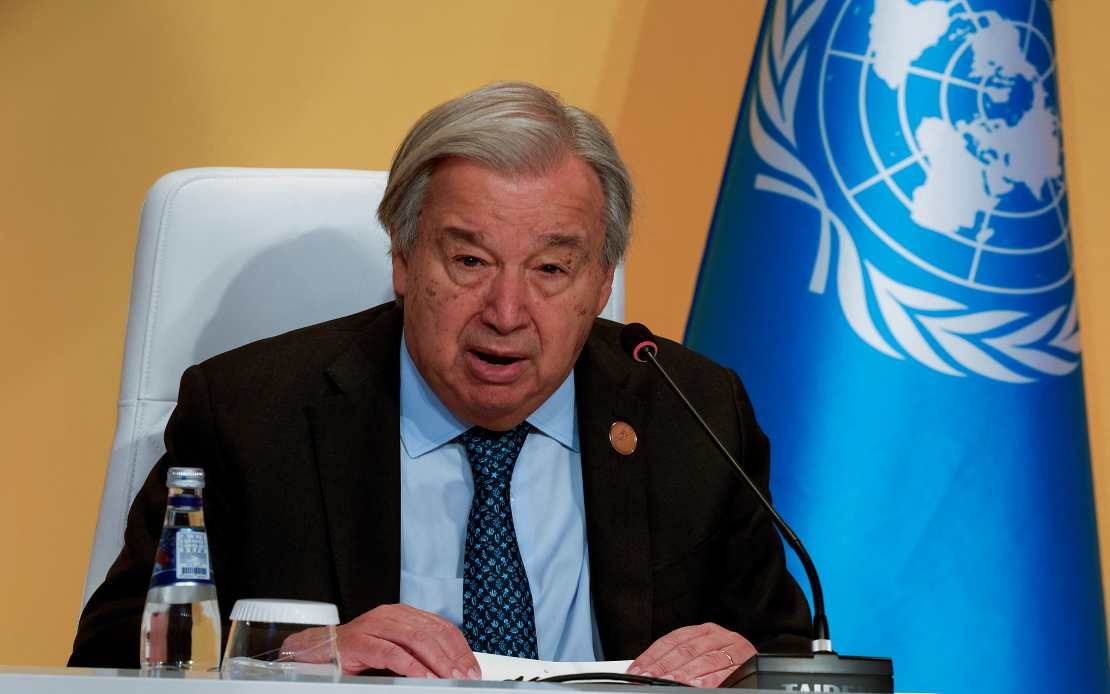
UN Secretary-General Antonio Guterres has signalled alarm at the deteriorating security situation unfolding across the Persian Gulf, where multiple layers of military confrontation have created what officials characterise as an unusually volatile landscape. The international community's chief diplomat released a statement through his spokesperson Stephane Dujarric expressing deep apprehension regarding recent incidents involving Iranian naval operations in the Strait of Hormuz, retaliatory strikes by the United States against Iranian targets, and subsequent Iranian military responses directed at neighbouring states. The confluence of these incidents within a compressed timeframe has prompted the UN to issue an urgent plea for immediate de-escalation, signalling that the trajectory of events carries implications extending far beyond the region itself.
The statement issued on Sunday underscores Guterres' conviction that all parties involved must immediately pivot toward restraint and abandon further moves that would deepen the security crisis. Rather than engaging in tit-for-tat military responses, the UN chief advocates for stakeholders to pursue concrete steps aimed at reducing tensions and creating space for diplomatic engagement. This messaging reflects the organisation's concern that the current pattern of action and counteraction risks becoming self-perpetuating, with each incident providing justification for subsequent military operations. The call for maximum restraint represents an attempt to interrupt this cycle before escalation reaches a point where political calculations become overshadowed by security imperatives.
Guterres has emphasised that a return to full-scale hostilities would produce consequences of genuinely catastrophic proportions, extending across multiple dimensions. A resumption of direct military conflict would devastate regional populations through loss of life, displacement, and destruction of civilian infrastructure. Beyond immediate humanitarian impacts, such a confrontation would destabilise the international order, threatening the rules-based framework that underpins global governance and cooperation. The global economy would face severe disruption, given the critical importance of Gulf shipping lanes to worldwide commerce and energy supplies. These interrelated consequences suggest that the stakes extend far beyond bilateral Iran-United States relations to encompass fundamental aspects of international stability and prosperity.
For Southeast Asian nations like Malaysia, the implications warrant particular attention. The region maintains substantial economic interests in uninterrupted Persian Gulf shipping, with significant portions of Malaysian trade and energy imports transiting through these waters. Escalating military confrontation would inevitably disrupt maritime commerce, increase insurance and transportation costs, and create supply chain uncertainties affecting everything from crude oil prices to manufactured goods. Malaysian businesses operating across the Gulf region would face heightened operational risks, while the broader regional economy would experience inflationary pressures stemming from energy price volatility.
The Strait of Hormuz occupies an especially critical position in this calculus. This narrow waterway constitutes one of the world's most strategically significant chokepoints, with approximately one-third of global maritime petroleum traffic passing through its waters daily. Any disruption to freedom of navigation—whether through military action, mine-laying, or deliberate interdiction—would reverberate through international energy markets with immediate consequences. Guterres' reiteration of the necessity to restore and maintain full freedom of navigation reflects recognition that this prerequisite remains fundamental to regional and global economic stability.
The fundamental challenge driving this escalation involves the historically fraught relationship between Iran and the United States, exacerbated by the broader realignment of Middle Eastern geopolitics. The Trump administration's withdrawal from the Joint Comprehensive Plan of Action in 2018 and subsequent imposition of extensive sanctions fundamentally altered the negotiating landscape, removing the primary diplomatic framework that had constrained military escalation. The absence of active dialogue mechanisms between Washington and Tehran means that misperceptions, miscalculations, and unintended consequences become increasingly probable.
Guterres' explicit call for Iran and the United States to urgently resume negotiations acknowledges this fundamental reality. The UN secretary-general recognises that sustainable resolution requires direct engagement between the principals, addressing the substantive disagreements that underlie the current confrontation. Without active diplomatic channels and negotiating frameworks, the risk multiplies that tactical military decisions will spiral into strategic miscalculation. The urgency attached to this appeal reflects growing concern that the current trajectory, if unchecked, could rapidly transition from episodic military incidents toward broader conflict scenarios.
The emphasis on addressing outstanding issues through diplomacy signals that potential pathways toward de-escalation exist but require political will from both parties. Outstanding disputes involve not merely the immediate military incidents but longer-term questions regarding sanctions regimes, nuclear programmes, and regional proxy activities. These represent complex issues requiring sustained negotiation, compromise, and confidence-building measures. The window for such engagement appears to be narrowing, making urgent action essential.
The regional dimension adds further complexity to this calculus. Several neighbouring countries possess stakes in the outcome, with some aligned with the United States and others maintaining closer relationships with Iran. The potential for third-party actors to become drawn into escalation scenarios increases geometrically as tensions mount. Neighbouring states already hosting substantial refugee populations and managing their own security challenges would face additional destabilisation from expanded regional conflict.
The UN secretary-general's statement reflects institutional concern about the adequacy of existing conflict prevention and dispute resolution mechanisms in addressing the current crisis. The Security Council's effectiveness has been constrained by great power divisions, limiting options for collective action. This underlying structural challenge underscores why diplomatic engagement between the primary parties becomes absolutely essential—the international system currently lacks robust mechanisms for forcibly restraining escalation between major powers operating in strategically significant regions.
Moving forward, the trajectory will largely depend on calculations within Tehran and Washington regarding the costs and benefits of continued escalation versus renewed engagement. Intermediate regional actors and international stakeholders have limited capacity to constrain these fundamental calculations directly, though robust diplomatic engagement and clear articulation of consequences may influence decision-making at the margins. Malaysian policymakers and business leaders should monitor developments closely, as sustained instability across the Gulf would produce measurable economic consequences throughout Southeast Asia.

