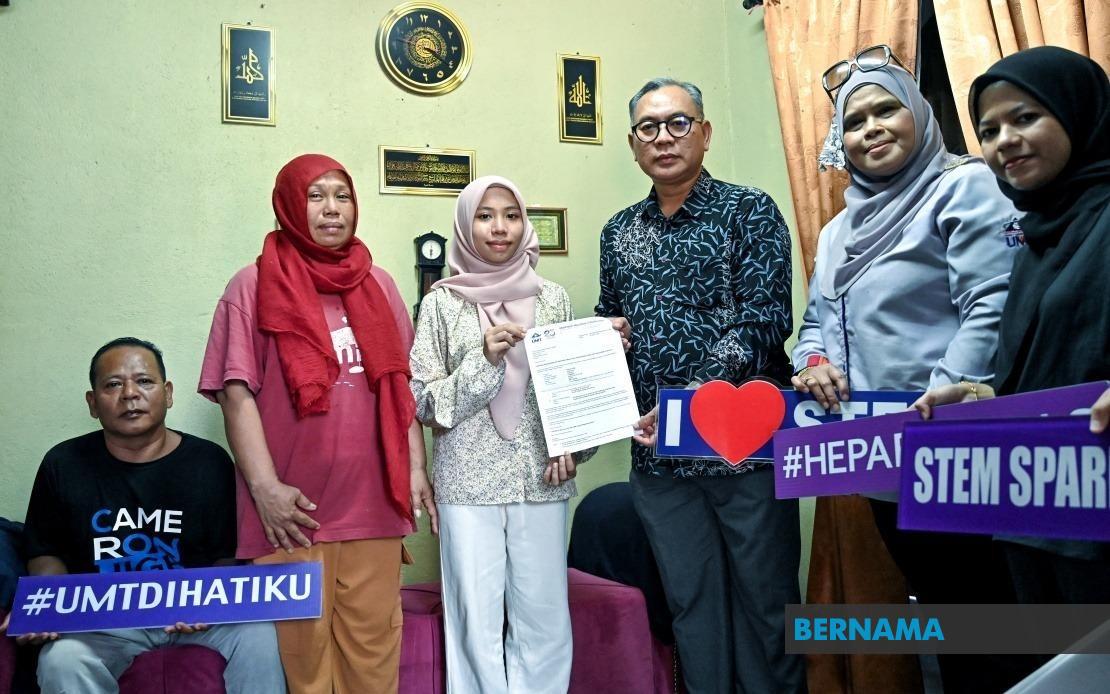
An 18-year-old girl from Bagan Serai nearly abandoned her university aspirations after securing an offer from Universiti Malaysia Terengganu when her family proved unable to fund her registration and tuition fees. Nurul Amira Abdul Hamid, however, discovered that institutional support existed when the university intervened decisively, fundamentally altering her educational trajectory and demonstrating the critical role tertiary institutions can play in addressing equity gaps in Malaysia's higher education landscape.
Nurul Amira's circumstances exemplify the persistent challenge facing many capable Malaysian students whose academic merit alone cannot guarantee access to university. Her household had been navigating genuine economic difficulty, with her father Abdul Hamid Othman facing ongoing health complications that constrained the family's earning potential, whilst her mother Asmah Che Ros remained occupied with domestic responsibilities. The burden of financial instability fell significantly upon Nurul Amira herself, who upon completing her SPM examination chose to enter the workforce rather than immediately pursue tertiary study. Employment at a goods retail outlet yielded a modest monthly salary of RM1,300, income she channelled directly towards household expenses and her parents' wellbeing rather than accumulating resources for her own advancement.
The turning point arrived when Nurul Amira made the proactive decision to contact UMT directly and candidly explain her predicament. This approach, demonstrating both honesty and initiative, proved instrumental in accessing institutional mechanisms designed precisely for such circumstances. The university responded by securing the Al-Ikhlas Scholarship valued at RM500 monthly, a contribution substantial enough to materially reduce the financial pressure whilst avoiding creating false impressions of complete cost elimination. Additional financial support mechanisms supplemented the scholarship award, collectively addressing her tuition obligations whilst the university assumed responsibility for a RM400 portion of registration-related expenses. The cumulative effect transformed an insurmountable barrier into a manageable challenge, permitting her transition into UMT's one-year STEM Foundation programme and subsequently into the Bachelor of Science degree specialising in Nautical Science and Maritime Transportation.
Nurul Amira's academic credentials underscored why institutional investment in her education represented sound policy rather than mere charity. Her SPM results had encompassed three A grades, positioning her firmly within the cohort of high-performing candidates capable of meaningful contribution to their chosen fields. Maritime industries throughout Southeast Asia face persistent skills shortages, particularly in technically qualified personnel conversant with contemporary navigational systems and transport logistics. Malaysian institutions investing in students destined for these sectors generate returns extending beyond individual beneficiaries, contributing to regional economic competitiveness and operational capability.
Universiti Malaysia Terengganu's approach, as articulated by Vice-Chancellor Prof Dr Mohd Zamri Ibrahim, transcends reactive scholarship distribution. The institution has adopted a proactive engagement model involving direct outreach to families experiencing financial strain, deliberately seeking to identify capable students before they abandon educational aspirations through resource exhaustion. This methodology recognises that many qualified candidates never formally approach universities precisely because they internalise their poverty as disqualifying, viewing financial difficulty as private shame rather than addressable institutional concern. By meeting families in their communities and demonstrating tangible willingness to collaborate on solutions, UMT reduces the psychological barriers that compound economic obstacles.
The living cost dimension constitutes another frequently overlooked component of student financial security. Beyond tuition and registration expenses, successful tertiary study demands capacity to sustain oneself during extended periods devoted to coursework, laboratory work, and examination preparation. UMT's commitment to providing living assistance throughout Nurul Amira's entire academic tenure acknowledges this reality, permitting her to concentrate upon academic performance rather than perpetually balancing precarious part-time employment against study demands. This support proves particularly critical for students originating from non-urban areas who cannot readily access family support networks whilst residing at distant campuses.
The broader institutional commitment to equitable access becomes evident in UMT's reported engagement with more than ten underprivileged students during the current academic year. This figure, whilst numerically modest relative to total institutional enrolment, signals systematic rather than ad-hoc assistance. The university has positioned accessibility as an explicit institutional responsibility rather than optional corporate social responsibility activity, embedding it within organisational culture and resource allocation processes. Prof Dr Mohd Zamri's public invitation—urging any student unable to afford fees to approach the university first—represents transparent communication that such support exists and requires no extraordinary circumstances to access.
Malaysia's socioeconomic landscape ensures that Nurul Amira's situation reflects broader patterns affecting educational equity. Regional disparities in household income, unequal distribution of secondary education quality between urban and rural areas, and the prevalence of single-income or precarious-income households create systemic obstacles to higher education access that individual merit cannot overcome. When universities respond to these challenges through strategic financial intervention, they address not merely individual hardship but contribute to broader social mobility mechanisms essential for equitable development.
The implications for Malaysian policymakers extend beyond individual institution-level responses. If flagship regional universities like UMT can sustainably absorb costs associated with assisting financially disadvantaged but academically capable students, arguments for corresponding national funding mechanisms warrant serious consideration. Scholarship schemes and student loan structures require calibration to ensure that financial assistance reaches genuinely underprivileged candidates rather than concentrating support among families possessing sufficient resources to navigate application bureaucracy. UMT's direct outreach model suggests that proactive identification outperforms passive application processes in reaching those most in need.
Nurul Amira's trajectory from potential abandonment of academic aspirations to meaningful university enrolment in a technically demanding field carries symbolic and practical significance for Southeast Asian higher education discourse. Her success demonstrates that financial barriers, whilst formidable, remain addressable through institutional commitment and coordinated support mechanisms. As maritime industries throughout the region expand and technological complexity increases, investing in students such as Nurul Amira represents not charity but rational allocation of scarce educational resources toward fields generating measurable economic and social returns. Her journey from retail employment to maritime science student exemplifies the transformative potential of institutional willingness to treat educational access as a core responsibility rather than peripheral function.

