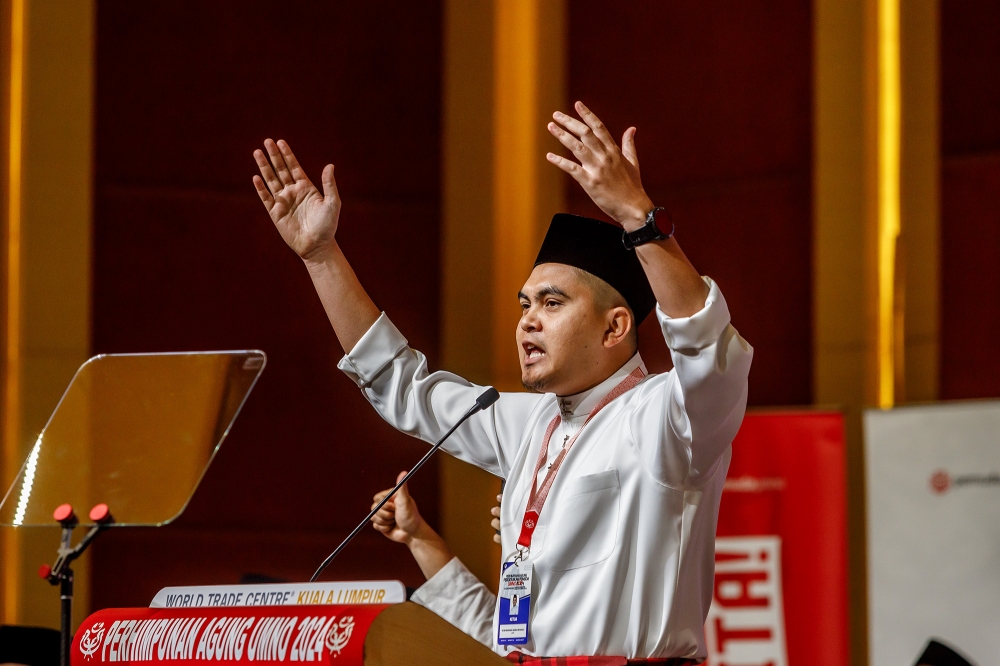
The tension between Malaysia's major political coalitions has taken a sharp turn with Umno Youth chief Datuk Dr Akmal Saleh directly challenging Pakatan Harapan to address what he characterises as a double standard in coalition governance. Speaking in Kuala Lumpur on July 19, Akmal pressed the opposition's youth movement to confront fundamental questions about the rules governing participation in government and election partnerships, suggesting that principles applied to one political bloc ought equally to constrain another.
The statement reflects deeper anxieties within the Barisan Nasional establishment concerning the framework of political accountability that shapes Malaysia's coalition politics. Akmal's intervention signals that Umno is prepared to escalate rhetorical pressure on Pakatan beyond the usual parliamentary exchanges, casting the debate in terms of fairness and consistency rather than mere tactical advantage. This framing attempts to reposition the argument away from immediate electoral calculations toward broader questions of constitutional principle and political integrity.
At the heart of Akmal's challenge lies a fundamental asymmetry in how Malaysia's two main coalitions navigate the delicate question of electoral alliances and government participation. The Barisan Nasional, which has historically functioned as the ruling coalition, faces a different set of expectations and constraints than Pakatan Harapan, which gained government only in 2018 before losing it in 2020. This historical imbalance creates different pressures: BN members must balance internal party autonomy with coalition solidarity in ways that opposition parties theoretically do not face while out of power.
For Malaysian observers accustomed to watching these political manoeuvres, the significance lies not in the immediate accusation but in what it reveals about coalition stability. Umno Youth's insistence that similar standards should apply universally suggests concerns that Pakatan enjoys rhetorical flexibility precisely because it lacks the responsibility of governing. If a component of Pakatan were to join the government, Umno's argument implies, it should face identical scrutiny and potentially identical consequences as BN parties face when they deviate from coalition discipline regarding electoral partnerships.
The reference to election alliances touches a particularly sensitive nerve in Malaysian politics. Coalition governments inherently involve negotiations between parties with distinct ideologies, voter bases, and strategic priorities. When a party participates in electoral cooperation that diverges from official coalition platforms, it creates internal friction. BN members, governing as part of the federal coalition, have previously faced criticism or pressure when pursuing separate electoral arrangements. Akmal's challenge essentially argues that Pakatan components ought to answer the same questions if they find themselves in analogous positions.
From a Southeast Asian perspective, this debate illuminates broader patterns in how multiethnic democracies manage coalition politics. Malaysia's system, built on ethnic-based parties working within coalition frameworks, depends heavily on formal and informal rules governing defection, alliance-switching, and electoral coordination. When these rules apply unevenly, they undermine the institutional consistency that coalitions require for stability. Umno Youth's intervention pushes toward clarifying whether such rules genuinely reflect political principle or merely serve factional advantage.
The timing of Akmal's statement also warrants consideration. Malaysia's political landscape has undergone significant reconfiguration in recent years, with Perikatan Nasional emerging as a competitor alongside traditional BN and PH structures. This tripartite competition has created unusual pressures, sometimes forcing unexpected alliances and raising questions about how parties justify their partnerships. Umno's challenge to Pakatan may partly reflect frustration that the opposition escapes scrutiny for maintaining relationships that would generate controversy if BN pursued them.
For Pakatan specifically, responding to Akmal's challenge requires either accepting the premise that identical standards should apply across coalitions, or articulating why different rules ought to govern coalition and opposition politics. This is no trivial matter, as it touches the philosophical foundations of how democracy functions when power is distributed among multiple parties. Opposition movements often reserve the right to maintain programmatic flexibility precisely because they do not yet shoulder governing responsibility, yet accepting Akmal's logic would constrain that flexibility considerably.
The exchange also reveals anxiety within BN about its long-term political positioning. If Pakatan components face no real consequences for alliance decisions that would trigger government upheaval in BN, then BN operates under a more restrictive regime. Akmal's intervention attempts to publicise this asymmetry, reasoning that public consciousness of unfair treatment might eventually force institutional adjustments. Whether this rhetorical strategy will generate practical political pressure remains uncertain, but it marks an escalation in how BN articulates its grievances.
Looking forward, this challenge will likely become more urgent if Pakatan genuinely approaches assuming government again. Once any Pakatan component occupies ministerial office, it will face concrete questions about electoral partnerships and coalition loyalty that mirror those confronting BN today. Akmal's preemptive intervention may be calculated to establish a record of principle that can be invoked when those circumstances arise, or it may simply reflect contemporary frustration with rules that appear to privilege one coalition over another.
Ultimately, Akmal's intervention highlights a persistent tension in Malaysia's political system: whether coalition governance operates according to universal principles or whether different coalitions operate under fundamentally different rules. Resolving this question would require either explicit constitutional reform or a political consensus that seems unlikely to emerge voluntarily. For now, the challenge stands as a reminder that Malaysian coalition politics remains an arena where questions of fairness, consistency, and principle remain perpetually contested.

