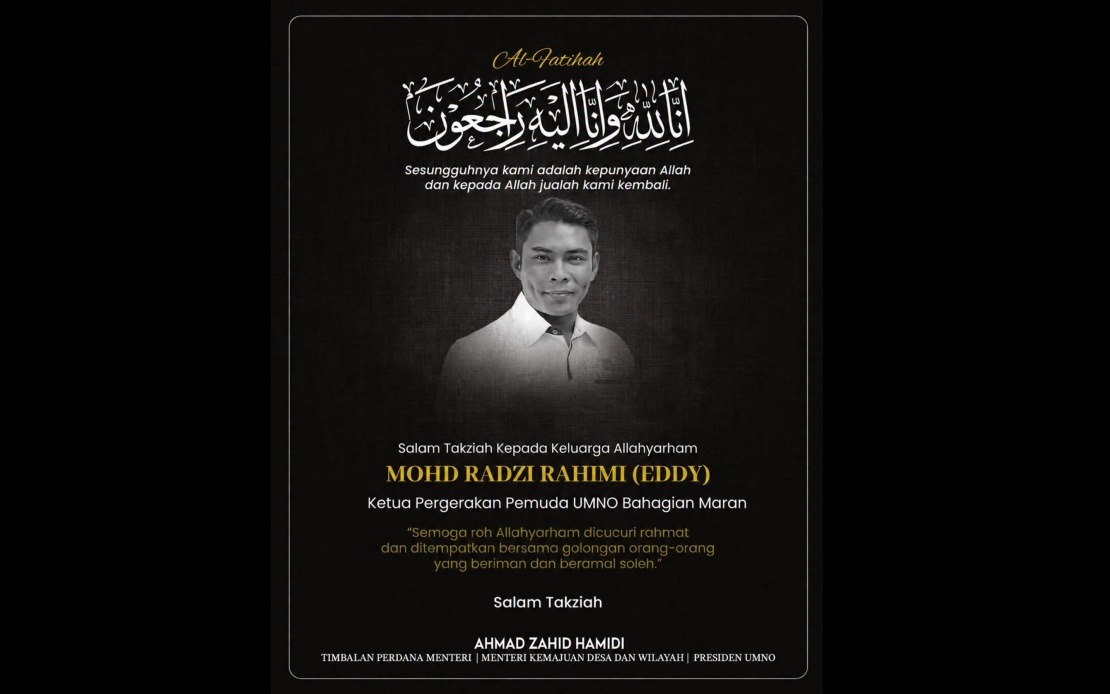
UMNO President Datuk Seri Dr Ahmad Zahid Hamidi has conveyed his heartfelt condolences following a devastating accident in Bentong that claimed the lives of Maran UMNO Youth chief Mohd Radzi Rahimi, his wife, and his brother-in-law. The tragedy, which occurred on August 3, has sent shockwaves through Malaysia's ruling party, prompting the party's top leadership to acknowledge what they describe as a significant loss to the broader UMNO movement and its youth wing.
In a statement posted on Facebook, Ahmad Zahid characterised Mohd Radzi's untimely passing as a major blow to the UMNO family structure, particularly affecting the Maran division and the Pahang branch of UMNO Youth. The loss of a youth leader carries particular weight within the party's organisational hierarchy, as the youth division serves as a crucial pipeline for future party leadership and grassroots mobilisation. Mohd Radzi's role in leading Maran UMNO Youth meant he occupied a position of responsibility in one of Pahang's significant party divisions, making his sudden death a notably disruptive event for the party's internal operations and succession planning within the state.
The accident itself resulted from a falling tree that crushed the vehicle carrying Mohd Radzi and his family members. Beyond the three fatalities, a five-year-old child was also killed in the incident, compounding the human tragedy of the event. Another young child, believed to be the twin of the deceased boy, sustained injuries and was transported to Bentong Hospital for medical care and observation. The circumstances of the accident underscore the unpredictability of such incidents and their capacity to devastate families across multiple generations simultaneously.
Ahmad Zahid's public expression of sympathy reflects broader UMNO protocols for acknowledging the deaths of party members and their families. His message emphasised the profound difficulty facing the bereaved family, using language that acknowledges the inadequacy of mere words in the face of such loss. By invoking Islamic sentiment through the phrase "May Allah SWT give them the strength to face these tough times," the UMNO president anchored his condolence within the religious and cultural framework that characterises Malaysian political discourse, particularly within Islamic-based political movements.
The death of party activists and leaders, while devastating on a personal level, carries organisational implications for UMNO's functioning at the divisional level. The sudden removal of a youth chief creates immediate vacancies in leadership roles and necessitates adjustments to planned activities and programmes within the division. For Maran UMNO in particular, the loss represents not merely the departure of an administrator but the disappearance of an individual who embodied the party's youth representation in that constituency and carried specific relationships and networks that extend throughout the party structure.
In the context of Malaysian politics, such tragedies occasionally prompt broader discussions about succession planning and institutional resilience within political parties. The unexpected nature of Mohd Radzi's death exemplifies how contingencies can reshape party structures, requiring remaining leaders to redistribute responsibilities and identify replacements who can command similar respect and maintain divisional cohesion. For UMNO, which has experienced various leadership transitions and internal challenges in recent years, the loss of younger generation members carries implications for the party's capacity to renew and sustain itself.
The tragedy also resonates within Pahang's political ecosystem, where UMNO maintains substantial influence and where youth mobilisation efforts form an integral component of the party's electoral strategy and internal organisation. The Maran division, while perhaps not commanding the same national profile as some larger urban divisions, plays a meaningful role in shaping Pahang's political landscape. The loss of the division's youth chief reverberates through networks of party loyalists, family connections, and local political relationships that characterise Malaysian party politics at the grassroots level.
Ahmad Zahid's measured and respectful tone in his public statement aligns with established norms for political figures addressing deaths within their party structures. Rather than extensively publicising the tragedy or drawing particular media attention, the UMNO president opted for a brief but sincere expression of sympathy, directing focus toward the bereaved family rather than leveraging the incident for broader political messaging. This approach demonstrates the distinction between genuine expressions of solidarity within party structures and the politicisation of personal tragedy—a line that Malaysian political leaders frequently navigate with varying degrees of sensitivity.
The Bentong incident, while geographically specific, reflects broader patterns of vehicular accidents and natural hazards that periodically intersect with Malaysian life. The falling tree that caused this particular tragedy represents a form of accident largely beyond human control, lending it a dimension of tragic inevitability that characterises the most poignant varieties of loss. Such incidents inevitably prompt reflection on the vulnerability of family units and the caprice of circumstances that can alter lives within moments.
For the UMNO party machine, the immediate practical tasks involve identifying and appointing a successor to Mohd Radzi's position within Maran UMNO Youth, ensuring continuity of the division's operations and maintaining momentum in party activities. The selection process for such replacements typically considers factors including seniority, demonstrated competence, factional considerations within the party, and the ability to command respect among existing party members. The timing of such transitions, particularly when unexpected, can occasionally create brief periods of uncertainty or jockeying for position within divisional hierarchies, though established succession protocols generally minimise such disruptions.
The broader Malaysian public's response to such tragedies typically encompasses expressions of sympathy across political lines, as deaths of this nature transcend partisan divisions and evoke universal recognition of human vulnerability. While Mohd Radzi's identity as an UMNO youth leader identifies him within a particular political context, the fundamental human dimensions of his loss—the destruction of family bonds, the interruption of life plans, the grief of surviving relatives—resonate across Malaysia's diverse political landscape. In this respect, the tragedy serves as a sobering reminder of the fragility underlying all human endeavour, regardless of political affiliation or social position.

