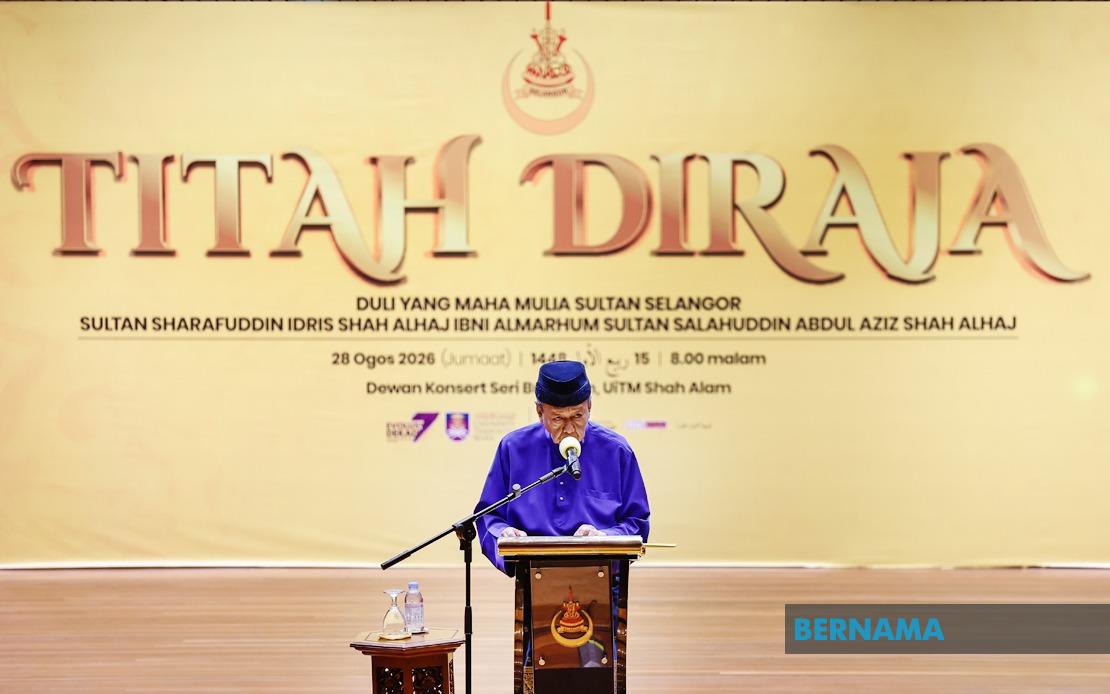
The Sultan of Selangor, Sultan Sharafuddin Idris Shah, has delivered a pointed reminder to Universiti Teknologi MARA that its founding mission to uplift economically disadvantaged Malay and Bumiputera youth must not be diluted as the institution grows. Speaking at the UiTM 2026 Royal Address held at Dewan Konsert Seri Budiman in Shah Alam on August 28, His Royal Highness stressed that educational access for children from farming, fishing, and labouring families should remain at the heart of UiTM's operations, regardless of the university's expanding footprint and prestige.
The remarks carry particular weight in the Malaysian context, where higher education access remains unevenly distributed and concerns periodically surface about whether institutions founded to serve specific communities are adequately fulfilling that mandate. UiTM's historical role as an engine of social mobility for Bumiputera communities has been central to its identity since inception, yet the tension between expansion and accessibility is a persistent challenge facing the institution.
Sultan Sharafuddin traced UiTM's remarkable trajectory from its 1965 founding with merely 219 students and 11 lecturers to its current stature as one of Southeast Asia's largest tertiary institutions. The growth has been extraordinary: within ten years of establishment, enrolment had climbed to nearly 7,000 with roughly 1,000 teaching staff and approximately 60 academic programmes spread across multiple campuses. Today, the university confers degrees on more than 40,000 graduates annually, drawing from an institutional alumni base exceeding one million members. This expansion represents genuine institutional success, yet the Sultan's intervention suggests concern that such scale might inadvertently create barriers for the very constituencies the university was established to serve.
Central to His Royal Highness's address was a novel proposal to mobilise UiTM's vast alumni network through a modest but structured contribution scheme. The Sultan proposed that each alumnus commit to contributing at least RM10 monthly or RM100 annually to the institution as recognition of the educational foundation UiTM provided during their formative years. The proposal carries both practical and symbolic dimensions—financially, such contributions could generate approximately RM100 million annually, resources that could directly address student financial hardship and support institutional development. Symbolically, the scheme represents a call for alumni to internalise their obligation to the institution's founding purpose, transforming the often-rhetorical slogan of "UiTM di Hatiku" (UiTM in My Heart) into concrete financial commitment.
The Sultan's framing of the contribution as RM10 monthly rather than larger lump sums reflects sophisticated understanding of the demographic composition of UiTM's graduate base. Many alumni work in modest income brackets across government service, teaching, and mid-level professional roles; a smaller amount represents genuine accessibility while establishing cultural expectation of alumni reciprocity. By positioning the contribution as affordable and painless—"a sacrifice" rather than a burden—the Sultan reframed institutional fundraising as moral obligation grounded in gratitude and social responsibility.
In the Malaysian context, this intervention occurs against the backdrop of ongoing discussions about equity in higher education and the role of bumiputera-focused institutions in a progressively diverse society. UiTM's enrolment composition and admission policies have periodically generated public debate, with questions raised about whether prioritising bumiputera access aligns with meritocratic principles or contemporary notions of inclusion. The Sultan's remarks sidestep these contentious debates and instead anchor the institution's purpose in human dignity—asserting that children of farmers, fishermen, and factory workers possess the capability to excel when given opportunity, and that UiTM's legitimacy derives from its effectiveness in transforming such lives.
The Sultan specifically highlighted the diversity of career outcomes among UiTM graduates, noting that alumni now operate across accounting, engineering, medicine, law, architecture, academia, entrepreneurship, public service, and creative industries. This breadth of professional achievement demonstrates that UiTM's accessibility model produces not merely employed graduates but leaders who shape organisations and drive economic activity. By measuring success not through enrolment statistics but through graduates' tangible contributions to national development and private sector dynamism, the Sultan reframed what institutional excellence actually means.
For Malaysian policymakers and higher education administrators, the address carries implicit warnings and suggestions. The warning is clear: expanding institutional prestige and increasingly selective admissions must not erode the foundational commitment to economic inclusion. The suggestion is equally pointed: preserving this commitment requires new mechanisms and mindsets. UiTM cannot rely solely on government budget allocations or modest student fees to ensure that financial hardship does not prevent capable students from accessing quality education. The alumni contribution model offers one potential answer, but its success depends on whether graduates genuinely internalise the institution's historical mission.
The Sultan's intervention also reflects broader regional patterns in Southeast Asia, where several countries maintain tier-one universities established to serve specific ethnic or socioeconomic constituencies. Thailand's Rajamangala University system, Indonesia's various regional institutes, and the Philippines' state university system all navigate similar tensions between expansion, prestige, and foundational access mandates. Malaysia's approach, as articulated through the Sultan's remarks, prioritises maintaining the access mission even as institutions grow—an approach with real resource implications but significant social stability benefits.
Attendance at the royal address by Higher Education Minister Datuk Seri Dr Zambry Abd Kadir suggests ministerial receptivity to the Sultan's framing, though translating royal preference into concrete policy and resource allocation presents administrative challenges. The finance ministry must be convinced that alumni contribution schemes warrant tax incentive treatment; the university administration must establish collection infrastructure while maintaining graduate goodwill; and institutional culture must genuinely commit to deploying such funds for financial assistance rather than prestige projects.
Looking forward, the Sultan's remarks establish a philosophical anchor for UiTM's continued expansion. Growth itself is not problematic; indeed, Malaysia's demographic composition and economic development needs justify larger higher education capacity. However, that growth must be accompanied by renewed commitment to the students who have fewest alternative pathways to tertiary education. By proposing the alumni scheme and reframing institutional success through social mobility rather than mere statistics, Sultan Sharafuddin has reminded stakeholders that UiTM's greatest achievements remain invisible in institutional rankings but visible in the lives of graduates who transcend their family circumstances.

