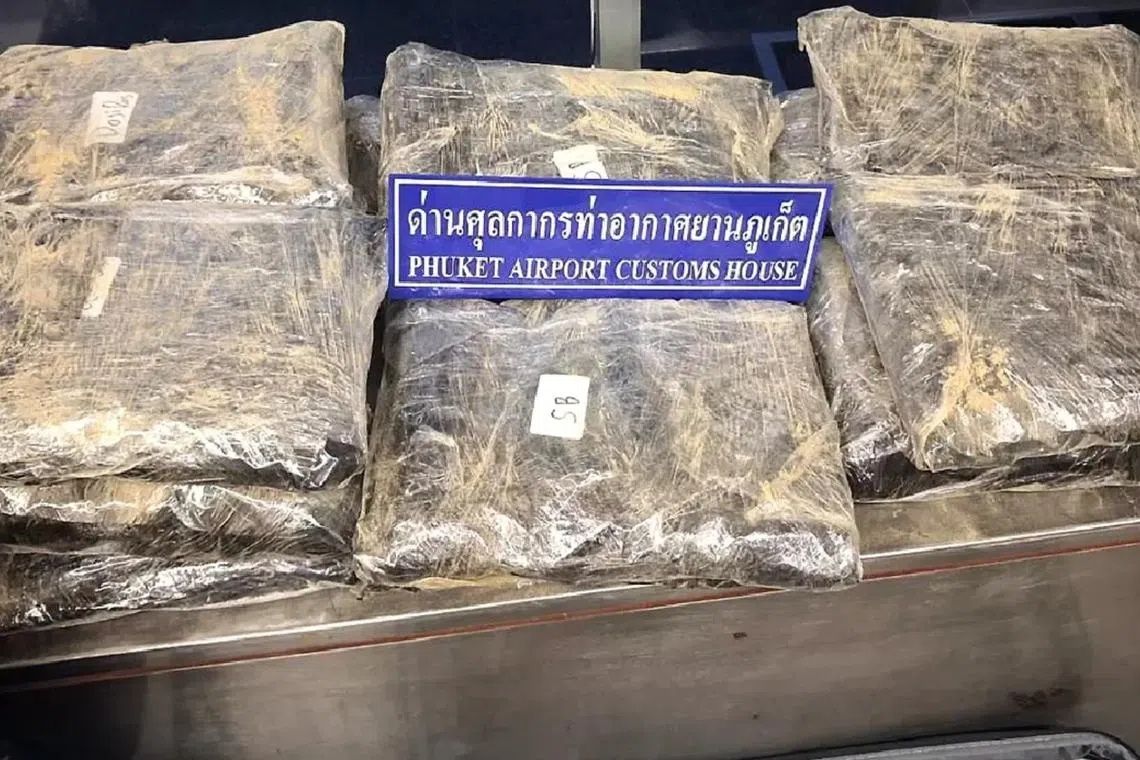
In a significant drugs interdiction operation, customs officers at Phuket International Airport have apprehended two women attempting to export cannabis flowers without proper authorisation on Thursday, July 9. The joint operation between Phuket Airport Customs House and Sakhu Police Station resulted in the seizure of more than 32 kilograms of processed cannabis, highlighting the region's ongoing struggle with drug trafficking through commercial aviation channels.
The first suspect taken into custody was 18-year-old Filipino national Levannah Chelsea Guzman, who was stopped at approximately 11am in the international departures terminal. When customs officers examined her black Pierre Cardin wheeled suitcase, they discovered 14 carefully prepared vacuum-sealed packages containing cannabis flowers. The total weight of the confiscated material, including packaging, reached 14.5 kilograms. During subsequent questioning, Guzman confirmed ownership of both the luggage and its contents, cooperating fully with the investigation.
The second arrest occurred roughly two hours later when customs personnel became suspicious of a green Swish Navy suitcase belonging to Penpitcha Phutsiang, a Thai national. Upon inspection, authorities uncovered 16 additional vacuum-sealed packages of cannabis flowers weighing 17.6 kilograms in total. Like her counterpart, Phutsiang acknowledged that the suitcase and seized materials were hers, making the combined cannabis haul exceed 32 kilograms—a substantial quantity suggesting either organised trafficking or preparation for large-scale distribution.
Both women face multiple serious charges under Thailand's complex legal framework governing controlled substances. The primary offence involves attempting to export goods without completing mandatory customs procedures, a violation of the Customs Act BE 2560 (2017). Beyond basic customs violations, authorities have applied charges under the comprehensive Narcotics Code, which carries substantially more severe penalties than simple customs infractions. The inclusion of charges under the Protection and Promotion of Traditional Thai Medicine Wisdom Act BE 2542 (1999) indicates that prosecutors are pursuing every available legal avenue, as cannabis has been increasingly classified within Thailand's regulatory structure despite the country's limited medical cannabis programme.
Notably, authorities have invoked Thailand's Public Health Ministry notification on controlled herbs concerning cannabis issued in 2025, reflecting the evolving legal status of cannabis in the kingdom. Thailand's approach to cannabis remains ambiguous internationally. While the country decriminalised low-THC cannabis and cannabis resin in 2018, making it the first Southeast Asian nation to do so, subsequent regulations have tightened considerably. The 2025 notification suggests an intensified enforcement posture that contradicts earlier liberalisation signals, complicating the legal landscape for both residents and travellers.
This incident underscores escalating efforts by Thai authorities to prevent the illegal export of cannabis through major airports. Border agencies have substantially increased scrutiny of outbound passengers' luggage, particularly targeting suspicious items and travelling patterns that suggest smuggling intent. The nearly simultaneous arrests—separated by only two hours—suggest that customs personnel were operating with heightened vigilance and detailed intelligence about potential trafficking attempts. The sophistication of the smuggling attempt, evidenced by professional vacuum-sealing and the deliberate choice of brand-name luggage designed to blend into normal airport traffic, indicates involvement by individuals with prior smuggling experience or coordination with organised groups.
For Malaysian travellers and residents familiar with Thai transit hubs, this development carries significant implications. Malaysia's own drug enforcement policies remain extraordinarily stringent, with cannabis possession classified as a serious narcotic offence. The visible enforcement action at Phuket International Airport, Thailand's busiest international terminal serving millions of Southeast Asian passengers annually, demonstrates that drug detection capabilities at major regional airports have substantially improved. The airport's strategic location makes it a critical chokepoint for regional drug trafficking networks attempting to move contraband between Southeast Asian countries.
The case also reveals the vulnerability of young people to involvement in drug trafficking schemes. Guzman's age—just eighteen years old—raises questions about recruitment and coercion within transnational smuggling networks that frequently target economically disadvantaged youth. The prosecution will need to establish whether she acted as an autonomous trafficker or was manipulated into carrying contraband by more senior operatives. Similar considerations apply to Phutsiang, though her Thai nationality may suggest different involvement patterns given Thailand's domestic cannabis cultivation and distribution networks.
From a regional security perspective, the seizure highlights cannabis as an emerging transnational drug trafficking concern alongside traditional narcotics like methamphetamine and heroin. Historically concentrated in Southeast Asian criminal markets, cannabis trafficking has expanded significantly as international attitudes have shifted and cultivation techniques have improved. The relatively high purity and consistent quality of modern cannabis products make them attractive to organised crime groups seeking profitable export opportunities.
The two women now face investigation and legal proceedings at Sakhu Police Station with the seized cannabis held as evidence. Thai courts typically impose lengthy sentences for drug export offences, with sentences potentially extending beyond fifteen years depending on precise statutory interpretation and prosecutorial discretion. The multiple charges strategy employed by authorities suggests prosecutors intend to secure maximum possible sentences.
Beyond the immediate criminal prosecution, this case illuminates broader challenges confronting Southeast Asian governments attempting to regulate cannabis amid conflicting international pressures, domestic public health concerns, and economic incentives surrounding agricultural production. Thailand's ambivalent regulatory position—neither fully embracing legalisation nor maintaining complete prohibition—creates enforcement complications reflected in the layered charge structure applied here.

