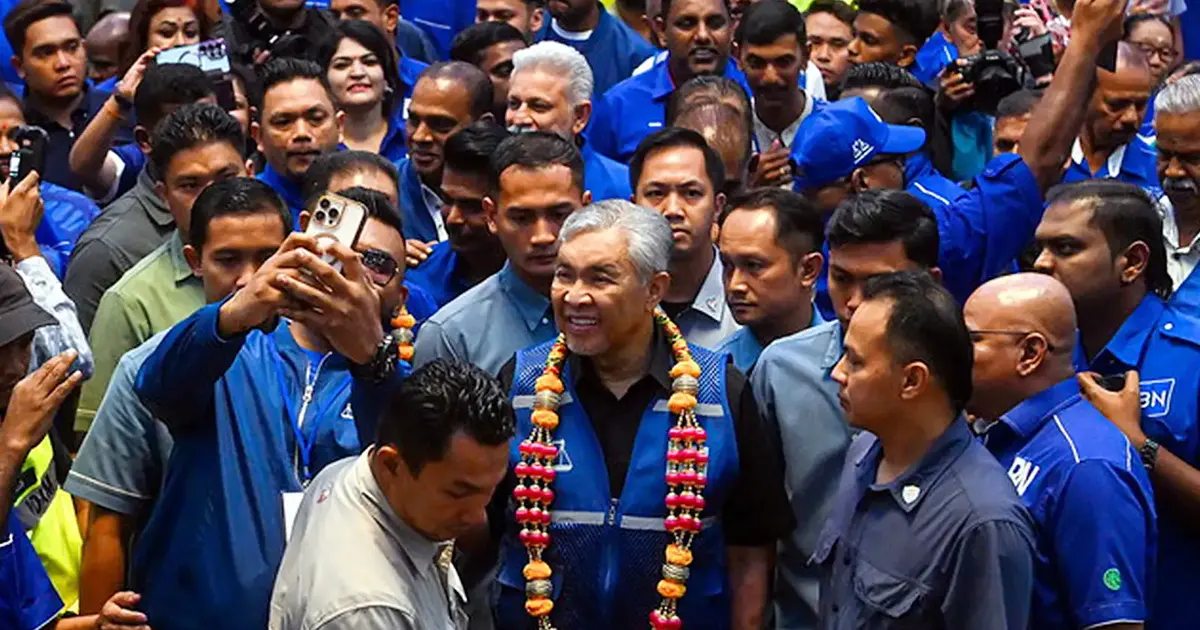
Barisan Nasional chairman Ahmad Zahid Hamidi has made a fresh electoral pledge aimed at securing Indian community support in Negeri Sembilan, promising two executive council positions should the coalition secure victory in the state polls. The undertaking underscores the continuing importance of the Malaysian Indian Congress (MIC) within the broader BN framework and signals the government's intent to maintain representation for ethnic minorities in state leadership structures.
Zahid's confidence in MIC's electoral prospects stems largely from the party's dominant performance in Johor, where the component successfully swept all contested seats in that state's recent elections. This sweeping mandate has become a reference point for assessing MIC's organizational strength and its capacity to mobilize Indian voters across different regions. The Johor result demonstrated that under strong leadership and effective campaign strategy, the party could deliver overwhelming support despite broader political headwinds that had challenged BN in previous cycles.
The Negeri Sembilan political landscape presents both opportunities and challenges for BN's Indian-focused outreach. As a smaller and more demographically diverse state, Negeri Sembilan requires tailored approaches distinct from Johor's peninsular heartland dynamics. The Indian community there represents a significant but not dominant electoral segment, meaning BN's broader coalition strategy must balance competing community interests while maintaining the confidence of its traditional support base.
MIC's historical role within BN has evolved considerably over recent years. The party experienced a prolonged period of declining electoral fortunes and internal turbulence before staging a comeback through renewed grassroots mobilization and clearer messaging on issues affecting Indian Malaysians. The Johor result suggested that with proper resources and party unity, MIC could rebuild its reputation as an effective representative of Indian interests within the coalition framework.
Zahid's specific commitment of two exco positions carries practical significance beyond symbolic value. Such guarantees typically require careful negotiation within BN structures to secure consensus from other component parties and the likely chief minister. The promise reflects calculations about the minimum threshold of representation necessary to maintain Indian community confidence while satisfying broader coalition arithmetic in a state where Malay-Muslim voters constitute the demographic majority.
The timing of this pledge coincides with broader BN efforts to consolidate support ahead of what observers expect will be a competitive electoral contest. After experiencing mixed results in several state elections over the past year, the coalition appears determined to demonstrate continued relevance and its capacity to deliver for key community segments. Promises of specific representation carry weight with organized community constituencies that view electoral participation as a vehicle for advancing group interests.
Indian Malaysian voters have shown themselves responsive to commitments regarding direct representation and access to decision-making structures. Beyond purely economic considerations, many prioritize ensuring community voices have meaningful influence over policies affecting education, religious affairs, and social services. Exco-level positions provide the leverage necessary to advocate effectively for such community-focused initiatives.
However, translating electoral pledges into implemented policy remains a persistent challenge across Malaysian politics. Previous commitments regarding minority representation have sometimes failed to materialize or proven less consequential than anticipated once campaigns concluded and governing realities took hold. Indian community leaders have learned to scrutinize not merely the positions promised but the portfolios assigned, as some exco roles carry substantially more influence and resources than others.
The broader context of Negeri Sembilan politics adds complexity to BN's strategic calculations. The state has historically alternated between different political coalitions and leadership models, with voters demonstrating pragmatic rather than deeply ideological voting patterns. This suggests that community-specific pledges may prove more decisive than broader ideological appeals, making Zahid's targeted commitment a potentially effective element of BN's overall campaign strategy.
MIC's performance in Negeri Sembilan carries implications extending beyond the state itself. Success would strengthen the party's internal position within BN and potentially influence how the coalition structures campaigns in other states with significant Indian populations. Conversely, disappointing results would raise questions about whether Johor represented a durable revival or merely a particular confluence of local circumstances that proved difficult to replicate elsewhere.
The commitment also reflects broader conversations within Malaysia's political sphere about federal unity and inclusive governance. As demographic change and generational shifts reshape electoral dynamics, maintaining coalition cohesion requires consistent messaging about power-sharing and representation. Zahid's explicit pledge represents one attempt to reinforce the proposition that participating within established coalition structures remains a viable path for communities seeking political influence.

