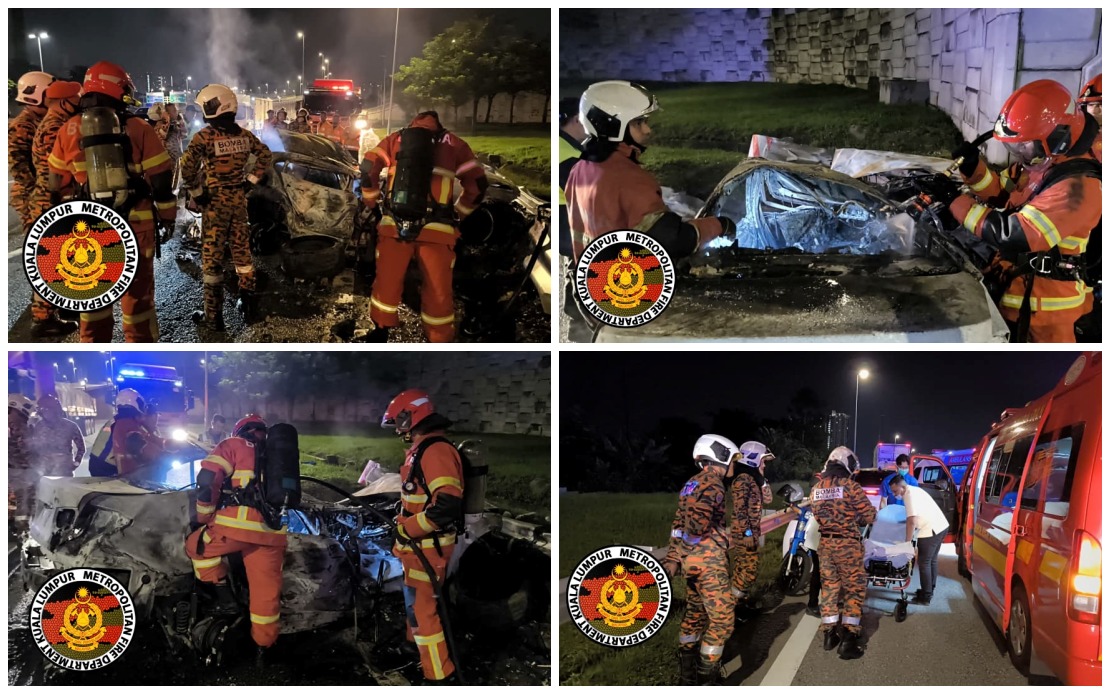
A tragic road accident on the Duta-Ulu Kelang Expressway (DUKE) claimed the lives of two university students on Wednesday morning, highlighting the persistent dangers of high-speed driving on major highways in the Klang Valley. The incident occurred at the Jalan Kuching exit ramp when a BMW 328i Sport, carrying three young passengers, went catastrophically out of control and burst into flames, trapping two occupants inside the burning wreckage.
According to ACP Mohd Zamzuri Mohd Isa, chief of the Kuala Lumpur Traffic Investigation and Enforcement Department, the vehicle was moving in the direction of Selayang from Jalan Duta when the driver allegedly exceeded safe speeds for the road conditions. The loss of control triggered a sequence of events that would prove fatal: the car skidded across lanes before impacting the left road divider with sufficient force to rupture the fuel system or ignite the vehicle's electrical components, engulfing it in flames within moments of the collision.
The two victims were identified as a 22-year-old male student enrolled at Queensland University of Technology in Australia, who was operating the vehicle, and a 21-year-old male passenger attending Sunway University. Both young men were pronounced dead at the scene, their bodies charred beyond immediate visual recognition inside the vehicle. The severity of the fire prevented any possibility of rescue or escape once the flames took hold, underscoring how rapidly such incidents turn fatal.
The third occupant, a 20-year-old male student from Singapore, managed to escape the vehicle with only minor injuries. He was transported to Kuala Lumpur Hospital for medical evaluation and treatment, and his survival provides investigators with a crucial eyewitness account of the circumstances leading up to the crash. Authorities have prioritised obtaining a detailed statement from this survivor, as his observations may clarify whether mechanical failure, driver error, or external factors contributed to the accident.
Police are relying on forensic methods to establish the identities of the two deceased, as the intensity of the fire destroyed facial features and distinguishing characteristics. DNA analysis has been initiated to confirm identity through biological matching, a process that may take several days to complete. The emotional toll on families of the victims awaiting definitive identification adds another dimension to this tragedy affecting three countries' nationals within Malaysian territory.
The investigation incorporates multiple analytical strands. Officers are retrieving closed-circuit television footage from surrounding infrastructure along the expressway to establish the vehicle's behaviour immediately preceding the collision. This video evidence may show whether the car was weaving through traffic, whether other vehicles were involved, or whether road conditions such as wet surfaces contributed to loss of traction. Witness statements from other motorists in the vicinity are being systematically collected to build a comprehensive narrative of the accident sequence.
The case falls under Section 41(1) of the Road Transport Act 1987, which addresses dangerous or negligent driving causing death or injury. This legal framework allows authorities to investigate comprehensively and potentially charge the driver's estate or pursue civil liability against vehicle owners or manufacturers, depending on findings. The statutory investigation pathway ensures that all causative factors receive official scrutiny rather than remaining matters of speculation.
This incident reflects a recurring pattern of high-speed accidents on Klang Valley expressways, where drivers—particularly younger motorists—sometimes misjudge safe velocities for prevailing conditions or vehicle handling characteristics. The DUKE expressway, despite its modern infrastructure and clear markings, continues to witness fatal collisions, suggesting that engineering alone cannot overcome human factors such as overconfidence, distraction, or insufficient experience managing high-powered vehicles at elevated speeds.
Police are appealing to the public for assistance, particularly from motorists who may possess dashcam recordings of the vehicle's passage along the expressway in the minutes preceding the crash. Such footage could reveal the BMW's speed, acceleration patterns, and interactions with other traffic. Members of the public can contact the Traffic Police Station at Jalan Tun H.S. Lee or any nearby police facility to submit information or video evidence that may aid the investigation.
The tragedy carries implications for road safety discourse in Malaysia and the broader region. Young drivers operating premium vehicles with substantial horsepower may require additional training or graduated licensing restrictions to reduce the incidence of speed-related collisions. The incident also highlights the inadequacy of existing road barriers in preventing catastrophic impacts, as the divider apparently lacked modern energy-absorbing technology that might have reduced the collision's severity.
For Australian and Singaporean authorities, this accident will likely trigger diplomatic communication and consular involvement with Malaysian police and hospital services. The families of the victims, now scattered across three nations, face the dual trauma of sudden loss and international logistics in repatriation and legal proceedings. The investigation's conclusions may inform safety recommendations for national highway authorities across Southeast Asia.
As investigations proceed, the expressway remains a vital artery for the Klang Valley's economy and commuter networks. However, this tragedy serves as a sobering reminder that speed, inexperience, and momentary loss of control can transform a routine journey into a catastrophe. The surviving passenger's recovery and cooperation with authorities may provide insights that could inform future driver education programmes and traffic enforcement strategies designed to prevent similar incidents.

