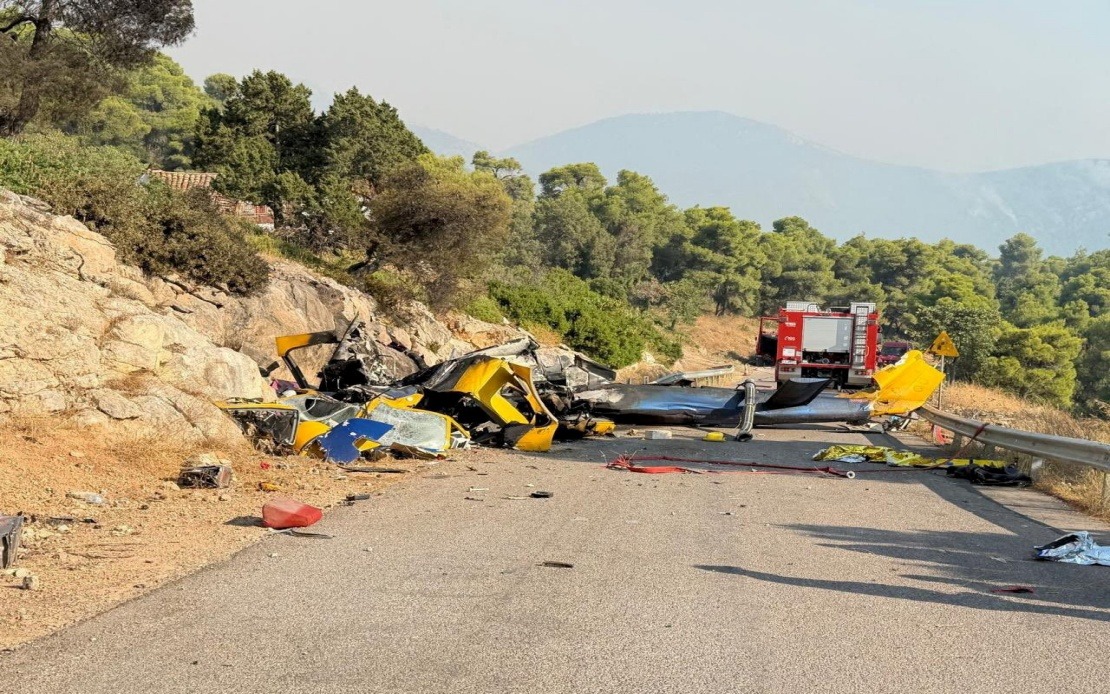
A tragedy unfolded in Greek skies on Sunday when two firefighting helicopters collided during aerial operations against a spreading wildfire in western Attica, claiming the lives of two crew members and raising fresh concerns about the risks faced by emergency responders combating Greece's intensifying fire season. According to the Greek Fire Service, the collision resulted in the deaths of a Danish pilot and a Greek firefighting coordinator, while a British pilot and another Greek coordinator survived the impact, though one sustained injuries in the incident.
The two Bell helicopters, each carrying a crew of two, were engaged in active firefighting operations above the coastal region near Psatha when the collision occurred. Both aircraft were contracted specifically to support the broader emergency response to the massive wildfire spreading across Attica and Boeotia provinces. Fire Service spokesperson Vassilis Vathrakogiannis confirmed the fatalities at a formal press briefing, providing crucial details about the identities of those involved in what marks one of the more serious incidents during Greece's current wildfire crisis.
The exact circumstances leading to the mid-air collision remain under active investigation, with Greek authorities still gathering evidence and conducting interviews with survivors. The speed at which this tragedy unfolded highlights the inherent dangers of coordinating multiple aircraft in the same airspace during intensive firefighting operations, particularly when visibility may be compromised by smoke and heat from the fires below. The collision represents a sobering reminder that even experienced personnel executing coordinated emergency operations face substantial risks.
Greece's wildfire season has intensified dramatically in recent weeks, driven by persistently high temperatures, exceptionally dry conditions, and strong winds that fan flames across vast territories. The combination of these meteorological factors has forced authorities to mobilise every available resource, including rented helicopter capacity, to contain multiple simultaneous fires threatening populated areas and critical infrastructure. The strain on emergency services has reached critical levels, with firefighting teams stretched across numerous fronts across the country.
The incident carries significant implications for how Mediterranean nations approach aerial firefighting coordination. Aviation safety officials will likely conduct a detailed technical investigation to determine whether the collision resulted from communication failures, inadequate separation protocols, compromised visibility, or equipment malfunctions. The findings could influence procedures governing how multiple aircraft operate in proximity during active disaster response, potentially affecting firefighting capabilities across the European Union during future emergencies.
For Malaysia and Southeast Asian nations increasingly vulnerable to transboundary haze and forest fires, the Greek accident underscores the complexity of managing large-scale aerial firefighting campaigns. The region's own reliance on contracted helicopter services during the annual haze season means that safety protocols developed from investigations into incidents like this one may directly influence how emergency response operations are conducted locally. The professional qualifications and coordination standards of international firefighting contractors deserve particular scrutiny given their critical role in regional disaster management.
The survivors of Sunday's collision face prolonged recovery periods both physical and psychological. The injured Greek coordinator requires medical attention, while the British pilot who walked away from the wreckage will likely face extensive debriefing and support as he processes the traumatic experience. Both survivors represent invaluable sources of information for investigators seeking to understand precisely what transpired in those final moments before impact.
Greece's continued struggle with multiple wildfires reflects broader climate change impacts reshaping fire seasons across southern Europe and the Mediterranean basin. What once constituted seasonal fire risk now represents an extended, intensified threat that demands unprecedented coordination of resources, personnel, and international support. The contracted helicopter services represent a critical gap-filling measure when national capacity proves insufficient, yet this reliance introduces additional complexity and potential vulnerability points within emergency response systems.
As investigation teams examine wreckage and conduct interviews over coming days and weeks, the incident will almost certainly prompt European aviation authorities and emergency management agencies to revisit protocols governing aircraft separation, communication standards, and real-time coordination during active firefighting missions. Such reviews typically result in operational adjustments that eventually filter through international civil aviation channels to influence practices globally, including throughout Southeast Asia where wildfire season presents comparable challenges to those currently overwhelming Greek resources.

